
Readers Theater Worksheets
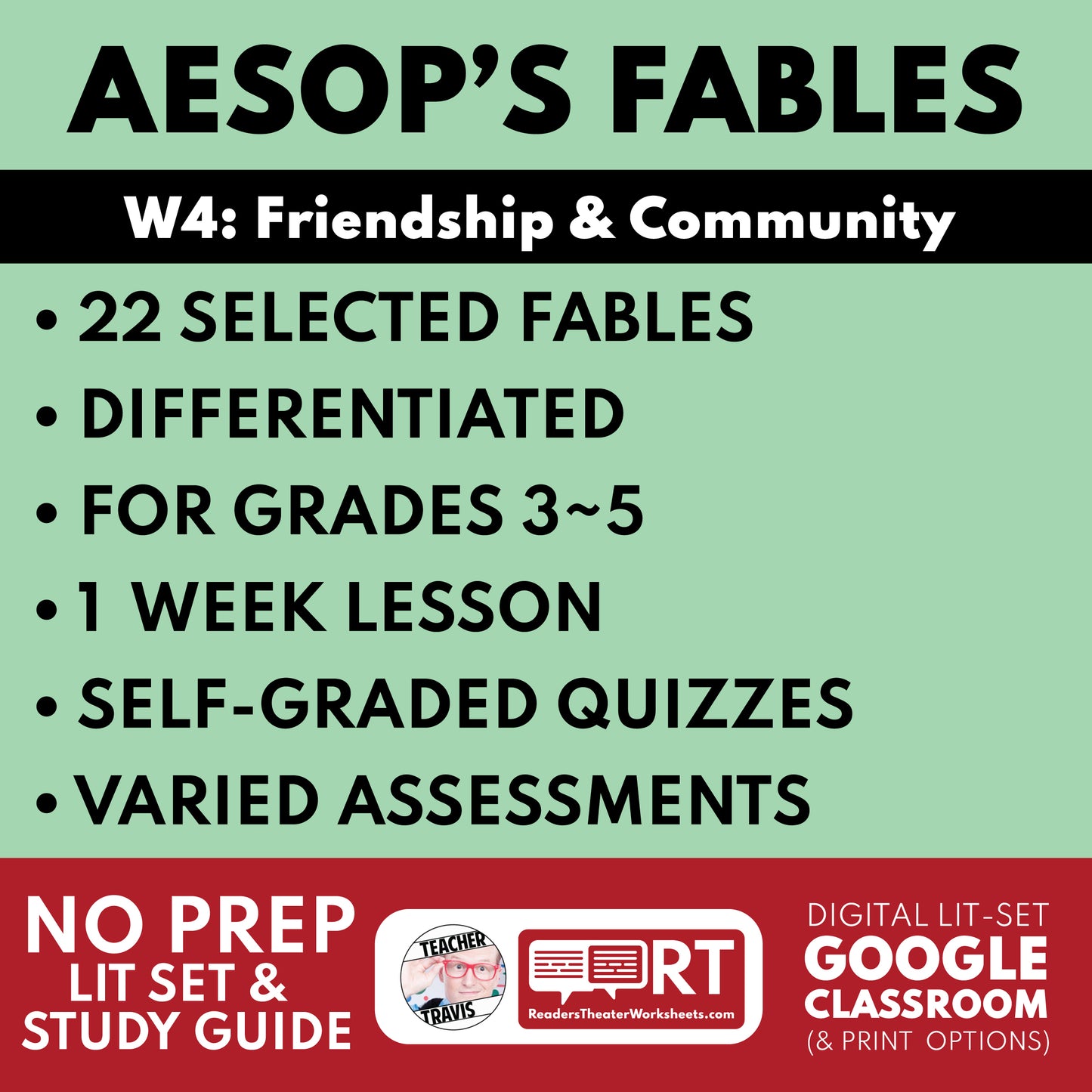
Aesop's Fables Differentiated Study Guide for Grades 3 to 5 | W4 Friendship, Cooperation & Community
Aesop's Fables Differentiated Study Guide for Grades 3 to 5 | W4 Friendship, Cooperation & Community
Couldn't load pickup availability
Classroom Use at a Glance
A differentiated literature study guide for grades 3–5 using Aesop's Fables Differentiated Study Guide for Grades 3 to 5. Supports mixed reading levels with original and leveled reading options, vocabulary, comprehension questions, discussion, written response, quizzes, and teacher support.
Classroom Uses Whole Class, Close Reading, Discussion, Assessment, Review, Enrichment, Intervention, Homework, Sub Plan view all
- Whole Class
- Close Reading
- Discussion
- Assessment
- Review
- Enrichment
- Intervention
- Homework
- Sub Plan
Included Original Text, Leveled Text, Teacher Guide, Student Worksheet, Answer Key, Quiz, Google Forms Quiz, Vocabulary, Discussion Questions, Writing Prompt view all
- Original Text
- Leveled Text
- Teacher Guide
- Student Worksheet
- Answer Key
- Quiz
- Google Forms Quiz
- Vocabulary
- Discussion Questions
- Writing Prompt
Format PDF, DOCX, Google Docs, Google Forms, Printable, Editable view all
- DOCX
- Google Docs
- Google Forms
- Printable
- Editable
Differentiation Original Version, Leveled Version, Mixed Reading Levels, Struggling Readers, Advanced Readers, Vocabulary Support, Short Sections view all
- Original Version
- Leveled Version
- Mixed Reading Levels
- Struggling Readers
- Advanced Readers
- Vocabulary Support
- Short Sections
PROBLEM: Many classic literature units fall apart in real elementary classrooms because the original text can be long and challenging, and students often read at different levels—so teachers end up reteaching constantly or simplifying until the story loses its power.
SOLUTION: This differentiated study guide for 22 of Aesop’s Fables (Week 4: Friendship, Cooperation & Community) solves that problem by giving you both the complete original text and a condensed, five-part adapted version, so your class can move together while students read at the level that fits. The adaptation preserves the core events, character choices, and morals so your discussions stay meaningful and text-based.
Dual-track assurance: Every discussion prompt, quiz item, and short-answer question is designed to be answerable from the adapted Part text while still mapping cleanly to the corresponding original fable set for extension reading and evidence practice.
Perfect for: Grades 3–5 ELA whole-class mini-units, read-aloud + partner reading, small-group instruction, intervention support, character education, and low-prep weekly assessments.
Will this resource meet your classroom needs?
FREE BONUS ALERT!
- Free Access Code to the text on the Leveled-Lit Classics Library!
- See all companion Study Guides in the Library here.
This product includes a zip file consisting of:
NOTE: All files are editable and include (PDF, DOCX, PPTX, Google Docs/Slides/Forms)
Full Original Text: 2,800 words | 11.0 Flesch-Kincaid GL
- Lexile Range (est.): 900L–1100L | CEFR (est.): B1–B2
- Best for teacher read-aloud, extension reading, and evidence practice with original language.
Adapted Version Text: 2,400 words | 5.0 Flesch-Kincaid GL
- Lexile Range (est.): 500L–700L | CEFR (est.): A2–B1
- Designed for Grades 3–5 pacing with simpler sentences while preserving fable events, morals, and assessment alignment.
- *Both versions tell the same story, allowing students to participate in shared discussions even when reading different texts.
Student Final Worksheet/Quizzes (PPTX, Google Slides/Forms)
- 10 Vocabulary Words
- 10 Short Answer Recall/Comprehension
- 5 Challenge Questions (synthesis, analysis, themes, real life connection)
- 5 Multiple Choice Quizzes (20 Questions) (1 per part)
Teacher’s Guide & Answer Key
- 5 Sets of Daily Discussion Questions (1 per part)
- 5 Sets of Self-Graded Exit Quizzes (1 per part, 20Qs each)
- Answer Keys for Vocab, Short Answer, and Challenge Questions
- Key Figures & Places reference sheets to help students track characters and settings
Quick Guide for Teachers:
Adapted-Only Track (Fastest: 5-Day Model)
- Best for Grades 3–6 classes that need a manageable, one-week literature experience.
- Day 1–5: Students read one adapted part per day and use the matching Main Ideas & Themes Discussion Questions and self-grading multiple-choice quiz.
- End the week with the Final Worksheet (Vocabulary Words, Short Answer Questions, and Challenge Questions).
- This track keeps lessons tight, predictable, and complete in five days.
Original-Only Track (Longer: Multi-Day Per Section)
- Ideal for stronger readers or classes ready for original language and sentence structure.
- Students read the original fable sets aligned to each adapted Part.
- Use the same Discussion Questions, MC exit quizzes, and Final Worksheet; all items are text-accurate for both versions.
- Vocabulary Words (10) are usable for both tracks, because each word appears in both the adapted text and the corresponding original fable set.
- This track preserves the original phrasing while keeping assessments and routines consistent.
Dual-Track Differentiation (Mixed Readers, Flexible Timelines)
- Lets your entire class study the same morals, choices, and themes at the same time—even when some students need the adapted text and others handle the full original.
- Assign adapted Part 1 to students who need a shorter, clearer text and the original corresponding fables to students reading the full text; repeat this pattern through Parts 2–5 (timing will depend on your classroom's reading level).
- Give original-text students multiple days per section while adapted-text students reread key fables, complete vocabulary tasks, and tackle discussion questions in pairs or small groups.
- All assessments are usable for both tracks: Discussion Questions, MC Exit Quizzes for each Part, and the Final Worksheet (Vocabulary, Short Answer, and Challenge Questions).
Adapted Version Summary
Part 1 (Helping Others — 5 fables)
Students explore kindness, small help that matters, and how communities respond to need. (The Ant and the Dove; The Dove and the Crow; The Bee and Jupiter; The Mouse and the Bull; The Mice in Council)
Part 2 (Working Together — 5 fables)
Teamwork requires planning and honest cooperation—without forcing others into risk. (The Mice and the Weasels; The Weasel and the Mice; The Two Pots; The Oxen and the Butchers; The Oxen and the Axle-Trees)
Part 3 (Cooperation vs. Selfishness — 3 fables)
Students compare mutual support with selfish choices that undermine trust. (The Fox and the Goat; The Wolf and the Housedog; The Shepherd and the Dog)
Part 4 (Betrayal and Loyalty — 5 fables)
Loyalty matters in groups, and betrayal creates lasting consequences. (The Lion and the Bull; The Lion and the Three Bulls; The Bull and the Goat; The Horse and the Stag; The Ass and the Old Shepherd)
Part 5 (Community Wisdom — 4 fables)
Communities learn through experience, and wisdom often comes from hard truths. (The Old Woman and the Physician; The Old Woman and the Wine-Jar; The Old Man and Death; The Old Hound)
Frequently Asked Questions
Can students answer the questions if they only read the adapted version?
Yes. All discussion prompts, short answers, challenge items, and quiz questions are written to be answerable from the adapted Parts.
How can I use the original text without losing pacing?
Run the adapted Parts as the shared anchor for everyone, then assign the original fable set as extension reading for evidence practice—without changing the assessments or discussions.
What if my class has a wide range of readers?
Use dual-track differentiation: supported readers stay on the adapted Parts while advanced readers cite details from the original fables. Everyone completes the same prompts so whole-class discussions stay unified.
Standards
Reading Literature: CCSS RL.3.1, CCSS RL.3.2, CCSS RL.3.3, CCSS RL.3.4, CCSS RL.3.5, CCSS RL.4.1, CCSS RL.4.2, CCSS RL.4.3, CCSS RL.4.4, CCSS RL.4.5, CCSS RL.5.1, CCSS RL.5.2, CCSS RL.5.3, CCSS RL.5.4, CCSS RL.5.5
Writing: CCSS W.5.1, CCSS W.5.2, CCSS W.5.9
Speaking & Listening: CCSS SL.5.1
Anchor Standards: CCRA.R.1, CCRA.R.2, CCRA.R.3, CCRA.R.4
Planning lessons with your department? Ask your school administrator about the Complete Leveled Lit Classics Library & Study Guide Bundle, with discounted one-time licensing options for teaching teams.
Share