

Readers Theater Worksheets
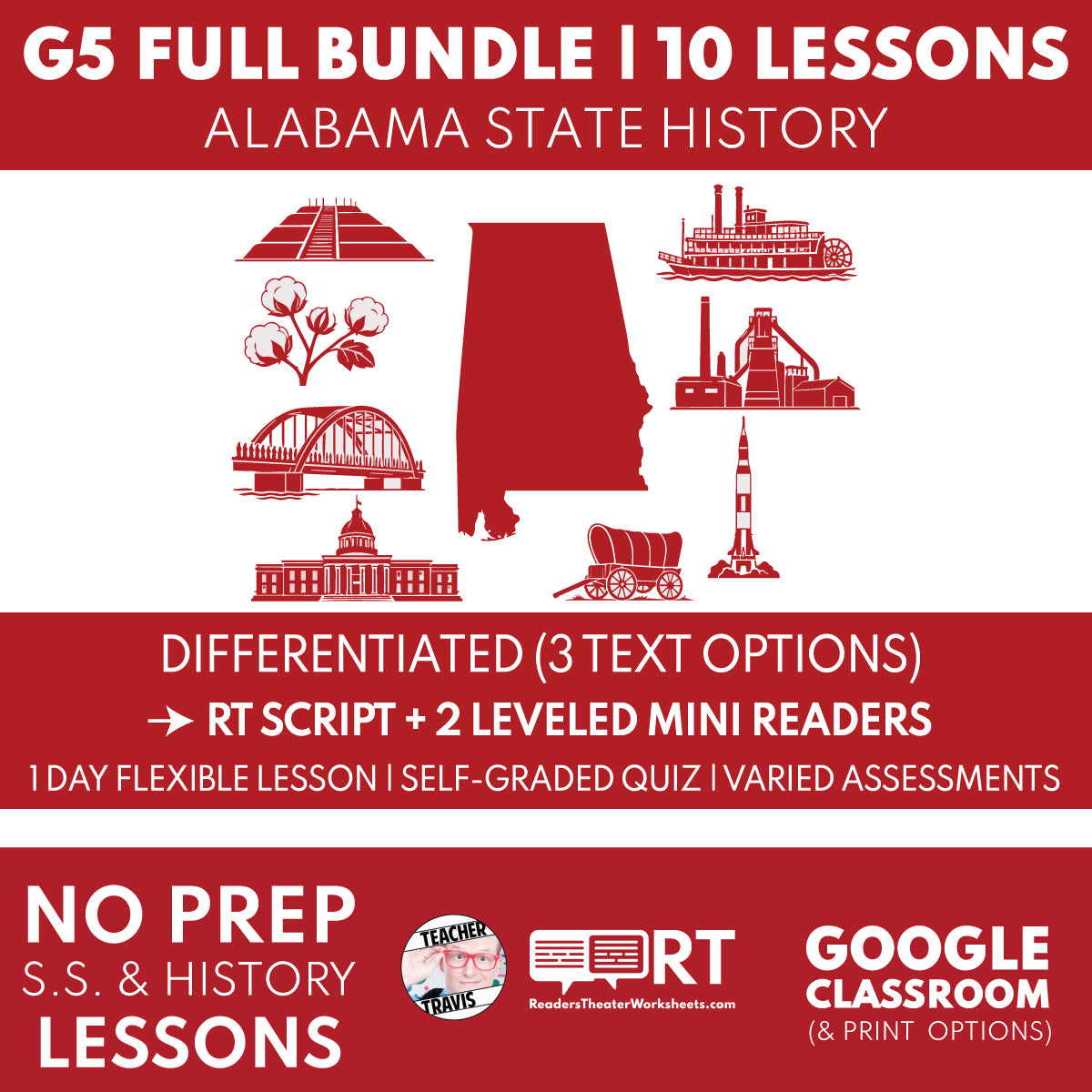
Alabama Grade 5 State History Bundle | 10 RT Script & Mini Readers
Alabama Grade 5 State History Bundle | 10 RT Script & Mini Readers
Couldn't load pickup availability
Classroom Use at a Glance
A complete 10-lesson Alabama Grade 5 State History bundle, differentiated for grades 3–5, with Reader’s Theater scripts, original and accessible Mini Readers, source-based extensions, worksheets, quizzes, and teacher guides.
Classroom Uses Whole Class, Small Groups, Fluency Practice, Content-Area Reading, Discussion, Assessment, Review, Sub Plan view all
- Whole Class
- Small Groups
- Fluency Practice
- Content-Area Reading
- Discussion
- Assessment
- Review
- Sub Plan
Included Reader’s Theater Script, Original Mini Reader, Accessible Mini Reader, Teacher Guide, Student Worksheet, Answer Key, Quiz, Google Forms Quiz, Vocabulary, Discussion Questions, Challenge Questions, Primary Source Extension view all
- Reader’s Theater Script
- Original Mini Reader
- Accessible Mini Reader
- Teacher Guide
- Student Worksheet
- Answer Key
- Quiz
- Google Forms Quiz
- Vocabulary
- Discussion Questions
- Challenge Questions
- Primary Source Extension
Format PDF, DOCX, Google Forms, ZIP Download, Printable, Editable view all
- DOCX
- Google Forms
- ZIP Download
- Printable
- Editable
Differentiation Accessible Version, Original Version, Mixed Reading Levels, ELL Support, Struggling Readers, Vocabulary Support, Small-Group Support view all
- Accessible Version
- Original Version
- Mixed Reading Levels
- ELL Support
- Struggling Readers
- Vocabulary Support
- Small-Group Support
Built for Alabama Grade 5 State History standards. This complete 10-lesson bundle uses Reader’s Theater, differentiated Mini Readers, shared assessments, and teacher guides to teach Alabama’s twentieth-century and modern history from Birmingham industrialization through reform, war, migration, the New Deal, the Civil Rights Movement, aerospace, sovereignty, and modern rights.
Each lesson keeps Grade 5 history at the center while offering three reading paths: a narrative Reader’s Theater script, an Original Mini Reader, and an Accessible Mini Reader. Students can use different reading supports and still complete the same core vocabulary, questions, and quiz.
Depending on your classroom, this Grade 5 bundle may also be suitable for grades 3–5.
10 Complete Alabama Grade 5 State History Lessons
- 1. Magic City Rising — Magic City Rising follows a preservation team at Sloss Furnaces as its first simple explanation for Birmingham’s growth is challenged by new evidence. The team compares maps, mineral evidence, rail connections, industrial structures, worker experiences, and reform evidence before rewriting its exhibit explanation. Students investigate why
- 2. Reform Alabama — Reform Alabama follows a newspaper team trying to write one simple headline about Progressive Era change. Their first idea—that Alabama simply “moved forward”—falls apart as they compare evidence about voting, education, prisons, working conditions, woman suffrage, and Helen Keller’s adult advocacy.
- 3. Alabama Goes to War — Alabama Goes to War follows a student archive team that begins with one World War I service card and tries to build an exhibit about Alabama’s role in the war. As the team adds the 167th Infantry, the Rainbow Division, training sites, transportation, the Port of Mobile, segregated service, women’s work, and home-front evidence, the first
- 4. The Blues and a Changing South — The Blues and a Changing South follows a radio team that begins with a cheerful program title—“Alabama Is Roaring!” As the team investigates W. C. Handy, blues traditions, migration routes, farm trouble, segregation, and new technology, the first title becomes harder to defend. By Scene 10, the team replaces the one-sided story with a bro
- 5. Hard Times, New Power — Hard Times, New Power follows a museum team that begins with a simple exhibit caption: “Jobs + Electricity = Progress.” The Depression makes jobs urgently important, but labor organizing, the New Deal’s larger federal role, TVA’s several river purposes, electrification, and Pickwick relocation evidence keep complicating the first story. B
- 6. Double Victory — Double Victory follows a museum team racing to finish an Alabama World War II exhibit. They begin with one pilot photograph and the incomplete label “Tuskegee Airmen: The Pilots.” A Moton Field checklist reveals the many people required for training. Maps add Tuskegee Institute, military installations, Alabama industries, ports, and commu
- 7. The Bus Boycott — The Bus Boycott follows an organizing team facing a leaflet deadline after Rosa Parks’s arrest. At first, the task is only to call a one-day boycott. Evidence about Claudette Colvin shows that resistance and organizing began earlier. The successful first day creates a harder problem: how can thousands of people keep traveling without city
- 8. Freedom Rides to Birmingham — Freedom Rides to Birmingham follows an evidence team that begins with a tempting but incomplete headline: COURT RULING ENDS SEGREGATION. The 1961 route through Anniston and Birmingham quickly shows the problem. Freedom Riders test federal interstate desegregation rules, encounter violent resistance, and expose the gap between a ruling and
- 9. The Road from Selma — The Road from Selma follows a trail-planning team that first assumes the famous bridge should be the beginning of the story. Evidence from citizenship classes, registration work, Brown Chapel, Bloody Sunday, news coverage, federal court protection, the fifty-four-mile march, and the Voting Rights Act forces the team to redraw the timeline
- 10. Rockets and a Changing State — Rockets and a Changing State follows a museum team that begins with a shiny Saturn V image and the simple claim that rockets made Alabama modern. Each new evidence file complicates that idea. Students follow Operation Paperclip to Redstone Arsenal, Marshall and Saturn work, the Nazi forced-labor ethics problem, Huntsville’s growth through
Alabama Grade 5 Standards Alignment
The final Teacher Guides document the following Alabama Grade 5 Social Studies connections:
- #1 Magic City Rising: AL5-1 (industry portion), AL5-1b, AL5-1c, AL5-3b, and AL5-4 — early twentieth-century industry, Birmingham’s urban growth, labor reform, and migration.
- #2 Reform Alabama: AL5-2, AL5-2a, AL5-2b, AL5-2c, AL5-3, AL5-3a, AL5-3b, and AL5-3c — Progressive political and social reform, suffrage, the 1901 Constitution, prison reform, education, labor reform, and Helen Keller.
- #3 Alabama Goes to War: AL5-5, AL5-5a, AL5-5b, AL5-5c, and AL5-5d — World War I causes, U.S. entry, alliances and geography, the 167th Infantry Regiment, and Alabama wartime training and logistics.
- #4 The Blues and a Changing South: AL5-4b, AL5-6, AL5-6a, and AL5-7 — Great Migration conditions, Alabama contributions to the arts, farming challenges, and economic change during the Roaring Twenties.
- #5 Hard Times, New Power: AL5-7, AL5-7a, AL5-7b, AL5-8, AL5-8a, and AL5-8b — Depression-era hardship, labor tensions, New Deal action, reformers, and Alabama relief projects including TVA. The Teacher Guide notes which broader standard components are listed but not independently assessed.
- #6 Double Victory: AL5-9, AL5-9b, AL5-10, AL5-10a, AL5-10b, and AL5-10c — World War II, the Tuskegee Airmen, Alabama’s war effort and military installations, wartime production, and changing employment opportunities. The Teacher Guide notes which broader standard components are not independently assessed.
- #7 The Bus Boycott: AL5-12, AL5-12a, AL5-12b, and AL5-12c — key Civil Rights Movement campaigns, methods for creating change, chronology, and the contributions of Alabama leaders and foot soldiers.
- #8 Freedom Rides to Birmingham: AL5-12, AL5-12a, AL5-12b, AL5-12c, and AL5-12d — Civil Rights Movement campaigns and strategies, chronology, Alabama leaders and foot soldiers, and opposition to the Movement.
- #9 The Road from Selma: AL5-12, AL5-12a, AL5-12b, AL5-12c, and AL5-12d — Civil Rights Movement campaigns and methods, chronology, Alabama leaders and foot soldiers, opposition, and the Selma voting-rights campaign.
- #10 Rockets and a Changing State: AL5-13, AL5-14b, AL5-16, AL5-17, and AL5-18 — Cold War context, Alabama’s role in the Space Race, the modern economy and global markets, benefits and drawbacks of technology, and modern civil-rights achievements.
Each individual Teacher Guide identifies the exact standard wording, scope, and classroom applications. CCSS literacy connections are also included for informational reading, evidence, vocabulary, speaking and listening, and explanatory writing.
Perfect For
- Alabama Grade 5 State History instruction
- A chronological twentieth-century-to-present Alabama history sequence
- Content-area literacy and social studies integration
- Whole-class lessons, small groups, sub plans, review, intervention, and enrichment
- Teachers who want standards-based Grade 5 history with built-in reading differentiation
Flexible Classroom Use
- Use the Reader’s Theater scripts for whole-class reading, small-group performance, oral fluency, and evidence-based discussion.
- Use the Original Mini Readers for independent or shared Grade 5 reading.
- Use the Accessible Mini Readers when students need shorter sentences, clearer transitions, and added reading support while learning the same Grade 5 history.
- Assign digitally or print only the student sections needed for the day’s lesson.
- Use vocabulary, comprehension questions, challenge questions, quizzes, and evidence extensions for assessment and review.
Differentiation Built Into Every Grade 5 Lesson
- Reader’s Theater roles with varied reading loads and narrative purpose
- Original Mini Reader for Grade 5 independent or shared reading
- Accessible Mini Reader preserving the same assessed history with added reading support
- Shared vocabulary and assessments across all three reading paths
- Printable and editable digital options for flexible classroom use
What Each Lesson Includes
Student Text Options
- Reader’s Theater Script with differentiated character roles
- Original Mini Reader
- Accessible Mini Reader
Assessment Materials
- Vocabulary in context
- 10 two-part comprehension questions
- 5 two-part challenge questions
- 20-question multiple-choice quiz
- Self-graded Google Forms quiz
Teacher Materials
- Teacher Guide with Alabama Grade 5 standards alignment
- Answer keys and discussion prompts
- Primary-source or evidence extension
- Printable and editable files
- Start Here PDF with Google Classroom folder access
Skills Addressed
- Reading fluency, comprehension, and vocabulary in context
- Chronology, cause and effect, and change over time
- Map, place, route, artifact, law, and other historical evidence
- Comparing perspectives and evaluating incomplete explanations
- Connecting Alabama Grade 5 history with government, economics, rights, culture, technology, and CCSS literacy skills
Text Summary
Students begin with Birmingham’s industrial growth and Progressive Era reform, then move through Alabama’s experiences in World War I, the blues and Great Migration, Depression-era federal programs, the Tuskegee Airmen and World War II, Montgomery, Birmingham, and Selma civil-rights campaigns, and the state’s modern connections to aerospace, Tribal sovereignty, industry, and worker rights.
Across the bundle, students learn that Alabama’s modern history was shaped by industry, migration, culture, government action, war, organizing, law, technology, rights, and communities working through both opportunity and inequality.
Share
Products Included in This Bundle
-

Alabama Grade 5 State History | Magic City Rising | RT Script & Mini Readers FREE
$0.00
-

Alabama Grade 5 State History | Reform Alabama | RT Script & Mini Readers
$3.00
-

Alabama Grade 5 State History | Alabama Goes to War | RT Script & Mini Readers
$3.00
-

Alabama Grade 5 State History | The Blues and a Changing South | RT Script & Mini Readers
$3.00
-

Alabama Grade 5 State History | Hard Times, New Power | RT Script & Mini Readers
$3.00
-

Alabama Grade 5 State History | Double Victory | RT Script & Mini Readers
$3.00
-

Alabama Grade 5 State History | The Bus Boycott | RT Script & Mini Readers
$3.00
-

Alabama Grade 5 State History | Freedom Rides to Birmingham | RT Script & Mini Readers
$3.00
-

Alabama Grade 5 State History | The Road from Selma | RT Script & Mini Readers
$3.00
-

Alabama Grade 5 State History | Rockets and a Changing State | RT Script & Mini Readers
$3.00


