Readers Theater Worksheets
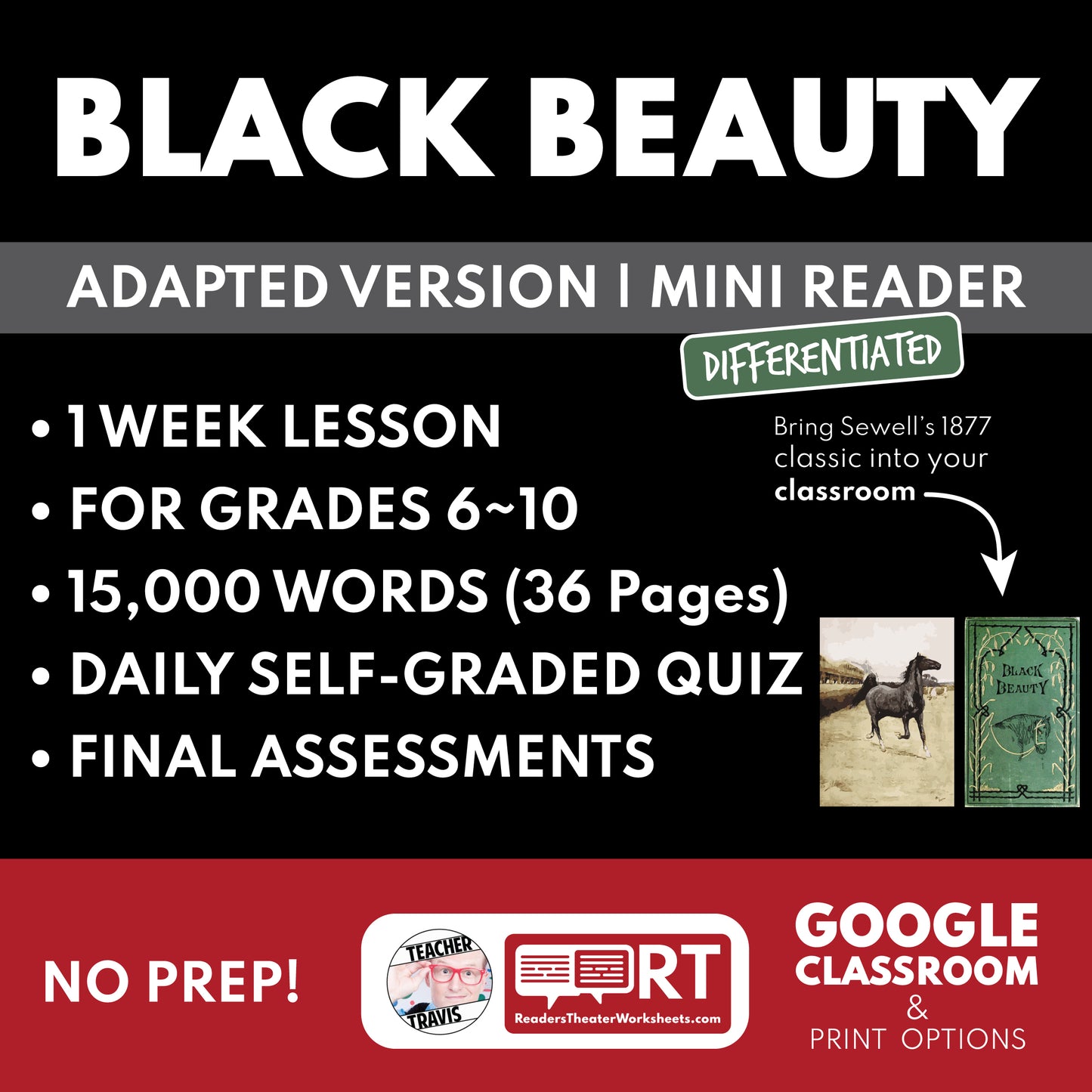
Black Beauty | Full Week Lesson | Adapted Version | Sewell | No Prep
Black Beauty | Full Week Lesson | Adapted Version | Sewell | No Prep
Couldn't load pickup availability
Classroom Use at a Glance
A differentiated study guide for Grades 6 to 8 built to support mixed reading levels, close reading, vocabulary, comprehension, discussion, written response, quizzes, and teacher-led literature instruction.
Classroom Uses Whole Class, Close Reading, Discussion, Assessment, Review, Enrichment, Intervention, Homework, Sub Plan view all
- Whole Class
- Close Reading
- Discussion
- Assessment
- Review
- Enrichment
- Intervention
- Homework
- Sub Plan
Included Original Text, Leveled Text, Teacher Guide, Student Worksheet, Answer Key, Quiz, Google Forms Quiz, Vocabulary, Discussion Questions, Writing Prompt view all
- Original Text
- Leveled Text
- Teacher Guide
- Student Worksheet
- Answer Key
- Quiz
- Google Forms Quiz
- Vocabulary
- Discussion Questions
- Writing Prompt
Format PDF, DOCX, Google Docs, Google Forms, Printable, Editable, ZIP Download view all
- DOCX
- Google Docs
- Google Forms
- Printable
- Editable
- ZIP Download
Differentiation Original Version, Leveled Version, Mixed Reading Levels, Struggling Readers, Advanced Readers, Vocabulary Support, Short Sections view all
- Original Version
- Leveled Version
- Mixed Reading Levels
- Struggling Readers
- Advanced Readers
- Vocabulary Support
- Short Sections
Do you want students to read Black Beauty, but you don’t have weeks to push through a full Victorian novel with uneven reading levels in the room?
Here’s the solution: a resource that gives you both the complete original Anna Sewell text (public domain) and a tightly adapted 5-part, one-week version, so you can match the reading path to every student—without changing your assessments or losing instructional time.
The adapted and original versions line up part-for-part using a clean chapter mapping (Parts I–V). Every discussion question, multiple-choice exit quiz, short-answer item, and challenge question has been audit-validated to work for both tracks. Mixed-ability classrooms can now stay on the same scenes, ideas, and themes—cruelty vs. kindness, responsibility toward animals, and moral growth—even when reading different versions of the text.
Quick Guide for Teachers
Adapted-Only Track (Fastest: 5-Day Model)
- Best for classes that need a manageable, one-week novel study.
- Day 1–5: Students read one adapted part per day and use the matching discussion questions and self-grading quiz
- End the week with the Final Worksheet (Vocab + short answer + challenge questions).
- This track keeps the lesson tight, predictable, and easy to finish within the week.
Original-Only Track (Longer: Multi-Day Per Section)
- Ideal for advanced readers or classes with time for a full novel study.
- Students read the original chapters aligned to each adapted Part.
- Assessments still work exactly the same (except no vocab words)
- This track preserves Baum’s full language, pacing, and descriptive style.
Dual-Track Differentiation (Mixed Readers, flexible timelines)
- Lets your entire class study the same plot, themes, and characters at the same time—even if they are reading different versions of the text.
- Assign adapted version part 1 to students who need a shorter, clearer text and original chapters that correspond to part 1 to students reading the full text (This is fully detailed in the Teacher's Guide)
- Give original-text students multiple days per section while adapted-text students can reread, complete targeted vocabulary work, and/or tackle included discussion questions in small-groups.
- All assessments are usable for both tracks: Discussion questions + MC exit quizzes for each Part + Final Worksheet (except for Vocab Words)
What's the tradeoff of using the adapted version?
Pros:
- Reduces story to a fraction of its original length, fitting neatly into a one week lesson.
- Well suited for shorter attention spans to maintain student interest.
- Preserves core narrative elements, themes and character development.
- Better than omitting it completely due to time limits.
- Works for whole-class read-alouds, small-group novel studies, independent reading, or close reading unit.
Cons:
- Omits some original language and details for brevity, potentially losing nuances of the author's style.
- Limits opportunities for in-depth literary analysis by excluding certain subplots or descriptive passages.
This product includes a zip file consisting of:
Full Original Text ~23,000 words (PDF, DOCX)
- Great for advanced students that can read fast or for classrooms that want to take multiple weeks to read through the story.
Adapted Version Text ~15,000 words, 36 pages (PDF, DOCX, Google Docs)
- Divided into 5 parts for easy daily reading sessions
-
BONUS: Free Access to the text on our LEVELED-LIT CLASSICS Library Platform.
Student Worksheet (PPT, Google Slides, PDF print)
- 10 Vocabulary Words
- 10 Short Answer Recall/Comprehension
- 5 Challenge Questions (synthesis, analysis, themes, real life connection)
Teacher’s Guide & Answer Key (PDF, DOCX, Google Docs)
- 5 Sets of Daily Discussion Questions (1 per part)
- 5 Sets of Self-Graded Exit Quizzes (1 per part, 20Qs each)
- Answer Keys for Vocab, Short Answer, and Challenge Questions
- Key Figures & Places reference sheets to help students track characters and settings
Text Summary
Each part is thoughtfully designed like a short, friendly “mini-novel” in sequence, with each day focused on a coherent slice of Black Beauty’s life. The structure supports chunking, repeated exposure to characters and themes, and clear points where you can pause to talk about kindness, power, and responsibility.
- Part 1 – From Meadow Colt to Birtwick Park: Beauty grows from a playful meadow colt into a trained young horse, learning manners and trust from his mother and kind handlers. He is sold to Squire Gordon at Birtwick Park, where he meets Merrylegs and Ginger and experiences thoughtful, humane care. Through Ginger’s backstory and John Manly’s opinions, Beauty first sees the contrast between gentle training and cruel fashion like bearing reins.
- Part 2 – Trials at Birtwick and the Pain of Parting: Beauty witnesses Squire Gordon speaking out against harsh drivers and dangerous habits, then saves his master from a broken bridge and survives a deadly stable fire thanks to James. Joe Green’s mistake nearly kills Beauty and shows how ignorance can harm as much as anger. Mrs. Gordon’s illness forces the family to move, Merrylegs is safely placed, and Beauty and Ginger are sold away from the only truly just home they have known.
- Part 3 – Bearing Reins, Bad Habits, and the Hard School of Work: At Earlshall, Lady W’s demand for “stylish” bearing reins brings back Ginger’s old torment and makes Beauty’s work painful and tiring. Reuben Smith’s relapse into drink, his refusal to fix a loose shoe, and the resulting fall leave Beauty scarred and lower in value. Sold on, Beauty enters the hard school of livery and then Mr. Barry’s household, where careless ignorance and a thieving groom quietly drain his strength.
- Part 4 – Jerry Barker’s Cab and a Just Master in an Unjust City: Beauty becomes a London cab horse for Jerry Barker, a fair, thoughtful driver who protects his horses’ rest, refuses Sunday work, and lives by the Golden Rule. Through sick children, honest fares, Captain’s war story, Seedy Sam’s death, and Jerry’s rescue of his own children from a stranger’s cab, Beauty sees the clash between one just master and a wider system that grinds both men and horses. Ginger’s final appearance as a broken cab mare ends in the knacker’s yard, and a brutal winter finally destroys Jerry’s health, forcing him to give up cab work.
- Part 5 – Overwork, Near Ruin, and a Final Safe Home: Sold on again, Beauty endures overloading, tight checkreins, and dark stables in the corn dealer’s yard and then brutal, seven-day driving under Skinner’s cab company until he collapses in the street. At a horse fair for worn-out animals, Farmer Thoroughgood and his grandson Willie recognize Beauty’s good build under the neglect and buy him for rest and rehabilitation. With time, care, and light work, Beauty recovers and is finally sold to the Blomefield sisters, where he is reunited with Joe Green and spends his remaining years as a beloved, well-kept carriage horse in the country.
This one classical literature reading resource gives you a complete, no-prep, one-week unit for teaching Black Beauty in bite-sized steps—preserving Sewell’s original story while making it truly teachable in real classrooms with real time limits.
Try one of these free classical literature mini readers just like this one to see if it meets your needs:
- A Christmas Carol | Free Full Week Lesson | Adapted Version | Charles Dickens
- The Wonderful Wizard of Oz | Full Week Lesson | Adapted Version Text | No Prep
Standards
- Reading Literature: CCSS RL.6-8.1, CCSS RL.6-8.2, CCSS RL.6-8.3, CCSS RL.6-8.4, CCSS RL.6-8.5, CCSS RL.6-8.6
- Writing: CCSS W.6-8.2
- Speaking & Listening: CCSS SL.6-7.1
Want more? Save 40%!
Get the full Middle School Classical Lit Sets | Bundle of 8 Adapted Text Versions
This bundle includes adapted versions of:
- The Wonderful Wizard of Oz (Baum, 1900) [FREE DOWNLOAD]
- Anne of Green Gables (Montgomery, 1908)
- The Secret Garden (Burnett, 1911)
- The Call of the Wild (London, 1903)
- Black Beauty (Sewell, 1877)
- White Fang (London, 1906)
- Twenty Thousand Leagues Under the Sea (Verne, 1870)
- Robinson Crusoe (Defoe, 1719)
- BONUS: A Christmas Carol (Dickens, 1843) [FREE DOWNLOAD]
Share