
Dynamic History
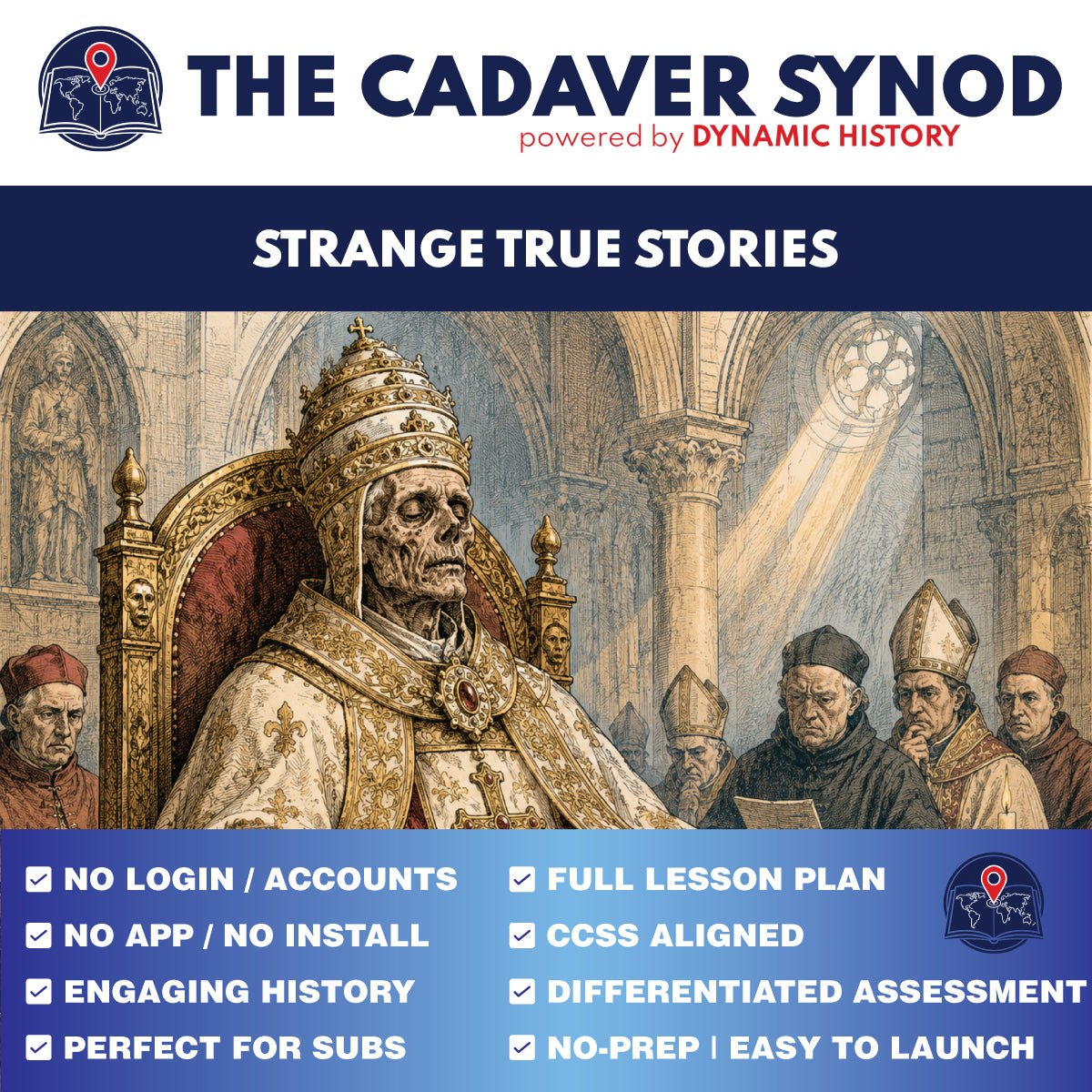
The Cadaver Synod | Dynamic History Module | Grades 9-12
The Cadaver Synod | Dynamic History Module | Grades 9-12
Couldn't load pickup availability
Classroom Use at a Glance
A grades 9-12 two-day Dynamic History investigation on the Cadaver Synod. Strong fit for World History, Medieval Europe, Church History, papal history, and historical-method lessons. Students connect imperial rivalry, papal legitimacy, church law, ordinations, conflicting medieval accounts, corroboration, burned records, and later historical memory.
Classroom Uses Whole Class, Small Groups, Content-Area Reading, Discussion, Assessment, Review, Homework, Sub Plan view all
- Whole Class
- Small Groups
- Content-Area Reading
- Discussion
- Assessment
- Review
- Homework
- Sub Plan
Included Teacher Guide, Student Worksheet, Answer Key, Quiz, Google Forms Quiz, Vocabulary, Discussion Questions, Challenge Questions view all
- Teacher Guide
- Student Worksheet
- Answer Key
- Quiz
- Google Forms Quiz
- Vocabulary
- Discussion Questions
- Challenge Questions
Format PDF, DOCX, Google Docs, Google Slides, Google Forms, PowerPoint, ZIP Download, Printable, Editable view all
- DOCX
- Google Docs
- Google Slides
- Google Forms
- PowerPoint
- ZIP Download
- Printable
- Editable
Differentiation Accessible Version, Mixed Reading Levels, ELL Support, Struggling Readers, Vocabulary Support, Small-Group Support view all
- Accessible Version
- Mixed Reading Levels
- ELL Support
- Struggling Readers
- Vocabulary Support
- Small-Group Support
Put one of medieval history's strangest trials in context instead of leaving it as a bizarre anecdote. In this Dynamic History module for grades 9-12, students investigate the Cadaver Synod through medieval European politics, papal authority, Church law, legitimacy, source reliability, and historical corroboration.
Students trace the conflict around Pope Formosus, Lambert of Spoleto, Arnulf of Carinthia, and Pope Stephen VI, then compare medieval accounts that agree on the core event but disagree on some of its most famous details. The final question is not simply what happened, but how confidently historians can say it happened.
What Students Investigate
- Why papal imperial coronation mattered in late ninth-century politics
- Why Formosus's move from the see of Porto to Rome became vulnerable to a Church-law attack
- How imperial rivalry increased the political danger around Formosus
- Why invalidating Formosus's papacy could threaten living clergy he had ordained
- How the Annals of Fulda, Auxilius, and Liudprand agree, disagree, and deserve different levels of confidence
- How the Ravenna reversal, burned records, and Jean-Paul Laurens's later painting affect what historians can know
What's Included
- Six-stop Dynamic History investigation designed for two class periods
- Teacher Guide and Answer Key with flexible pacing
- Standard Offline Print Module
- Accessible Offline Print Module with the same core history and evidence at reduced reading complexity
- Editable digital student worksheet and print student worksheet
- Self-grading Google Forms quiz and multiple-choice print quiz
- Vocabulary, short-answer, challenge, and multiple-choice assessment bank
Where This Fits in Your Curriculum
This lesson is a strong fit for World History, Medieval History, Medieval Europe, Church History, papal history, and early medieval political history. It is also useful when teaching historical method: students practice source reliability, corroboration, point of view, missing evidence, historiography, and ranking claims by confidence instead of treating every vivid detail as equally secure.
Skills Addressed
- Historical cause and effect
- Map and geographic reasoning
- Primary-source and evidence analysis
- Distinguishing what a source supports from what it cannot prove
- Evidence-based discussion and writing
Standards Alignment
CCSS RH.9-10.1, RH.9-10.2, RH.9-10.6, RH.9-10.7, RH.9-10.9; grades 11-12 may use corresponding RH standards; writing extensions may support WHST.9-10.1.
Pair It With the Matching Resource
The Cadaver Synod Reader's Theater gives students the same verified history through the other instructional format.
Try Strange True Stories Free
Preview both classroom formats at no cost: FREE Guano Islands Act Dynamic History Module and FREE Guano Act Reader's Theater.
Save With the Full Strange True Stories Bundle
Get all 5 Dynamic History modules + all 5 matching Reader's Theater resources, plus the bundle-exclusive Educator Planning & Implementation Guide. Browse the complete Strange True Stories collection.
Share