
Readers Theater Worksheets
California State History | Bear Flag Revolt and Statehood Readers Theater Script | Grades 3-5
California State History | Bear Flag Revolt and Statehood Readers Theater Script | Grades 3-5
Couldn't load pickup availability
Classroom Use at a Glance
A no-prep California State History Reader’s Theater script for grades 3–5 focused on California State History | Bear Flag Revolt and Statehood. Designed for one class period of content-area reading, fluency practice, discussion, review, and quick assessment in social studies or ELA classrooms.
Classroom Uses Whole Class, Small Groups, Fluency Practice, Performance Reading, Content-Area Reading, Discussion, Review, Assessment, Sub Plan view all
- Whole Class
- Small Groups
- Fluency Practice
- Performance Reading
- Content-Area Reading
- Discussion
- Review
- Assessment
- Sub Plan
Included Reader’s Theater Script, Teacher Guide, Student Worksheet, Answer Key, Quiz, Google Forms Quiz, Discussion Questions, Writing Prompt view all
- Reader’s Theater Script
- Teacher Guide
- Student Worksheet
- Answer Key
- Quiz
- Google Forms Quiz
- Discussion Questions
- Writing Prompt
Format PDF, DOCX, Google Docs, Google Forms, Printable, Editable view all
- DOCX
- Google Docs
- Google Forms
- Printable
- Editable
Differentiation Mixed Reading Levels, Vocabulary Support, Small-Group Support view all
- Mixed Reading Levels
- Vocabulary Support
- Small-Group Support
Overview
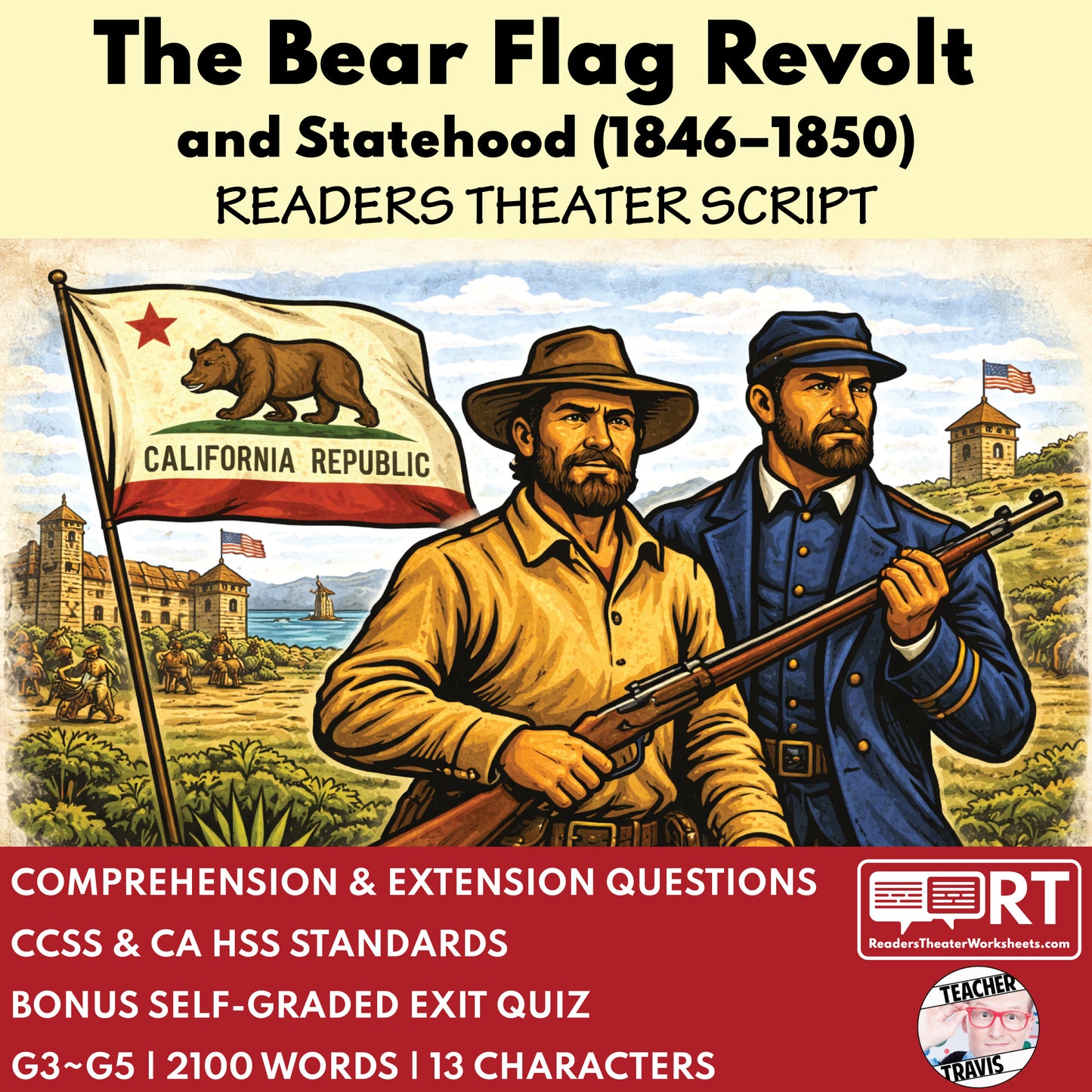
Join Joel and Amanda on a fast-paced time-travel adventure through a major turning point in California history: the Bear Flag Revolt and the path to statehood. Students step into Sonoma as William B. Ide’s group raises a bear-and-star flag and debates what “sovereignty” really means.
The story follows rapid change as U.S. forces claim California, the Treaty of Guadalupe Hidalgo shifts sovereignty, the Gold Rush fuels migration, and delegates write a constitution—while multiple perspectives highlight both opportunity and loss.
Perfect For
- California history units and standards-based instruction
- Social studies literacy blocks (RI skills in context)
- Readers Theater performances and fluency practice
- Small-group reading, discussion, and collaboration
What’s Included
(a single PDF with links to Google Docs/Slides, if print format is preferred you can download from your Google Drive to word/pdf/ppt/etc)
- Student Script: Editable, ~9 pages, ~2200 words, 10 scenes, casting breakdown (DOCX/PDF/Google Doc).
- Teacher Guide: Editable, ~12 pages, lesson tips, main ideas, answer keys, standards, casting with lexical levels (DOCX/PDF/Google Doc).
- Student Worksheet: Editable, ~25 slides, vocabulary (10 terms), short-answer (10), challenge (5), optional extensions (5) (Google Slides/PPTX).
- Self-Graded Exit Quiz: 20 multiple-choice questions (Google Forms).
Teacher’s Script Summary
- A Map That Keeps Changing: Joel and Amanda arrive and learn that sovereignty means “who is in charge.”
- Sonoma’s Tense Morning: Settlers debate action while Californios warn that fast change can cause harm.
- The Bear Flag Is Born: The rebels seize Sonoma, declare a republic, and raise a bear flag.
- Frémont and the Question of Power: Frémont questions plans and recognition as community members worry about protection.
- Monterey—A New Flag Over the Capital: Sloat raises the U.S. flag and the Bear Flag Republic ends.
- War Ends on Paper—Treaty Talk: The treaty ends the war and characters discuss rights, land, and promises.
- Gold—And the Rush of the World: Gold brings newcomers, rapid change, and displacement.
- Colton Hall—Writing a Constitution: Delegates write a constitution, publish in English and Spanish, and shape a new system.
- 1850—Statehood and Mixed Feelings: California becomes a state and characters reflect on land, courts, and belonging.
- A Final Look at the Map: The cast asks who gets heard when government changes.
Standards Addressed
California State Standards
- CA HSS 4.3: Students explain California’s social, political, and economic change from the Bear Flag period through war, the Gold Rush, and statehood (e.g., SAQ 2, SAQ 6, SAQ 8; Quiz Q3, Quiz Q6, Quiz Q9, Quiz Q20).
- CA HSS 4.3.5: Students discuss how California became a state and how the new government differed from Spanish and Mexican periods (e.g., SAQ 7, SAQ 9, SAQ 10; Quiz Q11, Quiz Q14, Quiz Q19).
CCSS
- RL.4.1: Refer to details and examples in a text when explaining what the text says explicitly and when drawing inferences from the text.
- RL.4.2: Determine a theme of a story, drama, or poem from details in the text; summarize the text.
- RL.4.3: Describe in depth a character, setting, or event in a story or drama, drawing on specific details in the text (e.g., a character’s thoughts, words, or actions).
- RI.4.1: Refer to details and examples in a text when explaining what the text says explicitly and when drawing inferences from the text.
- RI.4.2: Determine the main idea of a text and explain how it is supported by key details; summarize the text.
- RI.4.3: Explain events, procedures, ideas, or concepts in a historical, scientific, or technical text, including what happened and why, based on specific information in the text.
- RF.4.4: Read with sufficient accuracy and fluency to support comprehension.
- SL.4.4: Report on a topic or text in an organized manner, using appropriate facts and relevant details; speak clearly at an understandable pace.
- L.4.4: Determine or clarify the meaning of unknown and multiple-meaning words and phrases based on grade 4 reading and content, choosing flexibly from a range of strategies.
CCRA
- CCRA.R.1: Read closely to determine what the text says explicitly and to make logical inferences from it; cite specific textual evidence.
- CCRA.R.2: Determine central ideas or themes of a text and analyze their development; summarize key supporting details and ideas.
- CCRA.R.3: Analyze how and why individuals, events, and ideas develop and interact over the course of a text.
- CCRA.W.2: Write informative/explanatory texts to examine and convey complex ideas and information clearly and accurately.
- CCRA.SL.1: Prepare for and participate effectively in a range of conversations and collaborations.
- CCRA.L.4: Determine or clarify the meaning of unknown and multiple-meaning words and phrases by using context clues and word parts.
Share