Readers Theater Worksheets
California State History | Rancho Life Under Mexican Rule Readers Theater Script | Grades 3-5
California State History | Rancho Life Under Mexican Rule Readers Theater Script | Grades 3-5
Couldn't load pickup availability
Classroom Use at a Glance
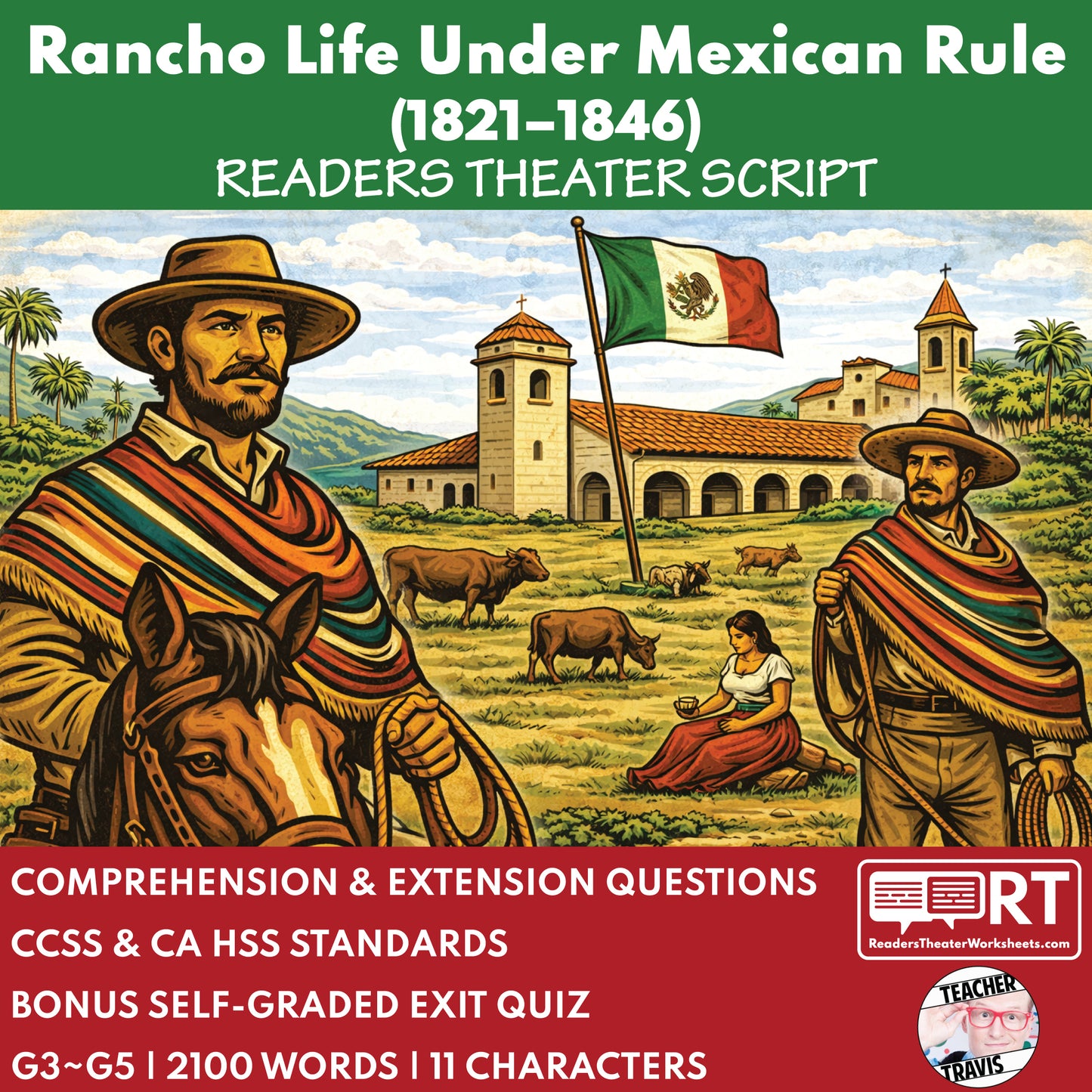
A no-prep state history Reader’s Theater script about Rancho Life Under Mexican Rule for elementary social studies classes. Designed for content-area reading, fluency practice, discussion, review, and quick assessment in one class period.
Classroom Uses Sub Plan, Small Groups, Fluency Practice, Performance Reading, Content-Area Reading, Review, Discussion, Assessment view all
- Sub Plan
- Small Groups
- Fluency Practice
- Performance Reading
- Content-Area Reading
- Review
- Discussion
- Assessment
Included Reader’s Theater Script, Teacher Guide, Student Worksheet, Quiz, Google Forms Quiz, Answer Key, Discussion Questions, Writing Prompt view all
- Reader’s Theater Script
- Teacher Guide
- Student Worksheet
- Quiz
- Google Forms Quiz
- Answer Key
- Discussion Questions
- Writing Prompt
Format PDF, DOCX, Google Docs, Google Forms, Printable, Editable view all
- DOCX
- Google Docs
- Google Forms
- Printable
- Editable
Differentiation Mixed Reading Levels, Vocabulary Support, Small-Group Support view all
- Mixed Reading Levels
- Vocabulary Support
- Small-Group Support
Overview
Join Joel and Amanda on a time-travel visit to Alta California during the Mexican Rancho Period. Students learn how Mexico’s independence changed California, how missions were affected by secularization, and how land grants and diseño maps helped ranchos spread across the region.
With daily-life details—adobe homes, meals like atole and pozole, rodeo roundups, and the hide-and-tallow trade—students explore culture, economy, and fairness through multiple viewpoints while building fluency and vocabulary.
Perfect For
- California history units and standards-based instruction
- Social studies literacy blocks (RI skills in context)
- Readers Theater performances and fluency practice
- Small-group reading, discussion, and collaboration
What’s Included
(a single PDF with links to Google Docs/Slides, if print format is preferred you can download from your Google Drive to word/pdf/ppt/etc)
- Student Script: Editable, ~9 pages, ~2200 words, 10 scenes, casting breakdown (DOCX/PDF/Google Doc).
- Teacher Guide: Editable, ~12 pages, lesson tips, main ideas, answer keys, standards, casting with lexical levels (DOCX/PDF/Google Doc).
- Student Worksheet: Editable, ~25 slides, vocabulary (10 terms), short-answer (10), challenge (5), optional extensions (5) (Google Slides/PPTX).
- Self-Graded Exit Quiz: 20 multiple-choice questions (Google Forms).
Teacher’s Script Summary
- Joel and Amanda arrive at a rancho and meet the people who live and work there, learning that rancho life has multiple viewpoints.
- The group explains how Mexico’s independence changed who ruled California and how decisions could feel distant from daily life.
- Students learn how missions changed through secularization and how land grants helped ranchos grow, often leaving Native families with few choices.
- Don Rafael applies for a land grant using a diseño map, and the group learns how unclear borders could lead to disputes.
- The rancho’s daily rhythm comes to life through adobe homes, early work, meals like atole and pozole, and the midday siesta.
- Students see a rodeo roundup and learn how vaquero skills—and Spanish words—shaped “cowboy” culture in California.
- The group visits a port to see the hide-and-tallow trade and how barter made hides feel like “cowhide gold.”
- A traveler arrives and the rancho’s hospitality and fandango traditions show community life and celebration.
- Toma shares how rancho life felt different for Native workers, and the group discusses power, pressure on land, and rising tension.
- The characters reflect on the rancho era’s lasting impact on California’s land, language, and the need to tell the whole story.
Standards Addressed
California State Standards
- CA HSS 4.2: Students learn social, political, cultural, and economic life during the rancho era (e.g., SAQ 1–10, Themes 1–5).
- CA HSS 4.2.5: Students describe daily lives of people on ranchos, including native and nonnative experiences (e.g., SAQ 4–6, 8–9; Themes 2 and 5).
- CA HSS 4.2.8: Students explain Mexican rule, secularization, land grants, and the rancho economy (e.g., SAQ 1–3, 7, 10; Themes 1 and 3).
CCSS
- RL.4.1: Refer to details and examples in a text when explaining what the text says explicitly and when drawing inferences from the text.
- RL.4.2: Determine a theme of a story, drama, or poem from details in the text; summarize the text.
- RL.4.3: Describe in depth a character, setting, or event in a story or drama, drawing on specific details in the text (e.g., a character’s thoughts, words, or actions).
- RI.4.1: Refer to details and examples in a text when explaining what the text says explicitly and when drawing inferences from the text.
- RI.4.2: Determine the main idea of a text and explain how it is supported by key details; summarize the text.
- RI.4.3: Explain events, procedures, ideas, or concepts in a historical, scientific, or technical text, including what happened and why, based on specific information in the text.
- RF.4.4: Read with sufficient accuracy and fluency to support comprehension.
- SL.4.4: Report on a topic or text in an organized manner, using appropriate facts and relevant details; speak clearly at an understandable pace.
- L.4.4: Determine or clarify the meaning of unknown and multiple-meaning words and phrases based on grade 4 reading and content, choosing flexibly from a range of strategies.
CCRA
- CCRA.R.1: Read closely to determine what the text says explicitly and to make logical inferences from it; cite specific textual evidence.
- CCRA.R.2: Determine central ideas or themes of a text and analyze their development; summarize key supporting details and ideas.
- CCRA.R.3: Analyze how and why individuals, events, and ideas develop and interact over the course of a text.
- CCRA.W.2: Write informative/explanatory texts to examine and convey complex ideas and information clearly and accurately.
- CCRA.SL.1: Prepare for and participate effectively in a range of conversations and collaborations.
- CCRA.L.4: Determine or clarify the meaning of unknown and multiple-meaning words and phrases by using context clues and word parts.
Share