Readers Theater Worksheets
California State History | Transcontinental Railroad Readers Theater Script | Grades 3-5
California State History | Transcontinental Railroad Readers Theater Script | Grades 3-5
Couldn't load pickup availability
Classroom Use at a Glance
A no-prep California State History Reader’s Theater script for grades 3–5 focused on California State History | Transcontinental Railroad. Designed for one class period of content-area reading, fluency practice, discussion, review, and quick assessment in social studies or ELA classrooms.
Classroom Uses Whole Class, Small Groups, Fluency Practice, Performance Reading, Content-Area Reading, Discussion, Review, Assessment, Sub Plan view all
- Whole Class
- Small Groups
- Fluency Practice
- Performance Reading
- Content-Area Reading
- Discussion
- Review
- Assessment
- Sub Plan
Included Reader’s Theater Script, Teacher Guide, Student Worksheet, Answer Key, Quiz, Google Forms Quiz, Discussion Questions, Writing Prompt view all
- Reader’s Theater Script
- Teacher Guide
- Student Worksheet
- Answer Key
- Quiz
- Google Forms Quiz
- Discussion Questions
- Writing Prompt
Format PDF, DOCX, Google Docs, Google Forms, Printable, Editable view all
- DOCX
- Google Docs
- Google Forms
- Printable
- Editable
Differentiation Mixed Reading Levels, Vocabulary Support, Small-Group Support view all
- Mixed Reading Levels
- Vocabulary Support
- Small-Group Support
Overview
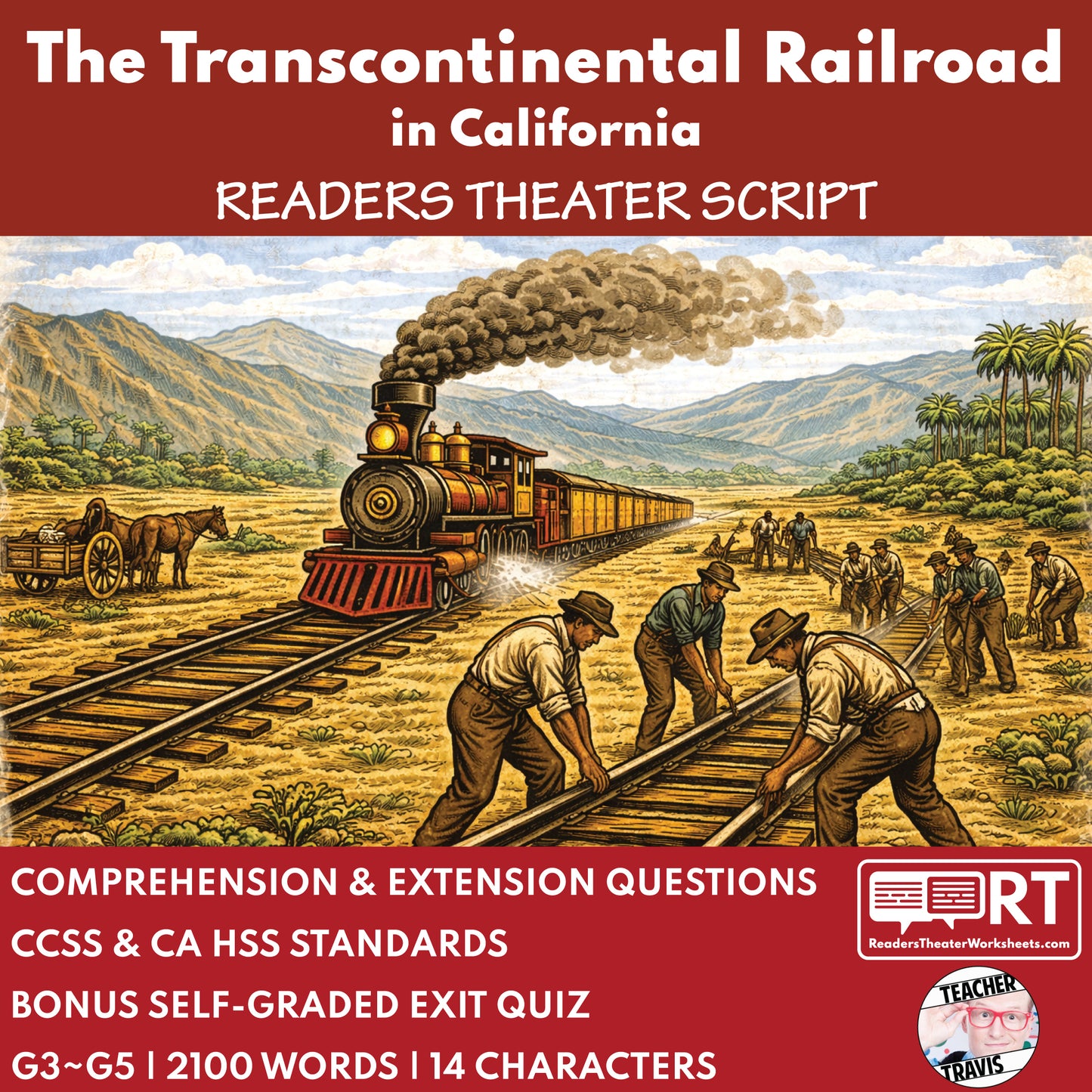
Hop aboard for a time-travel journey with Joel and Amanda as California races to connect East and West. Students learn how the Pacific Railroad Act launched a bold plan, how Theodore Judah mapped a route through the Sierra Nevada, and how the “Big Four” pushed construction forward.
Through multiple perspectives—including Li Wei and other Chinese workers—students explore granite tunnels, snowbound camps, a strike for fair pay, and how rail schedules and faster shipping transformed California while increasing pressure on Native communities.
Perfect For
- California history units and standards-based instruction
- Social studies literacy blocks (RI skills in context)
- Readers Theater performances and fluency practice
- Small-group reading, discussion, and collaboration
What’s Included
(a single PDF with links to Google Docs/Slides, if print format is preferred you can download from your Google Drive to word/pdf/ppt/etc)
- Student Script: Editable, ~9 pages, ~2200 words, 10 scenes, casting breakdown (DOCX/PDF/Google Doc).
- Teacher Guide: Editable, ~12 pages, lesson tips, main ideas, answer keys, standards, casting with lexical levels (DOCX/PDF/Google Doc).
- Student Worksheet: Editable, ~25 slides, vocabulary (10 terms), short-answer (10), challenge (5), optional extensions (5) (Google Slides/PPTX).
- Self-Graded Exit Quiz: 20 multiple-choice questions (Google Forms).
Teacher’s Script Summary
- California Feels Far Away: Students see why slow mail and travel made California feel distant.
- A Law and a Big Plan: The Pacific Railroad Act begins a two-company plan to link the nation.
- “We Need Workers”: Chinese immigrants join the workforce and show skill and teamwork.
- Granite, Snow, and Tunnels: Crews blast tunnels through granite while surviving harsh winters.
- Hanging Baskets at Cape Horn: Workers face cliffs and speak up about unfair treatment.
- A Strike for Fair Pay: Chinese workers organize a strike to demand better pay and safety.
- Ten Miles in One Day: The crew lays about ten miles of track in a day through teamwork.
- Promontory Summit and the Golden Spike: The rails meet in 1869, but Chinese workers are left out of the official spotlight.
- A One-Week Journey: Faster travel and shipping boost California’s economy and growth.
- The Clock Changes Too: Rail schedules influence shared time and later time zones, raising questions about fairness and memory.
Standards Addressed
California State Standards
- CA HSS 4.4: Students explain how faster shipping and rail links help California grow into an agricultural and industrial power (e.g., SAQ 9, SAQ 10; Quiz Q16, Quiz Q17).
- CA HSS 4.4.1: Students understand the railroad’s story and influence, including telegraph communication, fast travel, and Chinese worker contributions (e.g., SAQ 2–8; Quiz Q2–15, Quiz Q19–20).
CCSS
- RL.4.1: Refer to details and examples in a text when explaining what the text says explicitly and when drawing inferences from the text.
- RL.4.2: Determine a theme of a story, drama, or poem from details in the text; summarize the text.
- RL.4.3: Describe in depth a character, setting, or event in a story or drama, drawing on specific details in the text (e.g., a character’s thoughts, words, or actions).
- RI.4.1: Refer to details and examples in a text when explaining what the text says explicitly and when drawing inferences from the text.
- RI.4.2: Determine the main idea of a text and explain how it is supported by key details; summarize the text.
- RI.4.3: Explain events, procedures, ideas, or concepts in a historical, scientific, or technical text, including what happened and why, based on specific information in the text.
- RF.4.4: Read with sufficient accuracy and fluency to support comprehension.
- SL.4.4: Report on a topic or text in an organized manner, using appropriate facts and relevant details; speak clearly at an understandable pace.
- L.4.4: Determine or clarify the meaning of unknown and multiple-meaning words and phrases based on grade 4 reading and content, choosing flexibly from a range of strategies.
CCRA
- CCRA.R.1: Read closely to determine what the text says explicitly and to make logical inferences from it; cite specific textual evidence.
- CCRA.R.2: Determine central ideas or themes of a text and analyze their development; summarize key supporting details and ideas.
- CCRA.R.3: Analyze how and why individuals, events, and ideas develop and interact over the course of a text.
- CCRA.W.2: Write informative/explanatory texts to examine and convey complex ideas and information clearly and accurately.
- CCRA.SL.1: Prepare for and participate effectively in a range of conversations and collaborations.
- CCRA.L.4: Determine or clarify the meaning of unknown and multiple-meaning words and phrases by using context clues and word parts.
Share