Readers Theater Worksheets
Essentials ELA Poetry Mini Unit | Differentiated Study Guide & Analysis for Grades 9 to 12
Essentials ELA Poetry Mini Unit | Differentiated Study Guide & Analysis for Grades 9 to 12
Couldn't load pickup availability
Classroom Use at a Glance
A differentiated study guide for Grades 9 to 12 built to support mixed reading levels, close reading, vocabulary, comprehension, discussion, written response, quizzes, and teacher-led literature instruction.
Classroom Uses Whole Class, Close Reading, Discussion, Assessment, Review, Enrichment, Intervention, Homework, Sub Plan view all
- Whole Class
- Close Reading
- Discussion
- Assessment
- Review
- Enrichment
- Intervention
- Homework
- Sub Plan
Included Original Text, Leveled Text, Teacher Guide, Student Worksheet, Answer Key, Quiz, Google Forms Quiz, Vocabulary, Discussion Questions, Writing Prompt view all
- Original Text
- Leveled Text
- Teacher Guide
- Student Worksheet
- Answer Key
- Quiz
- Google Forms Quiz
- Vocabulary
- Discussion Questions
- Writing Prompt
Format PDF, DOCX, Google Docs, Google Forms, Printable, Editable, ZIP Download view all
- DOCX
- Google Docs
- Google Forms
- Printable
- Editable
- ZIP Download
Differentiation Original Version, Leveled Version, Mixed Reading Levels, Struggling Readers, Advanced Readers, Vocabulary Support, Short Sections view all
- Original Version
- Leveled Version
- Mixed Reading Levels
- Struggling Readers
- Advanced Readers
- Vocabulary Support
- Short Sections
PROBLEM: Many classic poetry units fall apart in real classrooms because the original language can be challenging, and students often read at different levels—so teachers end up reteaching constantly or simplifying until the poems lose their voice and power.
SOLUTION: This differentiated poetry mini-unit for Poetry Unit (10 Poems) solves that problem by giving you both the complete original poems and a five-day close-verse adapted track, so your class can move together while students read at the level that fits. The adaptation keeps each poem’s major images, speaker stance, tone, and key turns—while simplifying syntax and difficult vocabulary so students can comprehend and analyze without giving up.
Dual-track assurance: Every discussion prompt, exit quiz item, and short-answer question is designed to be answerable from the adapted Day text while still mapping cleanly to the corresponding original poem for extension reading and author’s craft comparisons. “Optional if students read both versions” questions are included to help students notice how original phrasing shapes tone and meaning.
Perfect for: Grades 4–8 ELA (whole-class instruction, small groups, intervention, inclusion, ELL support), a one-week poetry study, sub plans, and repeated close-reading practice focused on imagery, tone, symbolism, speaker/audience, and argument moves.
Important Note: “Give Me Liberty, or Give Me Death!” is a famous speech rather than a poem, but it fits this essentials poetry unit because it functions like a high-impact verse-style argument in the classroom: it uses rhythmic phrasing, repetition, parallel structure, and vivid figurative language to create tone and urgency—so students can practice the same close-reading skills they use in poetry (speaker/audience, imagery, tone shifts, and “argument moves”) while also building foundational rhetoric analysis.
1 Week Summary
Day 1 — Choice
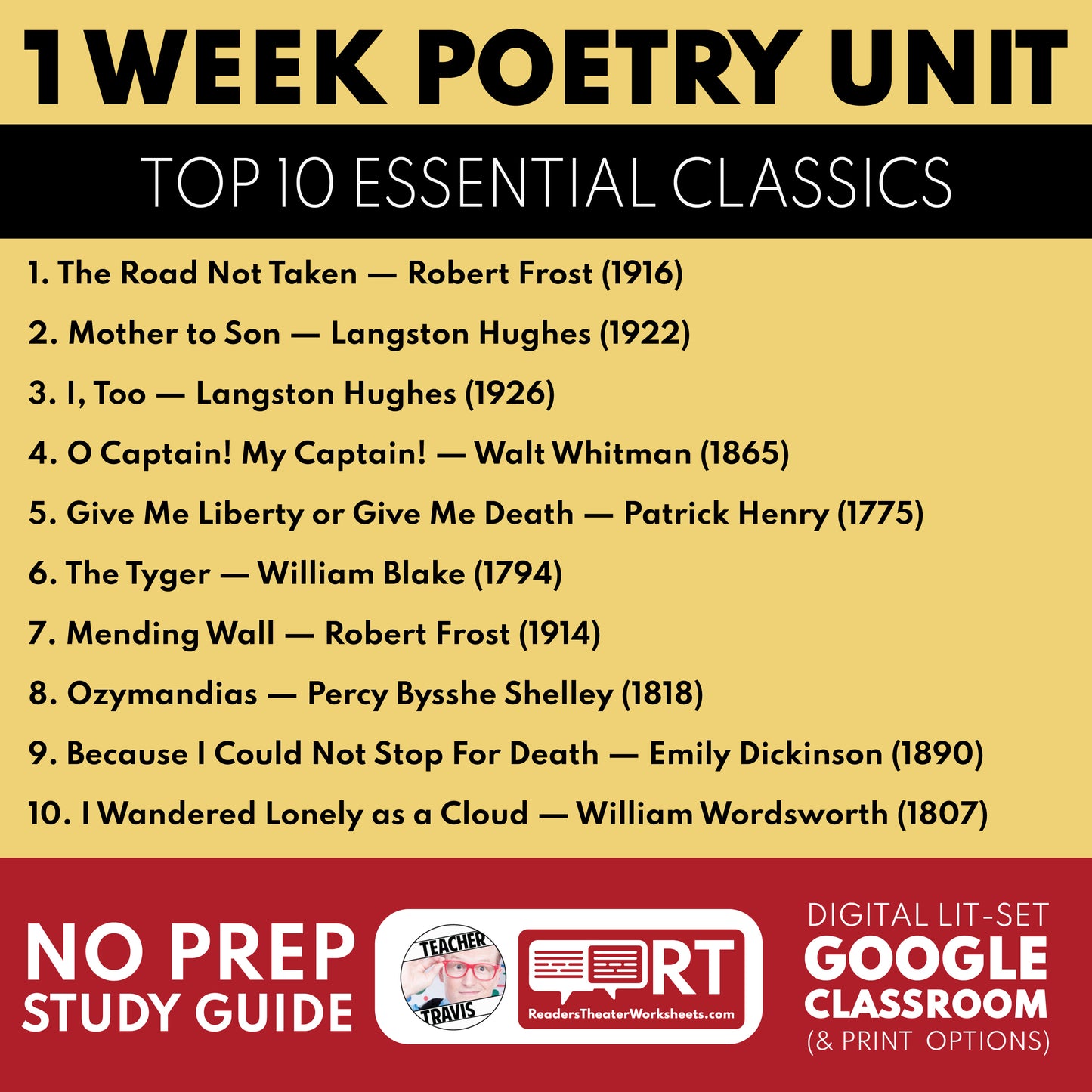
- The Road Not Taken (Robert Frost, 1916)
- Mother to Son (Langston Hughes, 1922)
- Focus: Choice is explored through metaphor—one speaker weighs diverging paths while the other urges perseverance up a “staircase” of hardship—showing how decisions and endurance shape a life.
Day 2 — Voice
- I, Too (Langston Hughes, 1926)
- O Captain! My Captain! (Walt Whitman, 1865)
- Focus: Voice is used to claim belonging and future change (a confident “I” speaking back to exclusion) alongside public mourning where celebration and grief collide, revealing how a speaker’s stance shapes tone.
Day 3 — Power
- Give Me Liberty, or Give Me Death! (Patrick Henry, 1775)
- The Tyger (William Blake, 1794)
- Focus: Power is built through language—Henry’s urgent persuasion uses repetition and rising intensity to drive action, while Blake’s questions and imagery examine fearsome creation, awe, and moral complexity.
Day 4 — Boundaries
- Mending Wall (Robert Frost, 1914)
- Ozymandias (Percy Bysshe Shelley, 1818)
- Focus: Boundaries are questioned through contrast: Frost probes why people maintain divisions (“good fences”) while Shelley shows how human power and pride collapse into ruins, turning monuments into warnings.
Day 5 — Mortality
- Because I could not stop for Death (Emily Dickinson, c. 1863)
- I Wandered Lonely as a Cloud (William Wordsworth, 1807)
- Focus: Mortality and time are reframed in two tones—Dickinson’s calm journey with Death makes the end feel measured and inevitable, while Wordsworth shows how memory of beauty returns later to restore joy and steadiness.
Quick Guide for Teachers
Adapted-Only Track (Fastest: 5-Day Model)
- Best for Grades 8–12 classes that need accessible language while keeping mature themes.
- Day 1–5: Students read the adapted versions of the two poems for the day and complete the matching Main Ideas & Themes Discussion Questions and the 12-question self-grading exit quiz.
- End the week with the Final Worksheet (Vocabulary Words, Short Answer Questions, and Challenge Questions).
- This track keeps the unit tight, predictable, and finishable in one week.
Original-Only Track (5-Day Close Reading)
- Ideal for strong readers or classes ready for original diction and syntax.
- Day 1–5: Students read the original poems for the day and use the same Discussion Questions, exit quizzes, and Final Worksheet—because all items are built on shared meaning, imagery, and argument moves present in both versions.
- Vocabulary Words (10) work for this track because each word appears in both the adapted and original texts.
Dual-Track Differentiation
- Use the same Day 1–5 schedule for everyone.
- Assign the adapted poems to supported readers and the original poems to advanced readers.
- All students complete the same Discussion Questions, daily exit quiz, and Final Worksheet because prompts target analysis that transfers across both versions (tone, symbolism, speaker stance, and thematic claim).
- If original-text readers need extra time, they can extend with annotation targets and evidence-based responses while adapted-text readers reread, strengthen vocabulary work, and draft higher-quality analytical answers.
This product includes a zip file consisting of:
NOTE: All files are editable and include (PDF, DOCX, PPTX, Google Docs/Slides/Forms)
Full Original Text: ~2,800 words | 7.1 Flesch-Kincaid GL
• Lexile Ranges: ~925L - 1185L | CEFR ~A2 – C1
• Great for Grades 9-12 readers, middle school core and extension groups.
Adapted Version Text: ~1,800 words | 5.1 Flesch-Kincaid GL
• Lexile Ranges: ~740L - 1010L | CEFR ~A2 – C1
• Great for Grades 8-12 readers who need support.
• Supported readers who need a shorter, clearer text with the same central images, themes, and assessment alignment.
• Both versions cover the same ideas so students can join shared discussions even when reading different texts.
Student Final Worksheet/Quizzes (PPTX, Google Slides/Forms)
- 10 Vocabulary Words
- 10 Short Answer Recall/Comprehension
- 5 Challenge Questions (synthesis, analysis, themes, real life connection)
- 5 Multiple Choice Quizzes (12 Questions per day)
Teacher’s Guide & Answer Key
- 5 Sets of Daily Discussion Questions (1 per part)
- 5 Sets of Self-Graded Exit Quizzes (1 per part, 12Qs each)
- Answer Keys for Vocab, Short Answer, and Challenge Questions
- Key Figures & Places reference sheets to help students track characters and settings
How can I confirm the quality of this resource? WANT MORE?
FREE BONUS ALERT!
- Free Access Code to the text on the Leveled-Lit Classics Library!
Frequently Asked Questions
Can I teach this if some students only read the adapted poems?
Yes. All questions and quizzes are designed to be answerable from the adapted track alone.
How do the “compare versions” questions work?
They’re labeled optional and quote both the original and adapted lines, giving teachers a simple way to discuss how diction and syntax affect tone and meaning.
How long does the unit take each day?
Most teachers complete a day in one class period: read two poems, discuss three theme blocks, then take a 12-question exit quiz (plus two short-answer questions as needed).
Share