Dynamic History
Texas State History - Grade 4 - European Explorers in Texas - Week 5 Full Curriculum
Texas State History - Grade 4 - European Explorers in Texas - Week 5 Full Curriculum
Couldn't load pickup availability
Classroom Use at a Glance
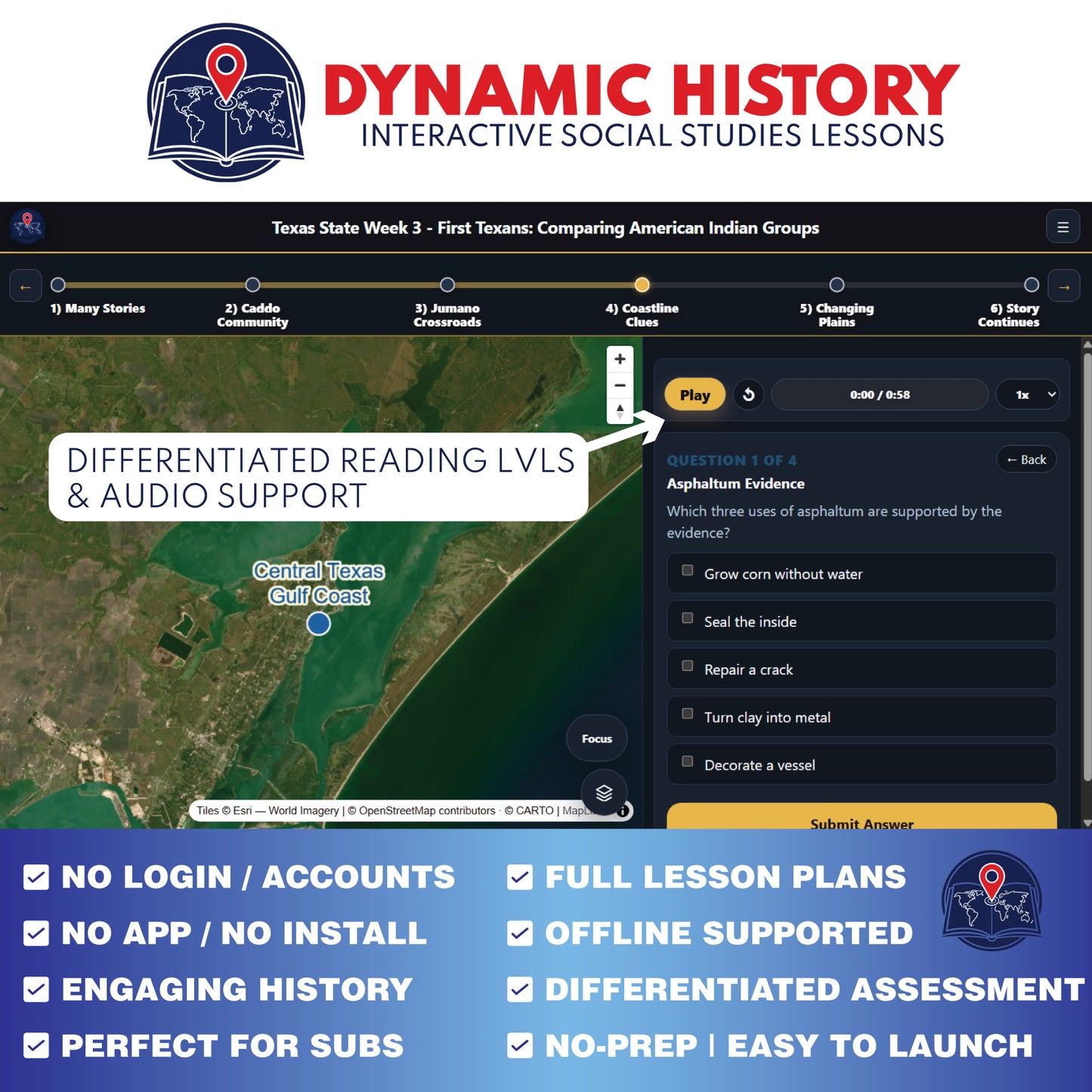
A complete Grade 4 Texas State History Week 5 resource built around the Dynamic History European Explorers in Texas interactive module. Includes a 6-stop investigation with 21 guided auto-graded tasks, stop-scoped clickable map evidence and reconstructed routes, Standard and Accessible reading paths with audio support, 22-page Standard and 27-page Accessible print modules, a 32-page all-in-one Teacher Guide and Answer Key, an 8-page Explorer Motive–Evidence–Impact Lab, a corrected 10-scene European Explorers Readers Theater Student Script with 13 roles, a Day 3 assessment with 6 vocabulary terms, 5 short-answer questions, 5 challenge questions, and 15 multiple-choice questions, a Day 4 assessment with 10 vocabulary terms, 10 short-answer questions, 5 challenge questions, and 20 multiple-choice questions, plus a Day 5 final assessment with 10 vocabulary terms, 10 short-answer questions, 5 challenge questions, and 25 multiple-choice questions. Printable assessment versions and self-grading Google Forms are provided through the shared classroom folder.
Classroom Uses Whole Class, Small Groups, Content-Area Reading, Discussion, Assessment, Review, Homework, Sub Plan view all
- Whole Class
- Small Groups
- Content-Area Reading
- Discussion
- Assessment
- Review
- Homework
- Sub Plan
Included Reader’s Theater Script, Teacher Guide, Student Worksheet, Answer Key, Quiz, Google Forms Quiz, Vocabulary, Discussion Questions, Challenge Questions view all
- Reader’s Theater Script
- Teacher Guide
- Student Worksheet
- Answer Key
- Quiz
- Google Forms Quiz
- Vocabulary
- Discussion Questions
- Challenge Questions
Format PDF, DOCX, Google Docs, Google Slides, Google Forms, PowerPoint, ZIP Download, Printable, Editable view all
- DOCX
- Google Docs
- Google Slides
- Google Forms
- PowerPoint
- ZIP Download
- Printable
- Editable
Differentiation Accessible Version, Mixed Reading Levels, ELL Support, Struggling Readers, Vocabulary Support, Audio Support, Small-Group Support view all
- Accessible Version
- Mixed Reading Levels
- ELL Support
- Struggling Readers
- Vocabulary Support
- Audio Support
- Small-Group Support
Teach Grade 4 Texas history through a complete five-day week built around a 6-stop Dynamic History interactive map investigation. Students examine why European expeditions entered Texas, compare the journeys of Cabeza de Vaca, Coronado, and La Salle, analyze real places and historical evidence, and explain how failed plans still affected Native communities, European rivalry, and later Spanish action.
This Week 5 resource coordinates the interactive Dynamic History module with Standard and Accessible print alternatives, an Explorer Motive–Evidence–Impact Lab, the complete European Explorers in Texas (1528–1687) Readers Theater, and complete Day 3, Day 4, and Day 5 assessments. Teachers can use the full five-day sequence or select individual components to fit their schedule.
Will this resource meet your expectations? Try Week 4! 100% FREE!
What students practice
- Texas before European expeditions: use real Texas landscapes to recognize that Native communities and trade networks already lived across the region.
- Motives and rivalry: distinguish economic opportunity, competition, and expansion as connected reasons governments supported expeditions and settlement plans.
- Routes, terrain, and survival: follow reconstructed paths and explain how coastlines, rivers, plains, canyons, distance, water, and supplies shaped choices.
- Sources and evidence: compare written accounts, artifacts from La Belle, historical maps, and modern reconstructed routes while identifying what each source can and cannot prove.
- Rumor and evidence: explain how Coronado's search for wealthy cities changed when the expedition encountered established Wichita farming communities instead.
- Cause and effect: connect La Salle's missed destination and failed colony at Matagorda Bay to Spanish searches, mapping, and increased Spanish activity in East Texas.
The five-day week
- Day 1: Dynamic History Stops 1-3 - Texas before European expeditions, exploration motives, and Cabeza de Vaca's survival journey and primary-source evidence.
- Day 2: Dynamic History Stops 4-6 - Coronado's search, La Salle's intended and actual destinations, artifacts from La Belle, and Spain's response.
- Day 3: Explorer Motive–Evidence–Impact Lab focused on comparing plans, sources, evidence limits, and consequences.
- Day 4: European Explorers in Texas (1528–1687) Readers Theater with performance guidance, discussion, and a complete follow-up assessment.
- Day 5: discussion, review, and a complete standalone final assessment.
What's included
- Dynamic History interactive module access with 6 guided stops and 21 auto-graded tasks.
- Stop-scoped clickable map evidence, reconstructed expedition routes, historical images, artifacts, Standard and Accessible reading paths, and Accessible Read Intro audio support.
- 22-page Standard and 27-page Accessible print-module companions with equivalent learning targets for classrooms that need a paper option.
- 32-page all-in-one Teacher Guide and Answer Key with week-at-a-glance planning, substitute-ready daily lesson plans, Days 1-2 Dynamic History guidance, differentiation, Readers Theater support, and complete assessment keys.
- Eight-page Day 3 Explorer Motive–Evidence–Impact Lab with source comparison, route analysis, and evidence-based writing.
- Day 4 corrected Readers Theater Student Script in the established series format with 10 scenes and 13 speaking roles.
- Day 3 assessment with 6 vocabulary terms, 5 short-answer questions, 5 challenge questions, and a 15-question multiple-choice quiz.
- Day 4 Readers Theater assessment with 10 vocabulary terms, 10 short-answer questions, 5 challenge questions, and a 20-question multiple-choice quiz.
- Day 5 final assessment with 10 vocabulary terms, 10 short-answer questions, 5 challenge questions, and a 25-question multiple-choice quiz.
- Printable student worksheets and multiple-choice quiz versions for the Day 3, Day 4, and Day 5 assessments.
- Self-grading Google Forms for the Day 3, Day 4, and Day 5 multiple-choice quizzes through the shared classroom folder.
- Complete model answers, direct answer keys, standards alignment, discussion guidance, map links, and performance support inside the single weekly Teacher Guide.
Google Forms note: Self-grading Google Forms are cloud-native and are provided through the shared Google folder. They do not appear inside a downloaded desktop ZIP.
Built for flexible classrooms
Use the complete five-day sequence, shorten the week by selecting one assessment format, or use the Standard and Accessible print modules when devices are limited. Both reading paths teach the same assessed ideas, so students can work at different reading levels without being assigned different learning targets.
Assessment options
The Dynamic History module uses 21 guided, auto-graded formative tasks across Days 1-2. The Day 3 application assessment, Day 4 Readers Theater assessment, and Day 5 final assessment remain separate so teachers can choose the mix of source analysis, performance, written response, challenge questions, printable multiple choice, and self-grading Google Forms that fits their classroom.
Best fit
Designed for Grade 4 Texas Social Studies and aligned to Week 5 learning targets for European exploration, motives, geography, primary and secondary sources, artifacts, reconstructed routes, Native perspectives, colonization, rivalry, and cause and effect. This resource works well for whole-class instruction, partner work, independent practice, social studies centers, substitute plans, review, and blended print/digital classrooms.
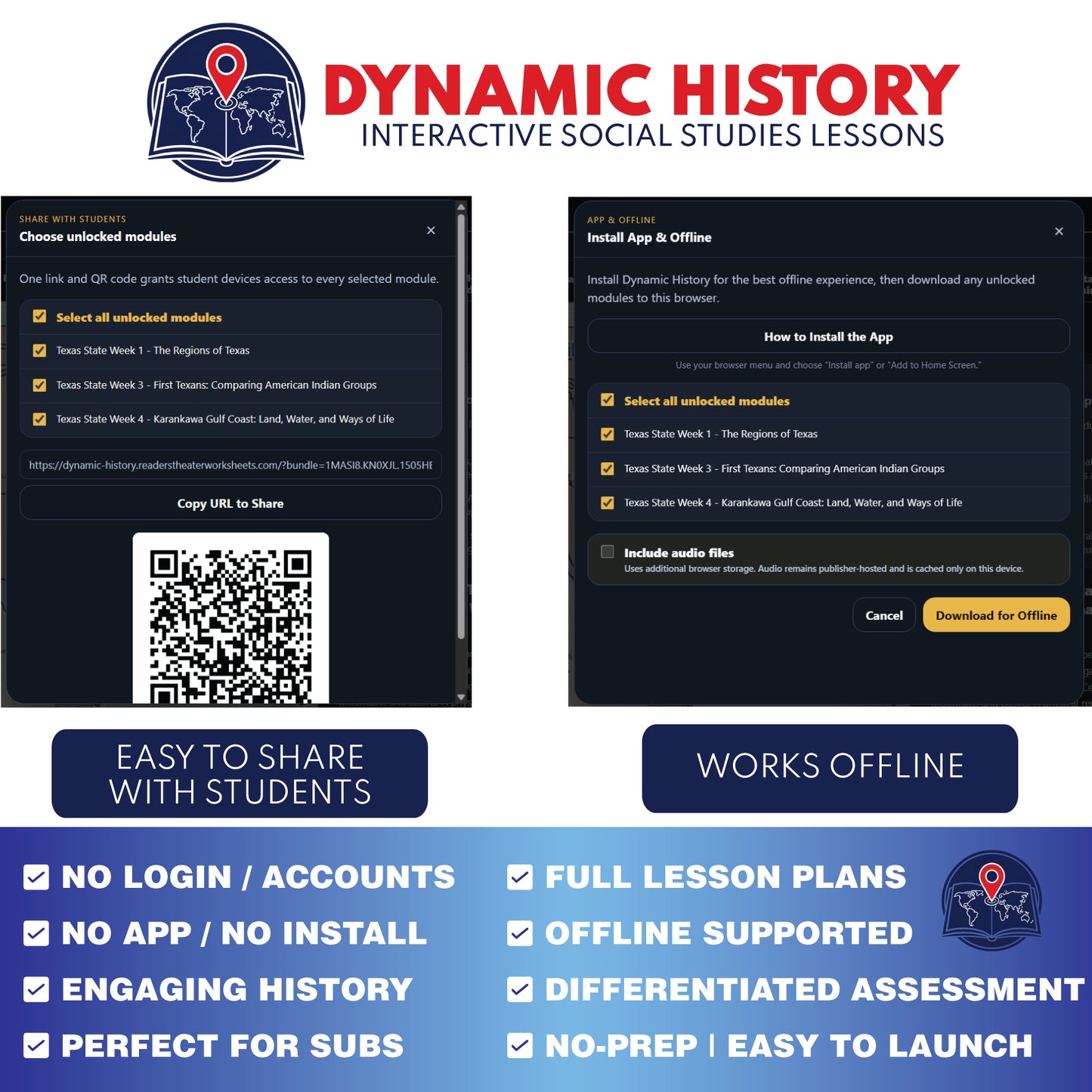
Technology note: Dynamic History and Google-native assessment files require internet access. The Standard and Accessible print modules, Explorer Motive–Evidence–Impact Lab, Readers Theater script, and printable assessment versions provide substantial offline alternatives for the week.
Share