

Dynamic History
Texas State History - Grade 4 - Fence Cutting War & Changing Texas - Week 16 Full Curriculum
Texas State History - Grade 4 - Fence Cutting War & Changing Texas - Week 16 Full Curriculum
Couldn't load pickup availability
Classroom Use at a Glance
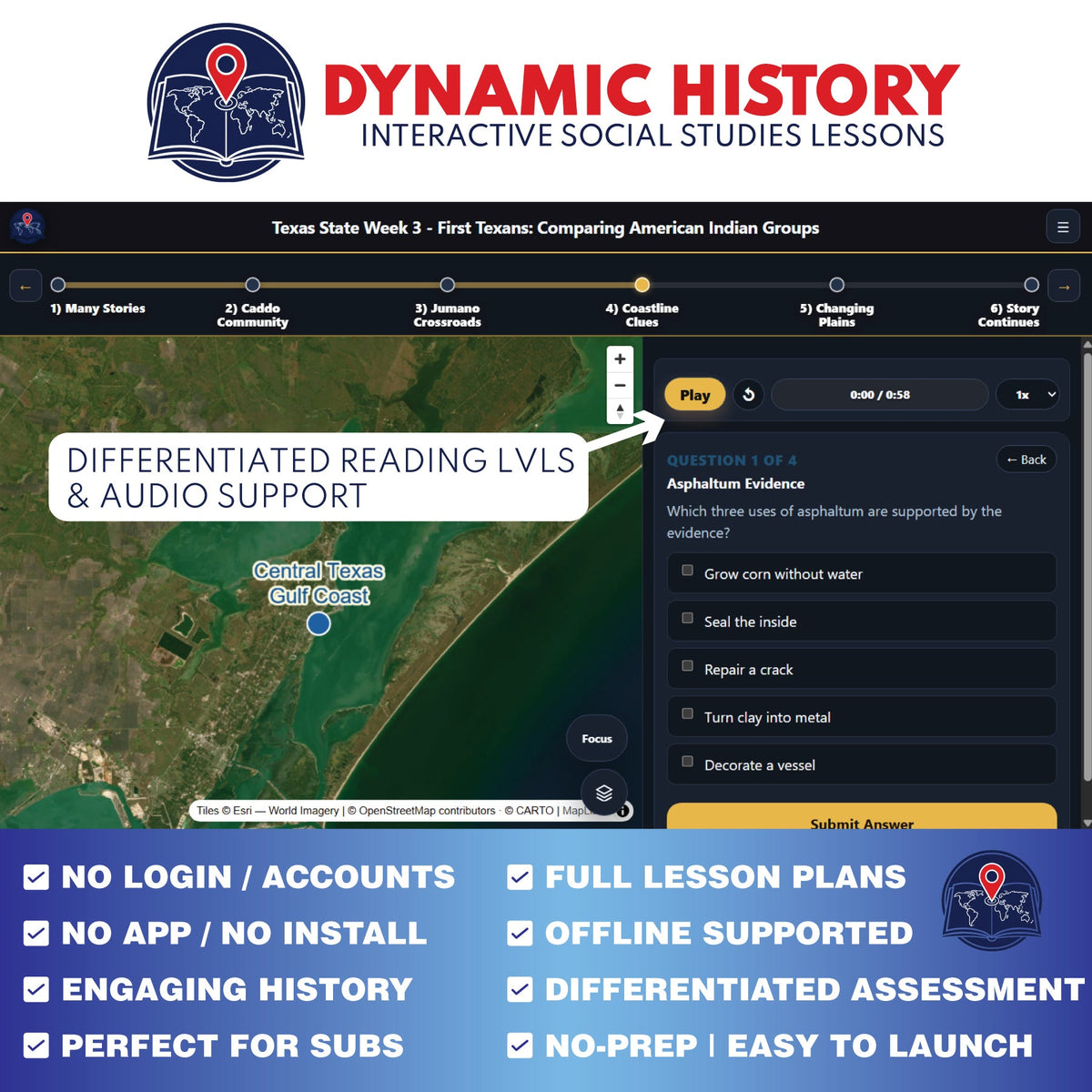
A complete Grade 4 Texas State History Week 16 resource centered on the Fence Cutting War of 1883-1884 and the connected systems that reshaped Texas. Includes a 6-stop Dynamic History investigation with 24 guided evidence tasks, Standard and Accessible reading paths with six Accessible Read Intro audio files, Standard and Accessible DOCX print modules, an all-in-one Teacher Guide and Answer Key, a substitute-ready Changing Texas Network Challenge with eight evidence cards and cause-and-effect mapping, an eight-stop Cattle, Forts, Bison, and Railroads Virtual Field Trip with editable and print student worksheets plus a 10-question quiz, and a Day 5 final assessment with 10 vocabulary terms, 10 short-answer questions, 5 challenge questions, and 20 multiple-choice questions. Google-native Day 5 student worksheets, self-grading Google Form, and MC print version are provided through the shared classroom folder.
Classroom Uses Whole Class, Small Groups, Content-Area Reading, Discussion, Assessment, Review, Homework, Sub Plan view all
- Whole Class
- Small Groups
- Content-Area Reading
- Discussion
- Assessment
- Review
- Homework
- Sub Plan
Included Teacher Guide, Student Worksheet, Answer Key, Quiz, Google Forms Quiz, Vocabulary, Discussion Questions, Challenge Questions view all
- Teacher Guide
- Student Worksheet
- Answer Key
- Quiz
- Google Forms Quiz
- Vocabulary
- Discussion Questions
- Challenge Questions
Format PDF, DOCX, Google Docs, Google Slides, Google Forms, PowerPoint, ZIP Download, Printable, Editable view all
- DOCX
- Google Docs
- Google Slides
- Google Forms
- PowerPoint
- ZIP Download
- Printable
- Editable
Differentiation Accessible Version, Mixed Reading Levels, ELL Support, Struggling Readers, Vocabulary Support, Audio Support, Small-Group Support view all
- Accessible Version
- Mixed Reading Levels
- ELL Support
- Struggling Readers
- Vocabulary Support
- Audio Support
- Small-Group Support
Teach Grade 4 Texas history through a complete five-day week centered on the Texas Fence Cutting War of 1883-1884 and the connected systems that reshaped Texas after the Civil War. Students investigate open-range ranching, barbed wire, railroads and markets, drought and water access, property rights, fence cutting, the 1884 state response, and the longer consequences of fencing and settlement while weighing competing historical perspectives.
This Week 16 resource coordinates a 6-stop Dynamic History interactive investigation with 24 guided tasks, Standard and Accessible print alternatives, a substitute-ready Changing Texas Network Challenge, an eight-stop Changing Texas Virtual Field Trip, and a complete Day 5 final assessment. The week is designed as a focused case study rather than a repeat of Week 15, helping students connect cattle, transportation, land, water, markets, conflict, law, conservation, and displacement through evidence and cause-and-effect reasoning.
Will this resource meet your needs?
Try the full week 1 curriculum - 100% FREE DOWNLOAD
What students practice
- Open range and property: distinguish what ranchers owned from grass, water, roads, and range that people had long used in common.
- Technology and transportation: explain how barbed wire and expanding rail networks made large-scale fencing and new market connections possible.
- Water and conflict: analyze how drought and fenced water access could create competing claims between landowners and small stockmen.
- Perspective taking: build the strongest evidence-based argument for both fence builders and fence cutters without treating every action on either side as justified.
- Law and civic response: examine how Texas responded in 1884 by protecting legal fences while addressing illegal fencing and public access.
- Systems thinking: connect cattle, forts, bison, railroads, markets, settlement, conservation, and displacement across the Changing Texas Virtual Field Trip.
- Historical evidence: use maps, historical images, artifacts, place-based evidence, and source limits to support claims and cause-and-effect explanations.
The five-day week
- Day 1: Dynamic History Stops 1-3 - open-range land use, barbed wire and rail connections, drought, water access, and the pressures that made fencing controversial.
- Day 2: Dynamic History Stops 4-6 - fence cutting, competing arguments, the 1884 state response, ownership, settlement, and the longer consequences of closing the range.
- Day 3: Changing Texas Network Challenge with eight evidence cards, cause-and-effect mapping, competing-perspective analysis, an 1884-law test, and an exit response. No outside video is required.
- Day 4: Cattle, Forts, Bison, and Railroads eight-stop Virtual Field Trip connecting Fort Griffin, Doan's Crossing, museums, Fort Worth Stockyards, the Goodnight Ranch, Caprock Canyons, and the Comanche National Museum and Cultural Center.
- Day 5: discussion, review, and a complete standalone final assessment.
What's included
- Dynamic History interactive module access with 6 guided stops and 24 evidence-based tasks.
- Stop-scoped map evidence, historical maps and images, Standard and Accessible reading paths, and six Accessible Read Intro audio files.
- Standard and Accessible DOCX print-module companions with equivalent learning targets for classrooms that need a paper option.
- All-in-one Week 16 Teacher Guide and Answer Key with week-at-a-glance planning, substitute-ready daily procedures, differentiation, standards alignment, discussion guidance, and complete Day 5 answer keys.
- Day 3 Changing Texas Network Challenge student packet with eight evidence cards, a cause-and-effect network organizer, perspective questions, law analysis, and an exit response.
- Day 4 Changing Texas Virtual Field Trip package with an eight-stop teacher guide, editable and print student worksheets, vocabulary, discussion questions, observation and end-of-tour questions, and a 10-question multiple-choice quiz.
- Day 5 final assessment with 10 vocabulary terms, 10 short-answer questions, 5 challenge questions, and 20 multiple-choice questions.
- Google-native Day 5 assessment outputs through the shared classroom folder: editable student worksheet, print worksheet, self-grading Google Form, and multiple-choice print version.
- Complete model answers, direct answer keys, map and evidence guidance, and support for whole-class, small-group, review, homework, and substitute use.
Google Forms note: Self-grading Google Forms and other Google-native classroom files are provided through the shared Google folder and do not appear inside a downloaded desktop ZIP.
Built for flexible classrooms
Use the complete five-day sequence, assign selected components, or use the Standard and Accessible print modules when devices are limited. Both reading paths teach the same assessed ideas, while the Day 3 Network Challenge and Day 4 VFT provide structured application without requiring the teacher to be a Texas-history specialist.
Assessment options
The Dynamic History module provides 24 guided formative tasks across Days 1-2. Day 3 adds evidence-based written application, the Day 4 VFT includes its own worksheet and 10-question quiz, and Day 5 provides the standalone weekly assessment. Teachers can combine written responses, discussion, printable multiple choice, and self-grading Google Forms to fit class time and student needs.
Best fit
Designed for Grade 4 Texas Social Studies and aligned to Week 16 learning targets involving cattle and railroads, land and water use, settlement, conflict, government response, American Indian impacts, historical evidence, perspective, cause and effect, and economic and geographic change. It works well for whole-class instruction, partners, small groups, independent practice, social studies centers, review, blended learning, and substitute plans.
Technology note: Dynamic History and Google-native files require internet access. The Standard and Accessible print modules, Day 3 Network Challenge, VFT print materials, and Day 5 printable assessment versions provide substantial offline alternatives.
Share