
Readers Theater Worksheets
Florida State History | Early European Explorers in Florida Readers Theater Script | Grades 3-5
Florida State History | Early European Explorers in Florida Readers Theater Script | Grades 3-5
Couldn't load pickup availability
Classroom Use at a Glance
A one-class-period Reader’s Theater script for grades 3–5 focused on Florida State History Early European Explorers in Florida, designed for reading fluency, content-area review, historical discussion, and quick classroom use.
Classroom Uses Fluency Practice, Small Groups, Performance Reading, Discussion, Review, Sub Plan, Content-Area Reading view all
- Fluency Practice
- Small Groups
- Performance Reading
- Discussion
- Review
- Sub Plan
- Content-Area Reading
Included Reader’s Theater Script, Teacher Guide, Student Worksheet, Answer Key, Quiz, Google Forms Quiz, Discussion Questions, Writing Prompt view all
- Reader’s Theater Script
- Teacher Guide
- Student Worksheet
- Answer Key
- Quiz
- Google Forms Quiz
- Discussion Questions
- Writing Prompt
Format PDF, DOCX, Google Docs, Google Forms, Printable, Editable view all
- DOCX
- Google Docs
- Google Forms
- Printable
- Editable
Differentiation Mixed Reading Levels, Vocabulary Support, Small-Group Support view all
- Mixed Reading Levels
- Vocabulary Support
- Small-Group Support
Overview
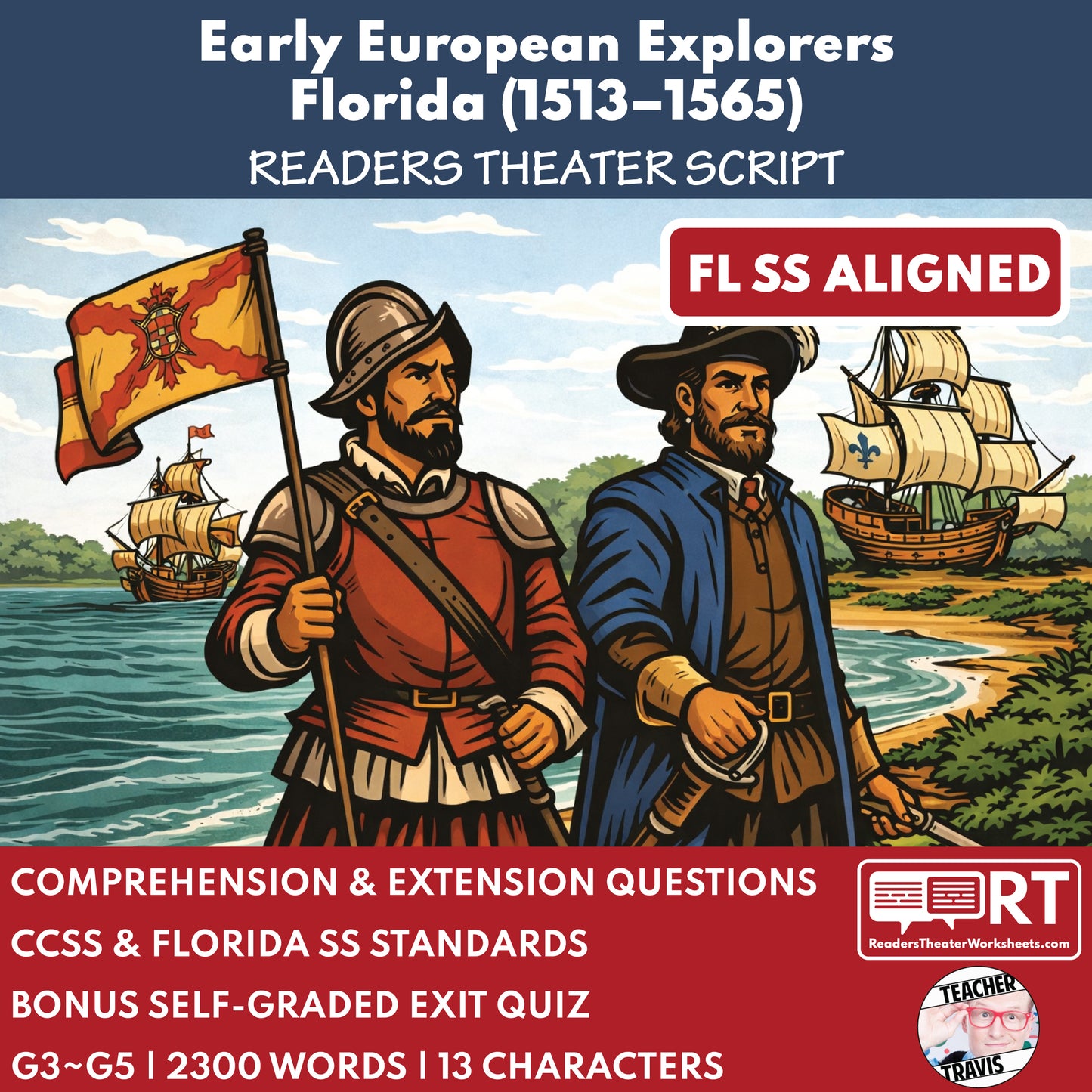
Travel through Florida’s earliest explorer era with Joel and Amanda in this exciting, 10-scene Readers Theater script for Grades 3–5. Students meet Juan Ponce de León naming “La Florida,” witness Calusa and Apalachee resistance, follow Narváez’s desperate expedition and Cabeza de Vaca’s survival story, and see Hernando de Soto’s harsh winter at Anhaica.
The script also introduces the French challenge at Fort Caroline and Spain’s response as Menéndez founds St. Augustine. This resource turns exploration into a vivid, memorable story about motives, strategy, survival, and consequences.
Perfect For
- Florida history units and standards-based instruction
- Social studies literacy blocks (RI skills in context)
- Readers Theater performances and fluency practice
- Small-group reading, discussion, and collaboration
Need more convincing?
- Get the full 8 RT Script Bundle (Click here to SAVE 40%)
- OR, try one out now! Founding of St. Augustine RT Script [FREE DOWNLOAD]
What’s Included
(a single PDF with links to Google Docs/Slides, if print format is preferred you can download from your Google Drive to word/pdf/ppt/etc)
- Student Script: Editable, ~10 pages, ~2100 words, 10 scenes, casting breakdown, student intro (DOCX/PDF/Google Doc).
- Teacher Guide: Editable, ~12 pages, lesson tips, main ideas, answer keys, standards, casting with lexical levels (DOCX/PDF/Google Doc).
- Student Worksheet: Editable, ~20 slides, vocabulary (10 terms), short-answer (10), challenge (5), optional extensions (5) (Google Slides/PPTX).
- Self-Graded Exit Quiz: 20 multiple-choice questions (Google Forms).
Teacher’s Script Summary
- A Map to 1513: Joel and Amanda travel to April 1513 as Ponce de León names Florida “La Florida” during Pascua Florida.
- The Fountain of Youth Question: The legend is discussed, but the script explains that exploration, land claims, and wealth were the real motives.
- The Calusa Stand Their Ground: In 1521, Ponce de León returns to start a colony, but the Calusa resist and he is wounded by an arrow.
- Narváez and the Search for Gold: In 1528, Narváez marches inland seeking gold, but his group loses supplies and clashes near Apalachee territory.
- Cabeza de Vaca Survives: Narváez orders boats built, storms scatter them, and Cabeza de Vaca survives and records years of struggle and learning.
- De Soto Marches Into Florida: In 1539, de Soto arrives with a large force, pushes inland, and reaches Anhaica near today’s Tallahassee.
- A Hard Winter and a First Christmas: De Soto’s camp endures winter conflict, with an early Christmas service happening during hardship and resistance.
- The French Arrive on the River of May: In 1562 Ribault claims the river for France, and in 1564 Laudonnière builds Fort Caroline for a new colony.
- Spain Strikes Back: In 1565, Menéndez founds St. Augustine and captures Fort Caroline, ending France’s foothold.
- What Motivations Really Mean: Back in 2025, characters reflect on wealth, strategy, refuge, resistance, and the lasting effects of exploration.
Standards Addressed
Florida State Standards
- Florida SS.4.A.3.1: Identify explorers who came to Florida and the motivations for their expeditions (e.g., Short Answer 1–2, 4–5, 8–10; Quiz 1–4, 10–14).
- Florida SS.4.A.3.2: Describe causes and effects of European colonization on the Native American tribes of Florida (e.g., Short Answer 3–7; Themes “Resistance and Consequences”; Quiz 5–9, 15–18).
CCSS
- RL.4.1: Refer to details and examples in a text when explaining what the text says explicitly and when drawing inferences from the text.
- RL.4.2: Determine a theme of a story, drama, or poem from details in the text; summarize the text.
- RL.4.3: Describe in depth a character, setting, or event in a story or drama, drawing on specific details in the text (e.g., a character’s thoughts, words, or actions).
- RI.4.1: Refer to details and examples in a text when explaining what the text says explicitly and when drawing inferences from the text.
- RI.4.2: Determine the main idea of a text and explain how it is supported by key details; summarize the text.
- RI.4.3: Explain events, procedures, ideas, or concepts in a historical, scientific, or technical text, including what happened and why, based on specific information in the text.
- RF.4.4: Read with sufficient accuracy and fluency to support comprehension.
- SL.4.4: Report on a topic or text in an organized manner, using appropriate facts and relevant details; speak clearly at an understandable pace.
- L.4.4: Determine or clarify the meaning of unknown and multiple-meaning words and phrases based on grade 4 reading and content, choosing flexibly from a range of strategies.
CCRA
- CCRA.R.1: Read closely to determine what the text says explicitly and to make logical inferences from it; cite specific textual evidence.
- CCRA.R.2: Determine central ideas or themes of a text and analyze their development; summarize key supporting details and ideas.
- CCRA.R.3: Analyze how and why individuals, events, and ideas develop and interact over the course of a text.
- CCRA.W.2: Write informative/explanatory texts to examine and convey complex ideas and information clearly and accurately.
- CCRA.SL.1: Prepare for and participate effectively in a range of conversations and collaborations.
- CCRA.L.4: Determine or clarify the meaning of unknown and multiple-meaning words and phrases by using context clues and word parts.
License
Single-teacher classroom license for use with your own students. Not affiliated with or endorsed by any government agency or historical site. Classroom implementation at teacher discretion.
Share