
Readers Theater Worksheets
Florida State History | Florida in the Civil War Readers Theater Script | Grades 3-5
Florida State History | Florida in the Civil War Readers Theater Script | Grades 3-5
Couldn't load pickup availability
Classroom Use at a Glance
A one-class-period Reader’s Theater script for grades 3–5 focused on Florida State History Florida in the Civil War, designed for reading fluency, content-area review, historical discussion, and quick classroom use.
Classroom Uses Fluency Practice, Small Groups, Performance Reading, Discussion, Review, Sub Plan, Content-Area Reading view all
- Fluency Practice
- Small Groups
- Performance Reading
- Discussion
- Review
- Sub Plan
- Content-Area Reading
Included Reader’s Theater Script, Teacher Guide, Student Worksheet, Answer Key, Quiz, Google Forms Quiz, Discussion Questions, Writing Prompt view all
- Reader’s Theater Script
- Teacher Guide
- Student Worksheet
- Answer Key
- Quiz
- Google Forms Quiz
- Discussion Questions
- Writing Prompt
Format PDF, DOCX, Google Docs, Google Forms, Printable, Editable view all
- DOCX
- Google Docs
- Google Forms
- Printable
- Editable
Differentiation Mixed Reading Levels, Vocabulary Support, Small-Group Support view all
- Mixed Reading Levels
- Vocabulary Support
- Small-Group Support
Overview
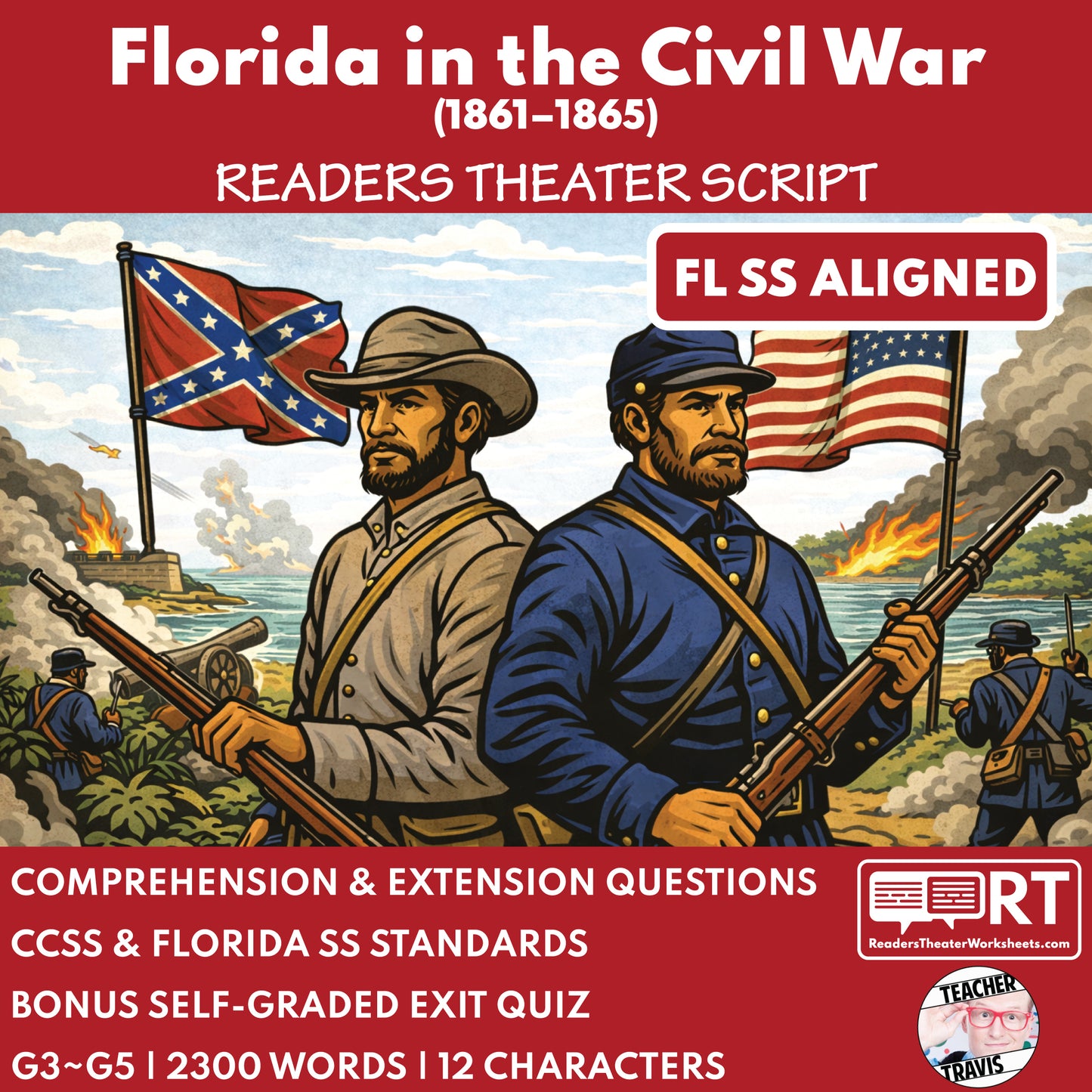
Bring Florida’s Civil War history to life with an engaging Readers Theater script for Grades 3–5 (Grade 4 language level). Join Joel and Amanda as they time-travel into the years of conflict to see how Florida’s long coastline, blockades, salt-making, cattle drives, and key battles shaped the war.
Students meet characters with different perspectives—including a Union seaman, a Florida rancher, a coastal salt-maker, an enslaved Floridian, and a young cadet defending Tallahassee at Natural Bridge—so big events connect to real people.
Perfect For
- Florida history units and standards-based instruction
- Social studies literacy blocks (RI skills in context)
- Readers Theater performances and fluency practice
- Small-group reading, discussion, and collaboration
Need more convincing?
- Get the full 8 RT Script Bundle (Click here to SAVE 40%)
- OR, try one out now! Founding of St. Augustine RT Script [FREE DOWNLOAD]
What’s Included
(a single PDF with links to Google Docs/Slides, if print format is preferred you can download from your Google Drive to word/pdf/ppt/etc)
- Student Script: Editable, ~10 pages, ~2100 words, 10 scenes, casting breakdown, student intro (DOCX/PDF/Google Doc).
- Teacher Guide: Editable, ~12 pages, lesson tips, main ideas, answer keys, standards, casting with lexical levels (DOCX/PDF/Google Doc).
- Student Worksheet: Editable, ~20 slides, vocabulary (10 terms), short-answer (10), challenge (5), optional extensions (5) (Google Slides/PPTX).
- Self-Graded Exit Quiz: 20 multiple-choice questions (Google Forms).
Teacher’s Script Summary
- A Timeline Turns to 1861: Florida joins the Confederacy, and blockades and supplies (especially salt) will shape the war in Florida.
- Florida Leaves the Union: Leaders vote to secede while an enslaved character explains that many people had no choice or voice in the decision.
- The Blockade at Sea: The Union Navy blocks Florida’s coastline and targets blockade runners; the class learns why supplies matter.
- Women and Salt on the Coast: Families boil seawater for salt, raids target salt kettles, and shortages raise prices.
- The Cow Cavalry: Ranchers protect cattle herds and keep food moving despite raids and uncertainty.
- Skirmish at Fort Brooke: Union forces strike near Tampa Bay to disrupt supplies, worsening shortages and fear.
- The Battle of Olustee: Students witness Florida’s largest battle and learn how the outcome changes what happens next.
- Occupied Towns and Hard Choices: Civilians, soldiers, and enslaved people describe raids, hunger, and difficult decisions as 1865 approaches.
- Natural Bridge Saves Tallahassee: Defenders hold a narrow crossing, keeping Tallahassee from being captured.
- May 20, 1865: A New Day: Florida surrenders; freedom is announced and enforced; characters reflect on change and unfinished problems.
Standards Addressed
Florida State Standards
- Florida SS.4.A.5.1: Students describe Florida’s involvement in the Civil War (secession, blockades, saltworks, cattle supply, Olustee, Fort Brooke, Natural Bridge) using events and examples from the script (e.g., SAQ 1–10, Quiz 1–20).
CCSS
- RL.4.1: Refer to details and examples in a text when explaining what the text says explicitly and when drawing inferences from the text.
- RL.4.2: Determine a theme of a story, drama, or poem from details in the text; summarize the text.
- RL.4.3: Describe in depth a character, setting, or event in a story or drama, drawing on specific details in the text (e.g., a character’s thoughts, words, or actions).
- RI.4.1: Refer to details and examples in a text when explaining what the text says explicitly and when drawing inferences from the text.
- RI.4.2: Determine the main idea of a text and explain how it is supported by key details; summarize the text.
- RI.4.3: Explain events, procedures, ideas, or concepts in a historical, scientific, or technical text, including what happened and why, based on specific information in the text.
- RF.4.4: Read with sufficient accuracy and fluency to support comprehension.
- SL.4.4: Report on a topic or text in an organized manner, using appropriate facts and relevant details; speak clearly at an understandable pace.
- L.4.4: Determine or clarify the meaning of unknown and multiple-meaning words and phrases based on grade 4 reading and content, choosing flexibly from a range of strategies.
CCRA
- CCRA.R.1: Read closely to determine what the text says explicitly and to make logical inferences from it; cite specific textual evidence.
- CCRA.R.2: Determine central ideas or themes of a text and analyze their development; summarize key supporting details and ideas.
- CCRA.R.3: Analyze how and why individuals, events, and ideas develop and interact over the course of a text.
- CCRA.W.2: Write informative/explanatory texts to examine and convey complex ideas and information clearly and accurately.
- CCRA.SL.1: Prepare for and participate effectively in a range of conversations and collaborations.
- CCRA.L.4: Determine or clarify the meaning of unknown and multiple-meaning words and phrases by using context clues and word parts.
Share