Readers Theater Worksheets
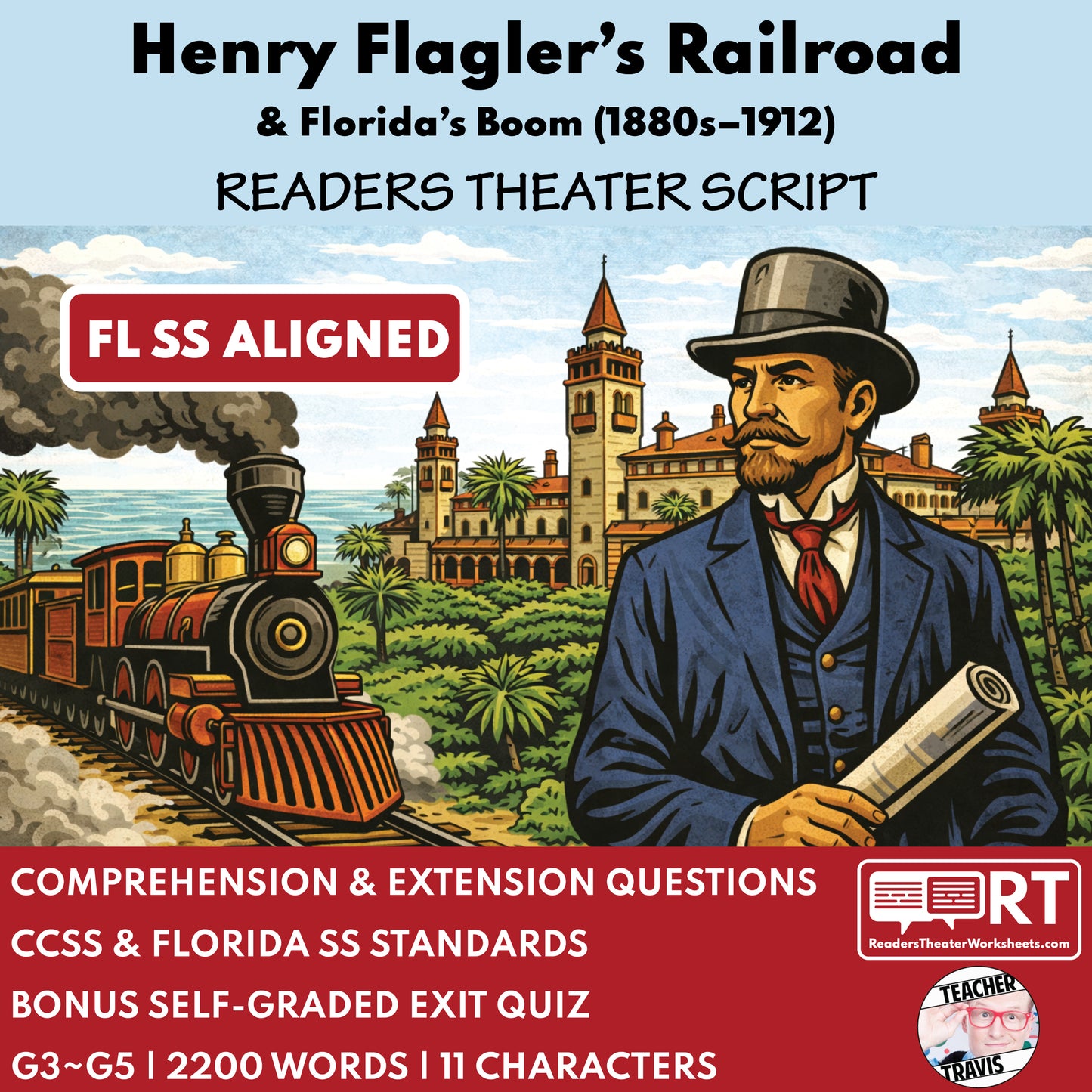
Florida State History | Henry Flagler’s Railroad and Florida’s Boom Readers Theater Script | Grades 3-5
Florida State History | Henry Flagler’s Railroad and Florida’s Boom Readers Theater Script | Grades 3-5
Couldn't load pickup availability
Classroom Use at a Glance
A one-class-period Reader’s Theater script for grades 3–5 focused on Florida State History Henry Flagler’s Railroad and Florida’s Boom, designed for reading fluency, content-area review, historical discussion, and quick classroom use.
Classroom Uses Fluency Practice, Small Groups, Performance Reading, Discussion, Review, Sub Plan, Content-Area Reading view all
- Fluency Practice
- Small Groups
- Performance Reading
- Discussion
- Review
- Sub Plan
- Content-Area Reading
Included Reader’s Theater Script, Teacher Guide, Student Worksheet, Answer Key, Quiz, Google Forms Quiz, Discussion Questions, Writing Prompt view all
- Reader’s Theater Script
- Teacher Guide
- Student Worksheet
- Answer Key
- Quiz
- Google Forms Quiz
- Discussion Questions
- Writing Prompt
Format PDF, DOCX, Google Docs, Google Forms, Printable, Editable view all
- DOCX
- Google Docs
- Google Forms
- Printable
- Editable
Differentiation Mixed Reading Levels, Vocabulary Support, Small-Group Support view all
- Mixed Reading Levels
- Vocabulary Support
- Small-Group Support
Overview
Travel back to Florida’s booming tourism era with Joel and Amanda as they discover how Henry Flagler’s hotels and railroads reshaped the state. Students tour the Ponce de León Hotel, learn how trains helped citrus farmers ship crops faster, watch Julia Tuttle help bring the railroad to Miami, and explore the risky engineering of the Overseas Railroad to Key West.
This 10-scene Readers Theater script replaces a textbook with engaging dialogue, strong vocabulary, and a built-in fairness question: who benefits, and who pays the price?
Perfect For
- Florida history units and standards-based instruction
- Social studies literacy blocks (RI skills in context)
- Readers Theater performances and fluency practice
- Small-group reading, discussion, and collaboration
Need more convincing?
- Get the full 8 RT Script Bundle (Click here to SAVE 40%)
- OR, try one out now! Founding of St. Augustine RT Script [FREE DOWNLOAD]
What’s Included
(a single PDF with links to Google Docs/Slides, if print format is preferred you can download from your Google Drive to word/pdf/ppt/etc)
- Student Script: Editable, ~10 pages, ~2100 words, 10 scenes, casting breakdown, student intro (DOCX/PDF/Google Doc).
- Teacher Guide: Editable, ~12 pages, lesson tips, main ideas, answer keys, standards, casting with lexical levels (DOCX/PDF/Google Doc).
- Student Worksheet: Editable, ~20 slides, vocabulary (10 terms), short-answer (10), challenge (5), optional extensions (5) (Google Slides/PPTX).
- Self-Graded Exit Quiz: 20 multiple-choice questions (Google Forms).
Teacher’s Script Summary
- Flagler Finds an Idea: Joel and Amanda learn that Henry Flagler’s hotels and railroad helped Florida boom, and they time-travel to the 1880s.
- A Hotel That Shocks Visitors: In St. Augustine, a luxury hotel amazes visitors with electricity, and Flagler explains why he will expand the railroad.
- Rails Create New Towns: The railroad helps farmers ship crops before they spoil, and tourists travel south to new resorts.
- Julia Tuttle Makes a Deal: Julia Tuttle convinces Flagler to bring rails farther south, and Miami grows quickly.
- “Flagler’s Folly”: Skeptics doubt the plan to reach Key West, but engineers plan bridges and warn that hurricanes are a serious threat.
- Working on the Sea Railroad: Workers endure heat, insects, accidents, and storms; after hurricanes, crews repair and continue.
- The Seven Mile Bridge: The bridge feels like it floats above the ocean, showing engineering skill and danger.
- The First Train to Key West: The first train arrives, connecting a port city to the mainland.
- Boom and Consequences: Tourism and towns grow, but growth affects environments and workers often get less credit than rich leaders.
- Legacy on the Map: In 2025, students connect the legacy to Flagler College, the Overseas Highway, and the question of who benefits and who pays the price.
Standards Addressed
Florida State Standards
- Florida SS.4.A.6.3: Students describe the contributions of Henry Flagler to Florida’s development through railroads, hotels, and tourism (e.g., SAQ 1–10, Quiz 1–20, Themes: Growth/Innovation).
CCSS
- RL.4.1: Refer to details and examples in a text when explaining what the text says explicitly and when drawing inferences from the text.
- RL.4.2: Determine a theme of a story, drama, or poem from details in the text; summarize the text.
- RL.4.3: Describe in depth a character, setting, or event in a story or drama, drawing on specific details in the text (e.g., a character’s thoughts, words, or actions).
- RI.4.1: Refer to details and examples in a text when explaining what the text says explicitly and when drawing inferences from the text.
- RI.4.2: Determine the main idea of a text and explain how it is supported by key details; summarize the text.
- RI.4.3: Explain events, procedures, ideas, or concepts in a historical, scientific, or technical text, including what happened and why, based on specific information in the text.
- RF.4.4: Read with sufficient accuracy and fluency to support comprehension.
- SL.4.4: Report on a topic or text in an organized manner, using appropriate facts and relevant details; speak clearly at an understandable pace.
- L.4.4: Determine or clarify the meaning of unknown and multiple-meaning words and phrases based on grade 4 reading and content, choosing flexibly from a range of strategies.
CCRA
- CCRA.R.1: Read closely to determine what the text says explicitly and to make logical inferences from it; cite specific textual evidence.
- CCRA.R.2: Determine central ideas or themes of a text and analyze their development; summarize key supporting details and ideas.
- CCRA.R.3: Analyze how and why individuals, events, and ideas develop and interact over the course of a text.
- CCRA.W.2: Write informative/explanatory texts to examine and convey complex ideas and information clearly and accurately.
- CCRA.SL.1: Prepare for and participate effectively in a range of conversations and collaborations.
- CCRA.L.4: Determine or clarify the meaning of unknown and multiple-meaning words and phrases by using context clues and word parts.
Share