
Readers Theater Worksheets
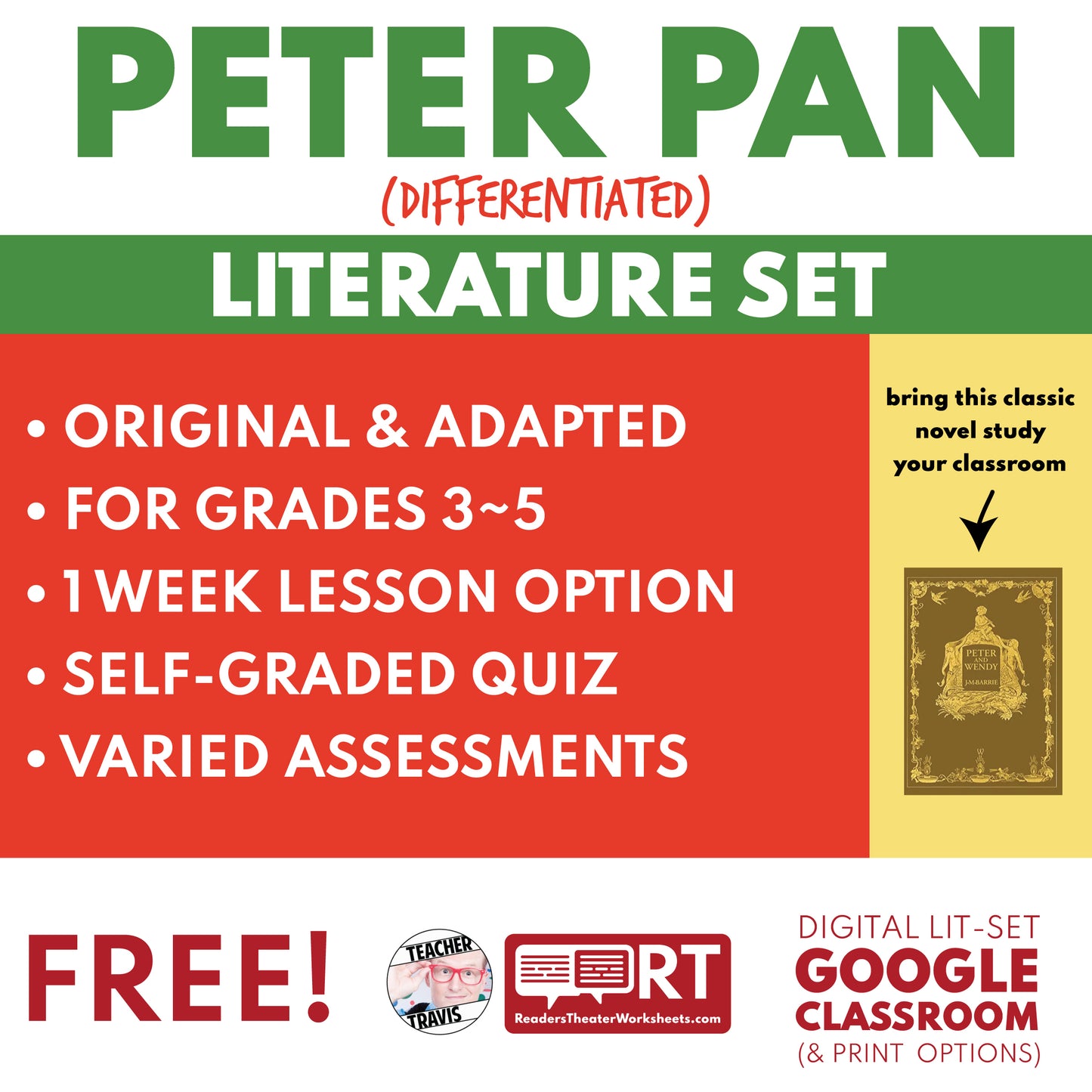
Free Adapted Peter Pan Differentiated Novel Study | ELA Unit | Literature Set for Grades 3 to 5
Free Adapted Peter Pan Differentiated Novel Study | ELA Unit | Literature Set for Grades 3 to 5
Couldn't load pickup availability
Classroom Use at a Glance
A differentiated literature study guide for grades 3–5 using Adapted Peter Pan. Built to support mixed reading levels, close reading, vocabulary, discussion, assessment, and no-prep ELA instruction.
Classroom Uses Close Reading, Discussion, Assessment, Whole Class, Homework, Sub Plan view all
- Close Reading
- Discussion
- Assessment
- Whole Class
- Homework
- Sub Plan
Included Original Text, Leveled Text, Teacher Guide, Student Worksheet, Answer Key, Quiz, Google Forms Quiz, Vocabulary, Discussion Questions, Writing Prompt view all
- Original Text
- Leveled Text
- Teacher Guide
- Student Worksheet
- Answer Key
- Quiz
- Google Forms Quiz
- Vocabulary
- Discussion Questions
- Writing Prompt
Format PDF, DOCX, Google Docs, Google Forms, Online Library Access, Printable, Editable, ZIP Download view all
- DOCX
- Google Docs
- Google Forms
- Online Library Access
- Printable
- Editable
- ZIP Download
Differentiation Original Version, Leveled Version, Mixed Reading Levels, Vocabulary Support, Struggling Readers, Advanced Readers view all
- Original Version
- Leveled Version
- Mixed Reading Levels
- Vocabulary Support
- Struggling Readers
- Advanced Readers
Teachers run into this problem all the time: you want your students to experience classic literature, but you do not have weeks (or months) to push through a 47,000-word novel with mixed reading levels in the room.
Here’s the solution: a differentiated novel study, or “digital lit-set.” This resource gives you both the complete original J. M. Barrie text (public domain) and a tightly adapted 5-part, one-week version at about 10,300 words—roughly 1/4th the original length. This dual-track design lets you match the reading path to every student without changing your assessments or losing instructional time. The adapted and original versions line up part-for-part using a clean chapter mapping (Parts 1–5). Every discussion question, multiple-choice exit quiz, short-answer item, challenge question, and vocabulary word works for both tracks. Mixed-ability classrooms can finally stay on the same scenes, ideas, and themes—even when reading different versions of the text.
SAVE 40% and get the full bundle of 10 Digital Lit Sets here : )
Perfect for a Peter Pan mini-reader unit in Grades 3–5, this resource supports CCSS reading, speaking/listening, language, and written response skills while keeping the pacing realistic for real classrooms.
Quick Guide for Teachers
Adapted-Only Track (Fastest: 5-Day Model)
- Best for Grades 3–5 classes that need a manageable, one-week novel experience.
- Day 1–5: Students read one adapted part per day and use the matching Main Ideas & Themes Discussion Questions and self-grading multiple-choice quiz.
- End the week with the Final Worksheet (Vocabulary Words, Short Answer Questions, and Challenge Questions).
- This track keeps lessons tight, predictable, and complete in five days.
Original-Only Track (Longer: Multi-Day Per Section)
- Ideal for stronger readers or classes ready for Barrie’s original language and sentence structure.
- Students read the original chapters aligned to each adapted Part (I–IV, V–VII, VIII–X, XI–XIII, XIV–XVII).
- Use the same Discussion Questions, MC exit quizzes, and Final Worksheet; all items are text-accurate for both versions.
- Vocabulary Words (10) are usable for both tracks, because each word appears in both the adapted text and the corresponding original chapters.
- This track preserves the full descriptive style and classic voice while giving you ready-made, age-appropriate assessments.
Dual-Track Differentiation (Mixed Readers, Flexible Timelines)
- Lets your entire class study the same plot, scenes, and themes at the same time—even when some students need the adapted text and others handle the full novel.
- Assign adapted Part 1 to students who need a shorter, clearer text and original Chapters I–IV to students reading the full text; repeat this pattern through Parts 2–5 (timing will depend on your classroom's reading level)
- Give original-text students multiple days per section while adapted-text students reread key scenes, complete vocabulary tasks, and tackle discussion questions in pairs or small groups.
- All assessments are usable for both tracks: Discussion Questions, MC Exit Quizzes for each Part, and the Final Worksheet (Vocabulary, Short Answer, and Challenge Questions).
What’s the Tradeoff of Using the Adapted Version?
Pros
- Reduces the novel to a fraction of its original length, fitting neatly into a one-week unit.
- Well suited for shorter attention spans and developing readers in Grades 3–5.
- Preserves core narrative elements, characters, and themes: the pull between adventure and home, the costs of never growing up, and the power of stories and family.
- Far better than skipping the book entirely due to time limits or reading-level concerns.
- Works for whole-class read-alouds, small-group novel studies, independent reading, or focused close-reading lessons.
Cons
- Omits some original language, side scenes, and descriptive passages for brevity, so students do not see every nuance of Barrie’s style.
- Leaves fewer opportunities for deep line-by-line stylistic analysis than a full-length, multi-week novel study.
Bottom Line
If you have the time and budget, nothing beats the feel of a real paperback in every student’s hands. But when time, copies, and reading levels are real constraints, a digital literature set like this—adapted text + original text mapping + shared assessments—lets you bring this classic novel into your classroom instead of leaving it on the “maybe someday” shelf. If you were to buy traditional paperbacks at about $7 per book for 30 students, that is a $210 investment. This digital lit-set gives you a reusable, print-friendly alternative you can adapt for many years and multiple groups.
This product includes a zip file consisting of
NOTE: All files are editable and include (PDF, DOCX, PPTX, Google Docs/Slides/Forms)
Full Original Text
Full Original Text: ~47,000 words | 6.0 Flesch-Kincaid GL
- Lexile Ranges: ~800L – 1000L | CEFR ~B1
- Great for advanced Grade 4–5 readers, enrichment or extension groups, or guided novel studies that allow time for discussion and vocabulary support.
-
BONUS: Free Access to the text on our LEVELED-LIT CLASSICS Library Platform.
Adapted Version Text
Adapted Version Text: ~10,300 words | 5.1 Flesch-Kincaid GL
- Lexile Ranges: ~700L – 900L | CEFR ~A2+ / low B1
- On-level Grade 4–5 readers
- Supported Grade 3 readers
- Divided into 5 parts for easy daily reading sessions
- *Both versions tell the same story, allowing students to participate in shared discussions even when reading different texts.
Student Final Worksheet/Quizzes (PPTX, Google Slides/Forms)
- 10 Vocabulary Words
- 10 Short Answer Recall/Comprehension
- 5 Challenge Questions (synthesis, analysis, themes, real life connection)
- 5 Multiple Choice Quizzes (20 Questions) (1 per part)
Teacher’s Guide & Answer Key (PDF, DOCX, Google Docs)
- 5 Sets of Daily Discussion Questions (1 per part)
- 5 Sets of Self-Graded Exit Quizzes (1 per part, 20Qs each)
- Answer Keys for Vocab, Short Answer, and Challenge Questions
- Key Figures & Places reference sheets to help students track characters and settings
- Text Summary (Adapted Version)
Text Summary (Adapted Version)
- Part 1 – From the Nursery to the Neverland Skies: The Darling family in London lives a mostly ordinary life until Mrs. Darling grows suspicious of a mysterious boy named Peter who slips in and out of the nursery at night. One evening, Peter and Tinker Bell enter the nursery, recover his lost shadow, and meet Wendy, John, and Michael. Peter teaches the children to fly and invites them to the Neverland, and they finally leave their beds and soar out into the night toward “the land second to the right and straight on till morning.”
- Part 2 – The Lost Boys’ New “Mother”: The children arrive in the Neverland amid swirling dangers—pirates, native warriors, wild beasts, and mermaids all circling the island. Because of Tinker Bell’s jealousy, Wendy is accidentally shot out of the sky, and the Lost Boys hurriedly build her a little house and nurse her back to health. As she recovers, Wendy becomes “mother” to the boys in their underground home, bringing stories, rules, chores, and make-believe dinners that turn wild playmates into something more like a family.
- Part 3 – Adventures on the Lagoon and the Night of Nights: Life in the Neverland expands into bigger, riskier adventures at the mermaids’ lagoon, where Peter rescues Tiger Lily from drowning and barely escapes a deadly rising tide with the help of the Never bird. These brave acts win the friendship of Tiger Lily’s warriors, who begin guarding the underground home while Hook and his pirates plot revenge in the shadows. As the “Night of Nights” approaches, the island grows tense and watchful, and everyone senses a major clash is coming.
- Part 4 – Homesick Stories and Deadly Plans: Wendy’s storytelling deepens, especially when she describes Mr. and Mrs. Darling, Nana, and the children who flew away from their London nursery. Her tales comfort the boys at first but slowly make everyone homesick and convince her that it is time to return home. Hidden nearby, Hook overhears these plans, captures the children on their way back, and leaves a poisoned “present” for Peter in the underground home. Tinker Bell drinks the poison to save Peter’s life, and the children’s belief in fairies becomes the power that brings her back.
- Part 5 – The Pirate Ship, the Return, and Growing Up: On the Jolly Roger, Hook lines up the captured children and offers them the cruel choice of joining his crew or walking the plank. Peter sneaks aboard, rescues the boys, and finally defeats Hook in a fierce duel that ends with the captain falling to the waiting crocodile. The children sail the pirate ship home to London, where the Darlings joyfully welcome them and adopt the Lost Boys, while Peter remains outside the window, shut out of the one joy he can never keep. An epilogue shows Wendy growing up and her daughter (and granddaughter) taking turns flying away with Peter, revealing the bittersweet truth that he never grows up, even as the children he loves move forward into their own lives.
Frequently Asked Questions About the Adapted Peter Pan Novel Study
How can I use adapted Peter Pan for reluctant or younger readers?
The 5-part adapted version (about 10,300 words, FK ≈ 5.1) is broken into one part per day with built-in discussion questions and self-grading quizzes. This structure lets you monitor comprehension and engagement without overwhelming readers who are still building stamina.
Is this Peter Pan novel study aligned with CCSS for Grades 3–5?
Yes. The unit supports RL.3–5, SL.3–5, L.3–5, and related anchor standards through close reading, text-based discussion, vocabulary work, and written responses grounded in both the adapted and original texts.
Can I use this for differentiated Peter Pan instruction?
Absolutely. The dual-track design (original + adapted + shared assessments) is built for mixed-ability classrooms. Strong readers can tackle the original chapters while developing readers work with the adapted parts. Everyone stays in sync on scenes, characters, and themes, and you only manage one set of assessments.
This single classical literature reading resource gives you a complete, no-prep, one-week core unit for teaching Peter Pan in manageable, high-engagement steps—preserving Barrie’s story while making it teachable in real classrooms with real time limits.
Standards
Reading Literature: CCSS RL.3-5.1, CCSS RL.3-5.2, CCSS RL.3-5.3, CCSS RL.3-5.4, CCSS RL.3-5.5, CCSS RL.3-5.6; CCRA.R.1, CCRA.R.2, CCRA.R.3, CCRA.R.4, CCRA.R.5, CCRA.R.6
Writing: CCSS W.3-5.2; CCRA.W.2
Speaking & Listening: CCSS SL.3-5.1; CCRA.SL.1
Share