

Readers Theater Worksheets
Georgia State History | Georgia Expansion, Cotton, Railroads, and Native Removal RT Script & Mini Readers | Grades 3-5
Georgia State History | Georgia Expansion, Cotton, Railroads, and Native Removal RT Script & Mini Readers | Grades 3-5
Couldn't load pickup availability
Classroom Use at a Glance
A Grade 4-centered Georgia State History lesson for grades 3–5 on Georgia expansion, cotton gin, railroads, Native removal, Worcester v Georgia, Treaty of New Echota with a 10-scene Reader’s Theater, two differentiated Mini Readers, and shared assessments.
Classroom Uses Whole Class, Small Groups, Fluency Practice, Content-Area Reading, Discussion, Assessment, Review view all
- Whole Class
- Small Groups
- Fluency Practice
- Content-Area Reading
- Discussion
- Assessment
- Review
Included Reader’s Theater Script, Original Mini Reader, Accessible Mini Reader, Teacher Guide, Student Worksheet, Answer Key, Quiz, Google Forms Quiz, Vocabulary, Discussion Questions, Challenge Questions view all
- Reader’s Theater Script
- Original Mini Reader
- Accessible Mini Reader
- Teacher Guide
- Student Worksheet
- Answer Key
- Quiz
- Google Forms Quiz
- Vocabulary
- Discussion Questions
- Challenge Questions
Format DOCX, Google Forms, ZIP Download, Printable, Editable view all
- DOCX
- Google Forms
- ZIP Download
- Printable
- Editable
Differentiation Accessible Version, Original Version, Mixed Reading Levels, ELL Support, Struggling Readers, Vocabulary Support, Small-Group Support view all
- Accessible Version
- Original Version
- Mixed Reading Levels
- ELL Support
- Struggling Readers
- Vocabulary Support
- Small-Group Support
Bring Georgia State History to life with a Grade 4-centered Reader’s Theater script and two differentiated Mini Readers for grades 3–5. Why does Georgia’s 1840s map look so different from its early-state map, and which changes pushed the next changes?
Students trace land distribution and westward settlement, cotton expansion and enslaved labor, Muscogee and Cherokee homelands, roads and treaties, the Georgia gold rush, Worcester v. Georgia, the Treaty of New Echota, forced removal, railroad growth, and Atlanta’s rise as a transportation center.
Lesson 5 of the 10-lesson Georgia State History bundle. Explore the complete Georgia State History 10-Lesson Bundle here.
View the Full 10-Lesson Georgia Bundle
Classroom Use
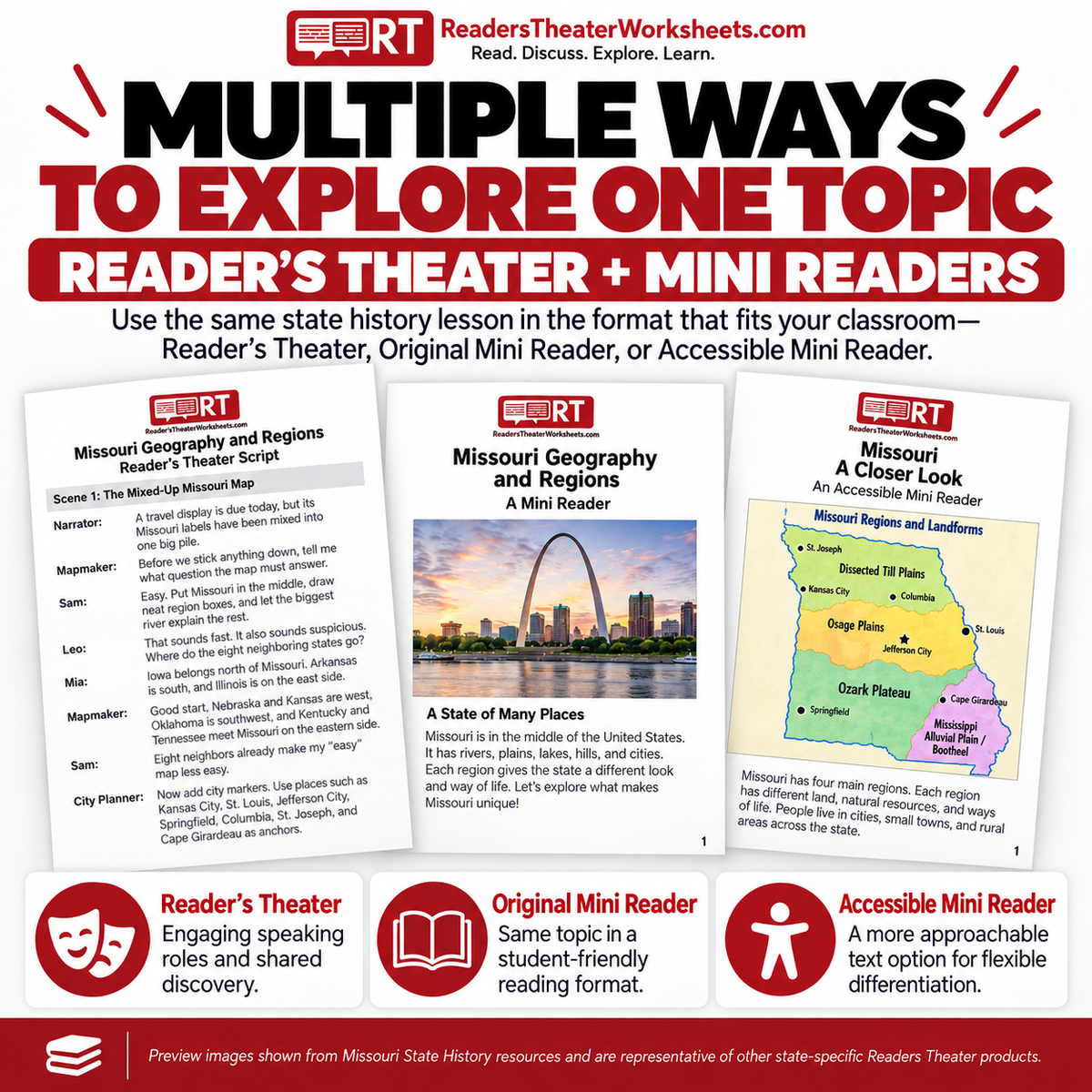
Use the Reader’s Theater for whole-class performance, partner or small-group fluency practice, content-area reading, discussion, review, sub plans, or assessment. The included Original and Accessible Mini Readers let students work from different reading paths while studying the same core history.
What’s Included
- 10-scene Reader’s Theater Script
- Original Mini Reader
- Accessible Mini Reader
- Teacher Guide and answer keys
- Vocabulary, 10 Short Answer questions, and 5 Challenge questions
- 20-question multiple-choice quiz
- Digital and print worksheet options
- Self-graded Google Forms quiz
- Pre-reading and post-reading discussion questions
Standards Alignment
The Teacher Guide positions this resource as Grades 3–5 Georgia-history enrichment with Grade 4 as the instructional/readability center. Documented Georgia standards connections include SS8H4, SS8H4.a, SS8H4.b, SS8H4.c, SS8H4.d, SS8H4.e, SS4H3.b, SS4E1.b, SS4E1.d, SS4E1.f. The Teacher Guide states the exact scope and any partial-alignment limits.
Perfect For
- Georgia history and social studies enrichment in grades 3–5
- Grade 4 content-area reading and fluency practice
- Whole class, small groups, centers, intervention, review, or sub plans
- Teachers who need a lower-writing assessment option alongside written response choices
Flexible Differentiation
All three student reading paths teach the same core history and support the same formal assessment questions. Teachers can use the Reader’s Theater for performance, the Original Mini Reader for independent reading, or the Accessible Mini Reader for shorter sentences and more explicit transitions.
Skills
Reading fluency, vocabulary in context, comprehension, text evidence, historical thinking, cause and effect, compare and contrast, discussion, and writing.
Text Summary
Students trace land distribution and westward settlement, cotton expansion and enslaved labor, Muscogee and Cherokee homelands, roads and treaties, the Georgia gold rush, Worcester v. Georgia, the Treaty of New Echota, forced removal, railroad growth, and Atlanta’s rise as a transportation center.
Share