Readers Theater Worksheets
Halloween Reader's Theater | The Great Halloween Parade Debate | 14 Roles | Grades 3-5 FREE
Halloween Reader's Theater | The Great Halloween Parade Debate | 14 Roles | Grades 3-5 FREE
Couldn't load pickup availability
Classroom Use at a Glance
A free whole-class Halloween Reader's Theater for grades 3-5 with a 10-scene script, 14 meaningful roles, scalable casting for up to 30 students, two Mini Readers, assessments, and self-grading quiz support.
Classroom Uses Whole Class, Fluency Practice, Discussion, Assessment, Review, Enrichment, Performance Reading view all
- Whole Class
- Fluency Practice
- Discussion
- Assessment
- Review
- Enrichment
- Performance Reading
Included Reader’s Theater Script, Original Mini Reader, Accessible Mini Reader, Teacher Guide, Student Worksheet, Answer Key, Quiz, Google Forms Quiz, Vocabulary, Discussion Questions, Challenge Questions view all
- Reader’s Theater Script
- Original Mini Reader
- Accessible Mini Reader
- Teacher Guide
- Student Worksheet
- Answer Key
- Quiz
- Google Forms Quiz
- Vocabulary
- Discussion Questions
- Challenge Questions
Format DOCX, Google Docs, Google Slides, Google Forms, PowerPoint, ZIP Download, Printable, Editable view all
- DOCX
- Google Docs
- Google Slides
- Google Forms
- PowerPoint
- ZIP Download
- Printable
- Editable
Differentiation Accessible Version, Original Version, Mixed Reading Levels, ELL Support, Struggling Readers, Advanced Readers, Vocabulary Support, Small-Group Support view all
- Accessible Version
- Original Version
- Mixed Reading Levels
- ELL Support
- Struggling Readers
- Advanced Readers
- Vocabulary Support
- Small-Group Support
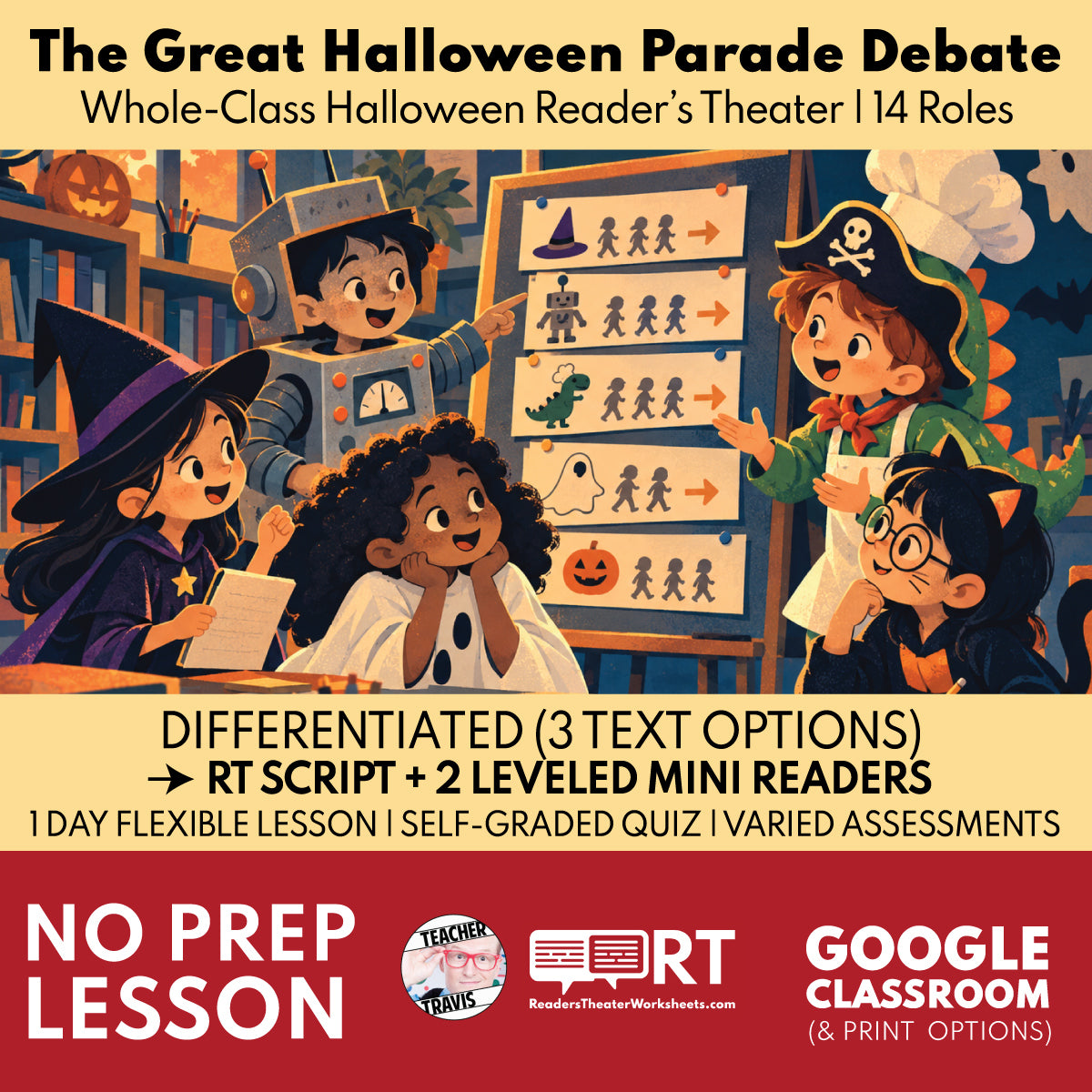
Bring the whole class into one shared Halloween performance with a free, no-prep Reader's Theater built around 14 meaningful speaking roles. The Great Halloween Parade Debate gives grades 3-5 students a playful fairness problem to solve while they practice oral reading, comprehension, text evidence, perspective taking, and discussion.
Fourteen students are minutes away from a school Halloween parade when a simple question—who goes first?—reveals that nobody agreed on fair parade rules. The group tests first-arrival order, costume judging, categories, effort, and even a no-awards solution. Each idea creates a new problem until the students identify the parade's purpose and build a plan that allows participation without forcing everyone to be judged.
Classroom Use
The 10-scene script has 14 recurring roles and is designed for one shared large-cast performance. The Teacher Guide explains how to keep the same story intact with 15-30 students by splitting narrator blocks or using co-readers and role teams instead of token one-line parts. No costumes or props are required.
What's Included
- 10-scene Reader's Theater script with 14 speaking roles
- Whole-class casting and expansion guidance for 14-30 students
- Original Mini Reader
- Accessible Mini Reader
- 10 vocabulary terms in context
- 10 two-part Short Answer questions
- 5 two-part Challenge questions
- 20-question multiple-choice quiz with teacher answer key
- Self-grading Google Forms quiz support
- Teacher Guide, discussion prompts, differentiation, and pacing guidance
Differentiation
Assign shorter-turn roles or rehearse early scene entries for students who need support, preview the four plot anchors for multilingual/developing readers, and extend Grades 4-5 students with rule comparison, evidence-based revision, and central-message work. The same assessed story is also available in Original and Accessible Mini Readers.
Standards & Skills
The Teacher Guide documents Grade 3 CCSS connections including RL.3.1, RL.3.2, RL.3.3, RL.3.4, RF.3.4.b, and SL.3.1, with corresponding Grade 4-5 extension use. Students practice fluency, comprehension, text evidence, character thinking, cause/effect, comparison, inference, theme, perspective taking, and discussion.
Text Summary
The Great Halloween Parade Debate follows fourteen students preparing for a school Halloween parade. A simple question-who goes first-reveals that the class never agreed on fair parade rules. The students test first-arrival order, costume judging, categories, effort, and an all-or-nothing no-awards solution. Each idea creates a new problem. Lena explains that she wants to participate without having her costume scored, and Priya asks what the parade is actually for. The group identifies the event's purposes, creates a random order with optional positive recognition, and stress-tests the new plan against difficult examples. The story ends when Marcus realizes his pirate-dinosaur-chef costume does not need a category at all; today, it belongs in the parade.
Share