
Readers Theater Worksheets
Holiday & Seasons Poetry Mini Unit | Differentiated Study Guide & Analysis | 12 Classics for Grades 9 to 12
Holiday & Seasons Poetry Mini Unit | Differentiated Study Guide & Analysis | 12 Classics for Grades 9 to 12
Couldn't load pickup availability
Classroom Use at a Glance
A no-prep differentiated study guide for Holiday & Seasons Poetry Mini Unit. Includes reading support, comprehension and analysis activities, quiz materials, and teacher-ready classroom materials for mixed-ability ELA classes.
Classroom Uses Sub Plan, Small Groups, Close Reading, Discussion, Assessment, Review, Enrichment, Intervention, Homework view all
- Sub Plan
- Small Groups
- Close Reading
- Discussion
- Assessment
- Review
- Enrichment
- Intervention
- Homework
Included Original Text, Leveled Text, Teacher Guide, Student Worksheet, Quiz, Google Forms Quiz, Answer Key, Vocabulary, Discussion Questions, Writing Prompt view all
- Original Text
- Leveled Text
- Teacher Guide
- Student Worksheet
- Quiz
- Google Forms Quiz
- Answer Key
- Vocabulary
- Discussion Questions
- Writing Prompt
Format PDF, DOCX, Google Docs, Google Forms, Online Library Access, Printable, Editable view all
- DOCX
- Google Docs
- Google Forms
- Online Library Access
- Printable
- Editable
Differentiation Original Version, Leveled Version, Accessible Version, Mixed Reading Levels, Vocabulary Support, Struggling Readers, Advanced Readers view all
- Original Version
- Leveled Version
- Accessible Version
- Mixed Reading Levels
- Vocabulary Support
- Struggling Readers
- Advanced Readers
PROBLEM: Poetry units can break down in real classrooms because older poems often include archaic syntax, dialect, and challenging vocabulary. When students read at different levels, teachers end up reteaching constantly or simplifying so much that tone, imagery, and craft get lost.
SOLUTION: This differentiated poetry study guide for Seasonal Poems Unit solves that problem by giving you both the complete original poems and a close-verse adapted version. The adaptation preserves stanza structure and line flow while smoothing word order and swapping difficult vocabulary so students can read more smoothly and focus on meaning and craft.
Flexible use: Teach it as a complete one-week poetry unit (Days 1–5), or use individual Parts as seasonal mini-units—Fall/Thanksgiving (Day 1), Halloween (Day 2), Winter journeys (Day 3), Christmas/holiday classics (Day 4), and Spring renewal (Day 5).
Dual-track assurance: Every discussion prompt, quiz item, and short-answer question is designed to be answerable from the adapted poem text while still mapping cleanly to the corresponding original poems for extension reading and evidence practice.
Perfect for: Grades 9–10 ELA, inclusion and intervention support inside core instruction, literature circles, seasonal lesson weeks, sub plans, and repeatable close-reading routines.
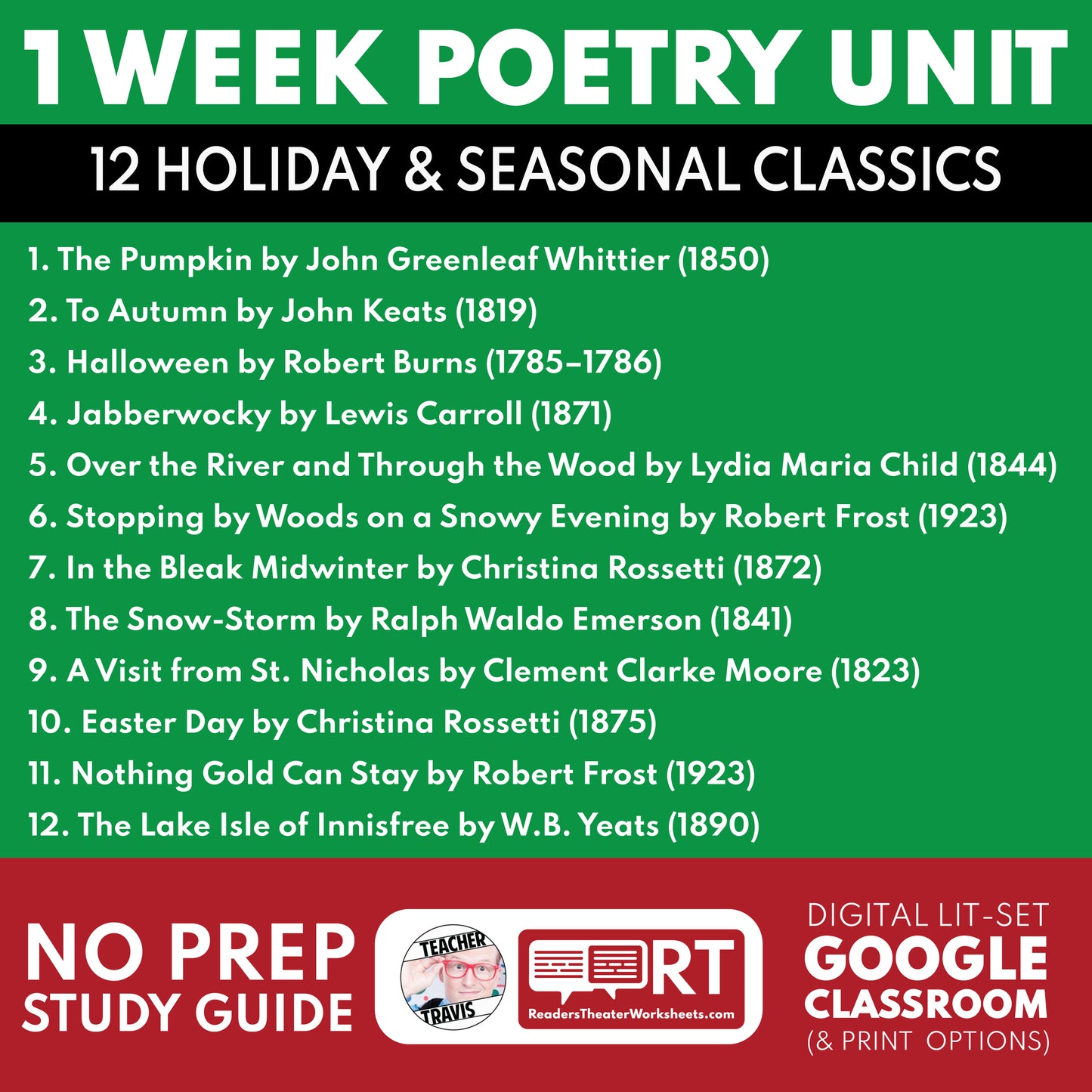
1 Week Summary
Day 1 — Fall Harvest & Sensory Abundance
- The Pumpkin (John Greenleaf Whittier, 1850)
- To Autumn (John Keats, 1819)
- Focus: Autumn abundance is celebrated through rich sensory imagery—food, harvest scenes, ripening fruit, and “mellow” seasonal tone—showing how poets build atmosphere through sight, taste, sound, and texture.
Day 2 — Autumn Folklore, Whimsy & Nostalgia
- Halloween (Robert Burns, 1785–1786)
- Jabberwocky (Lewis Carroll, 1871)
- Focus: Autumn imagination and tradition are explored through contrasting styles—Burns’s community folklore and customs paired with Carroll’s playful nonsense adventure—so students study dialect, invented language, rhythm, and narrative fun.
Day 3 — Winter Journeys & Quiet Contemplation
- Over the River and Through the Wood (Lydia Maria Child, 1844)
- Stopping by Woods on a Snowy Evening (Robert Frost, 1923)
- In the Bleak Midwinter (Christina Rossetti, 1872)
- Focus: Winter mood shifts across three voices—cheerful travel and anticipation, a quiet pause in snowy woods, and a hymn-like meditation—helping students track tone changes, reflective turns, and how sound and stillness shape meaning.
Day 4 — Winter Mood & Holiday Classics
- The Snow-Storm (Ralph Waldo Emerson, 1841)
- A Visit from St. Nicholas (Clement Clarke Moore, 1823)
- Focus: Winter wonder is shown in two forms—nature’s “architecture” and wild artistry versus human warmth and holiday tradition—inviting craft analysis of description, pacing, and imagery.
Day 5 — Renewal, Transience & Hopeful Close
- Easter Day (Christina Rossetti, 1875)
- Nothing Gold Can Stay (Robert Frost, 1923)
- The Lake Isle of Innisfree (W.B. Yeats, 1890)
- Focus: The unit closes with renewal and reflection—resurrection joy, fleeting beauty, and a longing for peace—so students compare how poets express hope, impermanence, and restoration through concise language and vivid images.
Quick Guide for Teachers
Adapted-Only Track (Fastest: 5-Day Model)
- Best for Grades 8–12 classes that need accessible language while keeping mature themes.
- Day 1–5: Students read the adapted versions of the two poems for the day and complete the matching Main Ideas & Themes Discussion Questions and the 12-question self-grading exit quiz.
- End the week with the Final Worksheet (Vocabulary Words, Short Answer Questions, and Challenge Questions).
- This track keeps the unit tight, predictable, and finishable in one week.
Original-Only Track (5-Day Close Reading)
- Ideal for strong readers or classes ready for original diction and syntax.
- Day 1–5: Students read the original poems for the day and use the same Discussion Questions, exit quizzes, and Final Worksheet—because all items are built on shared meaning, imagery, and argument moves present in both versions.
- Vocabulary Words (10) work for this track because each word appears in both the adapted and original texts.
Dual-Track Differentiation
- Use the same Day 1–5 schedule for everyone.
- Assign the adapted poems to supported readers and the original poems to advanced readers.
- All students complete the same Discussion Questions, daily exit quiz, and Final Worksheet because prompts target analysis that transfers across both versions (tone, symbolism, speaker stance, and thematic claim).
- If original-text readers need extra time, they can extend with annotation targets and evidence-based responses while adapted-text readers reread, strengthen vocabulary work, and draft higher-quality analytical answers.
This product includes a zip file consisting of:
NOTE: All files are editable and include (PDF, DOCX, PPTX, Google Docs/Slides/Forms)
Full Original Text: ~3,800 words | 10.0 Flesch-Kincaid GL
- Lexile Ranges: ~1050L - 1335L | CEFR ~B1 – C1
- Great for Grades 9–12 readers, high school core texts and literature circles.
Adapted Text: ~3,800 words | 9.5 Flesch-Kincaid GL
- Lexile Ranges: ~1050L - 1335L | CEFR ~B1 – C1
- Great for Grades 8-12 readers who need support.
- Supported readers who need a shorter, clearer text with the same central images, themes, and assessment alignment.
- Both versions cover the same ideas so students can join shared discussions even when reading different texts.
Student Final Worksheet/Quizzes (PPTX, Google Slides/Forms)
- 10 Vocabulary Words
- 10 Short Answer Recall/Comprehension
- 5 Challenge Questions (synthesis, analysis, themes, real life connection)
- 5 Multiple Choice Quizzes (12 Questions per day)
Teacher’s Guide & Answer Key
- 5 Sets of Daily Discussion Questions (1 per part)
- 5 Sets of Self-Graded Exit Quizzes (1 per part, 12Qs each)
- Answer Keys for Vocab, Short Answer, and Challenge Questions
- Key Figures & Places reference sheets to help students track characters and settings
How can I confirm the quality of this resource? WANT MORE?
FREE BONUS ALERT!
- Free Access Code to the text on the Leveled-Lit Classics Library!
Frequently Asked Questions
Can I use this as seasonal mini-units instead of a full week?
Yes. Each Day/Part is self-contained with poems, discussion questions, a 12-question exit quiz, and two short answers.
Do students have to read both versions?
No. Students can read the original, the adapted, or both. The last two quiz questions each day are optional comparison items if students read both.
How long does one Part take?
Most Parts fit in one class period; Day 3 and Day 5 can be stretched to two periods if you want deeper discussion or more rereading.
Share