
Readers Theater Worksheets
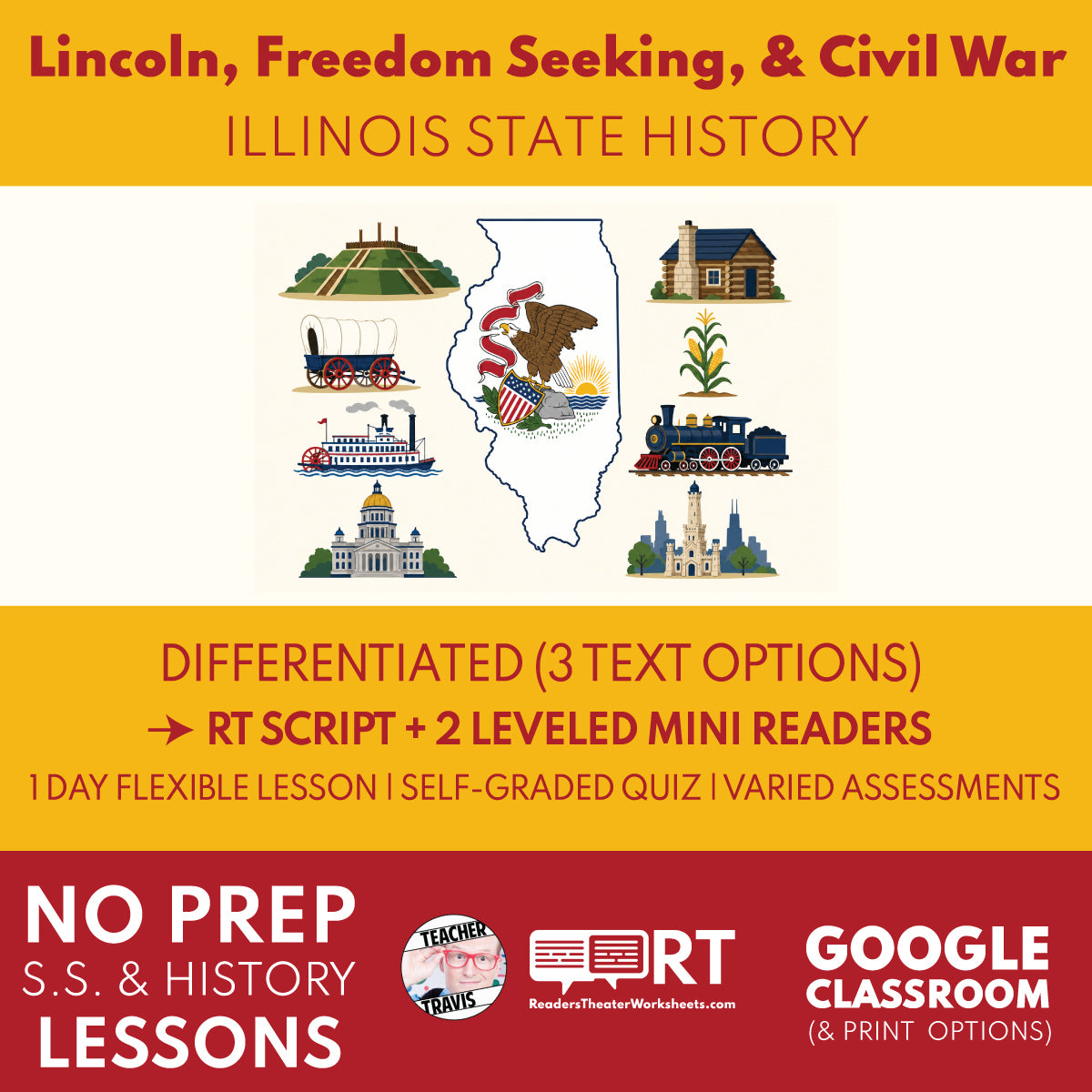
Illinois State History | Lincoln, Freedom Seeking, and Civil War RT Script and Mini Readers | Grades 3-5
Illinois State History | Lincoln, Freedom Seeking, and Civil War RT Script and Mini Readers | Grades 3-5
Couldn't load pickup availability
Classroom Use at a Glance
An Illinois State History lesson for grades 3–5 on Frank McWorter and New Philadelphia, Jameson Jenkins, John Jones, Lincoln-Douglas debates, freedom seeking, Illinois in the Civil War and USCT with three reading paths and shared assessments.
Classroom Uses Whole Class, Small Groups, Fluency Practice, Content-Area Reading, Discussion, Assessment, Review view all
- Whole Class
- Small Groups
- Fluency Practice
- Content-Area Reading
- Discussion
- Assessment
- Review
Included Reader’s Theater Script, Original Mini Reader, Accessible Mini Reader, Teacher Guide, Student Worksheet, Answer Key, Quiz, Google Forms Quiz, Vocabulary, Discussion Questions, Challenge Questions, Primary Source Extension view all
- Reader’s Theater Script
- Original Mini Reader
- Accessible Mini Reader
- Teacher Guide
- Student Worksheet
- Answer Key
- Quiz
- Google Forms Quiz
- Vocabulary
- Discussion Questions
- Challenge Questions
- Primary Source Extension
Format PDF, DOCX, Google Forms, ZIP Download, Printable, Editable view all
- DOCX
- Google Forms
- ZIP Download
- Printable
- Editable
Differentiation Accessible Version, Original Version, Mixed Reading Levels, ELL Support, Struggling Readers, Vocabulary Support, Small-Group Support view all
- Accessible Version
- Original Version
- Mixed Reading Levels
- ELL Support
- Struggling Readers
- Vocabulary Support
- Small-Group Support
Students test a Lincoln-centered freedom story against New Philadelphia, freedom-seeking networks, Black civic action, the Lincoln-Douglas debates, Illinois Union service, USCT service, and emancipation.
This Grade 4-focused Illinois State History resource combines a 10-scene student-led Reader’s Theater, an Original Mini Reader, an Accessible Mini Reader, shared vocabulary, written questions, and a 20-question quiz so mixed reading levels can study the same essential history.
Classroom Use
- Whole-class Reader’s Theater and content-area reading
- Small groups and differentiated reading paths
- Sub plans, review, intervention, enrichment, and assessment
- Shared questions and quiz across all three student-text options
Standards Alignment
The final Teacher Guide documents Illinois Social Science Standards including SS.4.H.1, SS.4.H.2, SS.4.H.3, SS.4.CV.2, SS.4.CV.4. The guide does not assign lesson-specific CCSS code numbers; literacy tasks support informational reading, evidence use, vocabulary, discussion, speaking/listening, and explanatory writing.
Perfect For
- Grade 4 Illinois State History and grades 3–5 social studies
- Frank McWorter and New Philadelphia; Jameson Jenkins; John Jones
- Content-area literacy, fluency, historical thinking, and discussion
- Classes with mixed reading levels using shared assessments
Flexible Differentiation
- Reader’s Theater Script for oral reading, fluency, and collaborative discussion
- Original Mini Reader for fuller Grade 4 independent or shared reading
- Accessible Mini Reader with clearer supported language and the same assessed history
- Vocabulary, two-part questions, challenge questions, print quiz, and self-graded Google Forms quiz support
Skills Addressed
- Reading fluency, vocabulary in context, and comprehension
- Chronology, cause and effect, and change over time
- Map, source, and historical evidence analysis
- Perspective taking, discussion, and concise evidence-based writing
What’s Included
- 10-scene Reader’s Theater Script with differentiated speaking roles
- Original Mini Reader
- Accessible Mini Reader with the same assessed facts and relationships
- 10 vocabulary terms in context
- 10 two-part comprehension questions
- 5 two-part challenge questions
- 20-question multiple-choice quiz with answer key
- Self-graded Google Forms quiz support
- Teacher Guide with Illinois standards alignment, discussion prompts, and source references
- Printable and editable classroom files
Explore All 10 Illinois State History Scripts
- 1. Prairies, Rivers, and Regions — Students test the idea that Illinois is simply flat prairie by connecting glaciers, prairie soils, major rivers, Lake Michigan, regional landforms, farming, and prairie restoration.
- 2. Cahokia and Native Homelands — Students rebuild a misleading Cahokia exhibit by using archaeology, timelines, maps, and Nation-authored histories to connect Cahokia with Native homelands, sovereignty, and continuity.
- 3. French Illinois and Mississippi Trade — Students follow a Mississippi River shipment through Kaskaskia, Prairie du Rocher, Fort de Chartres, farms, mills, trade networks, Native diplomacy, and colonial labor systems.
- 4. Revolution in the Illinois Country — Students test a one-hero Revolutionary War story against regional geography, local choices, Francis Vigo, Vincennes, Native Nation strategies, and the difference between occupation and sovereignty.
- 5. Territory to Statehood — Students use a timeline and document set to examine Illinois Territory, the 1818 Constitution and statehood, early capitals, unequal political rights, Black Laws, and limits of early state government.
- 6. Black Hawk, Removal, and Native Persistence — Students trace the Black Hawk conflict back to Saukenuk, disputed treaty authority, settlement pressure, removal, the 1832 war, dispossession, and continuing Sauk and Meskwaki histories.
- 7. Lincoln, Freedom Seeking, and Civil War — Students test a Lincoln-centered freedom story against New Philadelphia, freedom-seeking networks, Black civic action, the Lincoln-Douglas debates, Illinois Union service, USCT service, and emancipation.
- 8. The Great Chicago Fire — Students test the O’Leary cow legend against evidence about drought, wood construction, wind, dense urban development, human losses, scapegoating, relief, rebuilding, and fire-safety change.
- 9. Immigration, Industry, and Labor — Students connect railroads, manufacturing, immigration, Pullman, the eight-hour movement, Haymarket, Hull House, and the Pullman Strike to examine industrial growth, work, community, and conflict.
- 10. Government and Modern Illinois — Students connect agriculture, Springfield government, civil rights, the Great Migration and Bronzeville, modern immigration, transportation, taxes, prices, and statewide public decisions.
Text Summary
Lincoln, Freedom Seeking, and Civil War begins with a museum panel claiming “Lincoln freed Illinois.” Students test that claim against Frank McWorter’s 1836 New Philadelphia town plat, freedom-seeking networks, Jameson Jenkins in Springfield, John Jones in Chicago, the seven 1858 Lincoln-Douglas debates, Illinois Union service from 1861-1865, Black service in the USCT, and emancipation. The final panel keeps Lincoln important while centering Black agency and distinguishing legal emancipation from the continued reality of racism and unequal rights.
Share