
Readers Theater Worksheets
Indiana State History | Government, Symbols, and Modern Indiana RT Script and Mini Readers | Grades 3-5
Indiana State History | Government, Symbols, and Modern Indiana RT Script and Mini Readers | Grades 3-5
Couldn't load pickup availability
Classroom Use at a Glance
An Indiana State History lesson for grades 3–5 focused on Indiana constitutional government, state symbols, civil rights, transportation, modern industry, technology, and global connections, with Reader’s Theater, original and accessible Mini Readers, shared assessments, and teacher support.
Classroom Uses Whole Class, Small Groups, Fluency Practice, Content-Area Reading, Discussion, Assessment, Review view all
- Whole Class
- Small Groups
- Fluency Practice
- Content-Area Reading
- Discussion
- Assessment
- Review
Included Reader’s Theater Script, Original Mini Reader, Accessible Mini Reader, Teacher Guide, Student Worksheet, Answer Key, Quiz, Google Forms Quiz, Vocabulary, Discussion Questions, Challenge Questions view all
- Reader’s Theater Script
- Original Mini Reader
- Accessible Mini Reader
- Teacher Guide
- Student Worksheet
- Answer Key
- Quiz
- Google Forms Quiz
- Vocabulary
- Discussion Questions
- Challenge Questions
Format PDF, DOCX, Google Forms, ZIP Download, Printable, Editable view all
- DOCX
- Google Forms
- ZIP Download
- Printable
- Editable
Differentiation Accessible Version, Original Version, Mixed Reading Levels, ELL Support, Struggling Readers, Vocabulary Support, Small-Group Support view all
- Accessible Version
- Original Version
- Mixed Reading Levels
- ELL Support
- Struggling Readers
- Vocabulary Support
- Small-Group Support
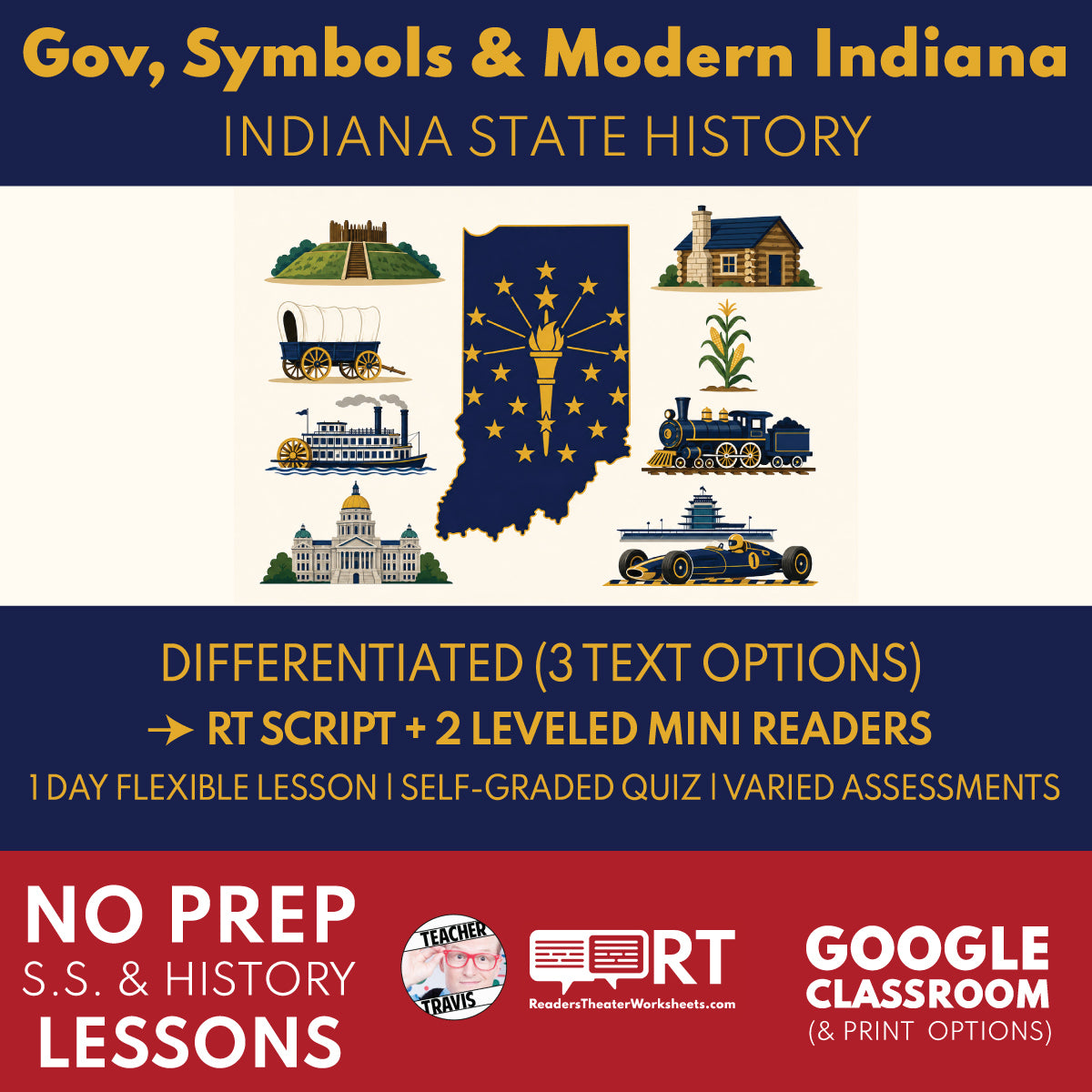
Teach Government, Symbols, and Modern Indiana as a complete Grade 4 Indiana State History lesson with a Reader’s Theater script and two differentiated Mini Readers for grades 3–5. Students study Indiana constitutional government, state symbols, civil rights, transportation, modern industry, technology, and global connections.
Indiana’s current state government is grounded in the 1851 Indiana Constitution, as amended. The Constitution divides power among legislative, executive, and judicial branches and protects individual rights. Citizens can participate through voting and other lawful civic actions. Official symbols—including the flag, its nineteen stars, the Wabash River, Salem limestone, and the “Crossroads of America” motto—represent parts of Indiana identity and history without replacing the legal functions of government. After World War II, civil-rights and school-integration struggles continued in Indiana, including a long Indianapolis desegregation process. Meanwhile, interstates, railroads, airports, and ports deepened national and global connections. Modern Indiana combines agriculture and manufacturing with life sciences, advanced manufacturing, logistics, semiconductors, mobility, and other technologies. The closing synthesis connects these changes to continuing migration, cultural change, Native homeland connections, civil rights, and global economic ties.
Part 10 of the 10-lesson Indiana State History bundle. View the complete Indiana State History Mini Unit Bundle.
View the Full 10-Lesson Indiana Bundle
Classroom Use
Students can use the Reader’s Theater Script, Original Mini Reader, or Accessible Mini Reader while working toward the same essential Indiana history content. The shared vocabulary, short-answer questions, challenge questions, and quiz let teachers differentiate reading support without creating separate lessons.
Standards Alignment
The final Teacher Guide identifies Indiana Grade 4 Social Studies standards including 4.H.11, 4.H.12, 4.C.1, 4.C.2, 4.C.3, and related lesson-specific standards. The lesson also provides CCSS-compatible literacy practice through informational reading, vocabulary in context, evidence-based discussion, oral fluency, and written response; the final Indiana Teacher Guide does not print separate CCSS code numbers.
Perfect For
- Grade 4 Indiana State History and state-history review
- Indiana constitutional government, state symbols, civil rights, transportation, modern industry, technology, and global connections
- Content-area literacy and Reader’s Theater fluency
- Whole-class lessons, small groups, sub plans, intervention, or review
- Mixed reading levels across grades 3–5
Flexible Differentiation
- Use the Reader’s Theater script for oral reading, collaborative performance, fluency, and discussion.
- Use the Original Mini Reader for independent or partner reading with fuller explanation.
- Use the Accessible Mini Reader for supported Grade 3-level reading while preserving the same assessed history.
- Use the worksheet, challenge questions, print quiz, or self-grading Google Forms quiz for assessment and review.
Skills Addressed
- Reading fluency and vocabulary in context
- Historical thinking and chronology
- Cause and effect and change over time
- Text evidence, discussion, and concise written response
- Comparing places, perspectives, choices, or consequences when the lesson requires it
What’s Included
- 10-scene Reader’s Theater Script with 12 character roles
- Original Mini Reader
- Accessible Mini Reader
- Vocabulary in context
- 10 two-part Short Answer questions
- 5 two-part Challenge Questions
- 20-question multiple-choice quiz
- Self-grading Google Forms quiz support
- Teacher Guide and answer keys
Explore All 10 Indiana State History Lessons
This lesson belongs to a connected ten-product sequence. Use the entire set as an Indiana State History mini unit or choose individual lessons to match your pacing guide.
- 1. Regions, Rivers, and Resources — Indiana geography, glaciers, rivers, regional landforms, resources, and human-environment relationships.
- 2. First Peoples and Native Homelands — Archaeology, Native nations, homelands, river corridors, movement, and present-day continuity.
- 3. French Traders and Vincennes — French trade, Vincennes, the Wabash corridor, Native agency, exchange, and changing imperial control.
- 4. Clark and Revolutionary Indiana — George Rogers Clark, Vincennes, Fort Sackville, Revolutionary-era strategy, local participation, and changing control.
- 5. Tippecanoe, Treaties, and Territory — Treaties, Native sovereignty, Prophetstown, Tecumseh and Tenskwatawa, Tippecanoe, territorial expansion, and removal.
- 6. Statehood in 1816 — Northwest Ordinance, Indiana Territory, the 1816 Constitution, Corydon, statehood, and the move to Indianapolis.
- 7. Roads, Canals, and Railroads — Roads, the National Road, Michigan Road, canals, internal improvements, railroads, markets, and Indiana’s crossroads identity.
- 8. Freedom Seeking and Civil War Indiana — Freedom seeking, antislavery networks, Black agency, Indiana’s Civil War participation, Morgan’s Raid, and emancipation.
- 9. Factories, Migration, and a Changing Indiana — Industrialization, the gas boom, manufacturing cities, immigration, the Great Migration, the Great Depression, and wartime production.
- 10. Government, Symbols, and Modern Indiana — Indiana constitutional government, state symbols, civil rights, transportation, modern industry, technology, and global connections.
Get the Complete Indiana State History Bundle
Text Summary
Indiana’s current state government is grounded in the 1851 Indiana Constitution, as amended. The Constitution divides power among legislative, executive, and judicial branches and protects individual rights. Citizens can participate through voting and other lawful civic actions. Official symbols—including the flag, its nineteen stars, the Wabash River, Salem limestone, and the “Crossroads of America” motto—represent parts of Indiana identity and history without replacing the legal functions of government. After World War II, civil-rights and school-integration struggles continued in Indiana, including a long Indianapolis desegregation process. Meanwhile, interstates, railroads, airports, and ports deepened national and global connections. Modern Indiana combines agriculture and manufacturing with life sciences, advanced manufacturing, logistics, semiconductors, mobility, and other technologies. The closing synthesis connects these changes to continuing migration, cultural change, Native homeland connections, civil rights, and global economic ties.
Share