

Dynamic History
Texas State History - Grade 4 - Joining the United States - Week 13 Full Curriculum
Texas State History - Grade 4 - Joining the United States - Week 13 Full Curriculum
Couldn't load pickup availability
Classroom Use at a Glance
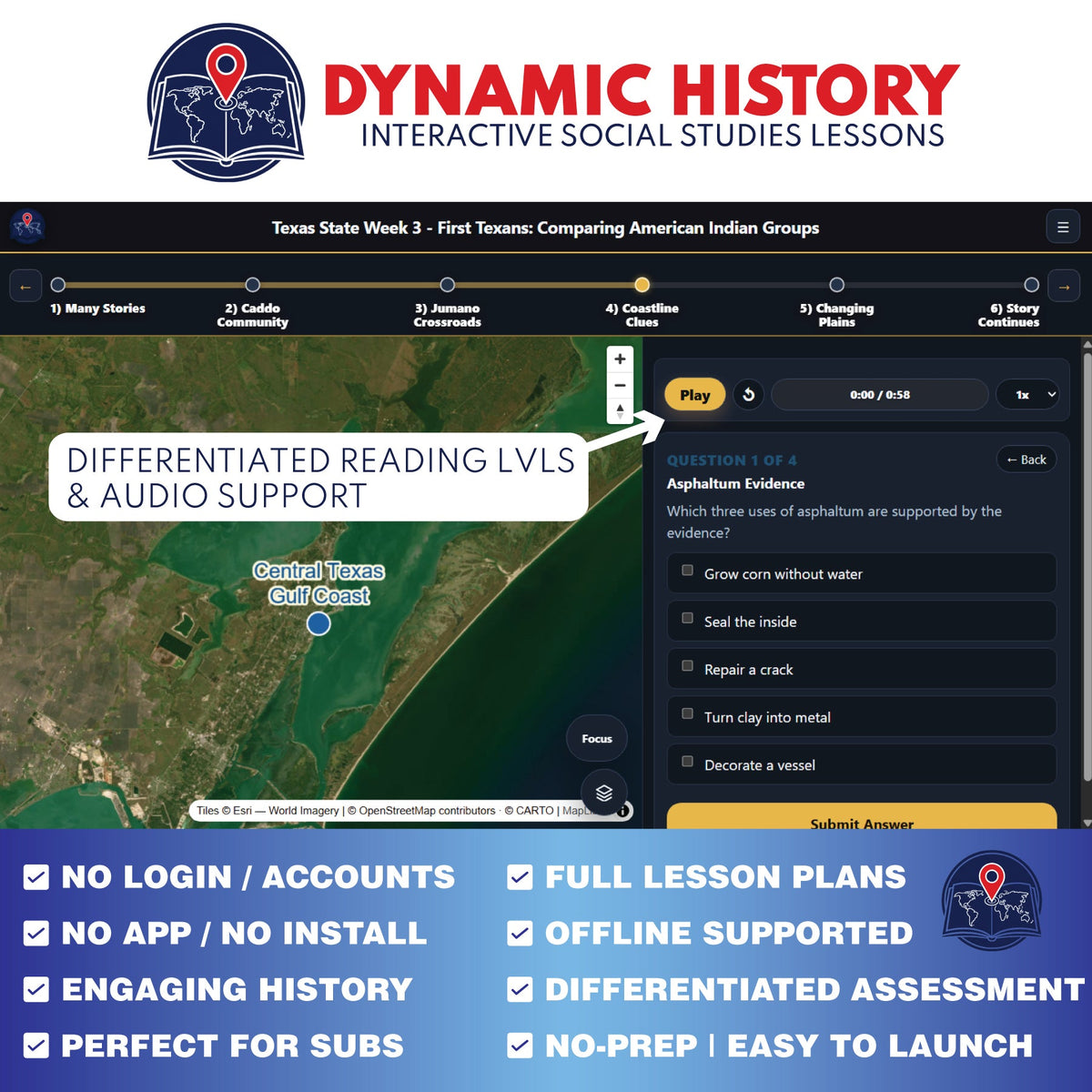
A complete Grade 4 Texas State History Week 13 resource built around the Dynamic History Joining the United States interactive module. Includes a 6-stop investigation with 28 guided auto-graded tasks, stop-scoped map evidence on Republic claims, annexation, the Nueces-Rio Grande boundary dispute, troop movement, wider U.S.-Mexican War campaigns, and the 1848 map change; Standard and Accessible reading paths; 20-page Standard and 22-page Accessible print modules; a 38-page all-in-one Teacher Guide and Answer Key; a 4-page Day 3 Annexation Decision Matrix; and an 8-page Day 4 Changing Borders Map Lab. Day 3 includes 10 vocabulary terms, 10 short-answer questions, 5 challenge questions, and 20 multiple-choice questions; Day 4 includes 10 vocabulary terms, 10 short-answer questions, 5 challenge questions, and 20 multiple-choice questions; and Day 5 includes 10 vocabulary terms, 10 short-answer questions, 5 challenge questions, and 25 multiple-choice questions. Printable assessment versions and self-grading Google Forms are generated from the weekly Teacher Guide through the shared classroom folder.
Classroom Uses Whole Class, Small Groups, Content-Area Reading, Discussion, Assessment, Review, Homework, Sub Plan view all
- Whole Class
- Small Groups
- Content-Area Reading
- Discussion
- Assessment
- Review
- Homework
- Sub Plan
Included Teacher Guide, Student Worksheet, Answer Key, Quiz, Google Forms Quiz, Vocabulary, Discussion Questions, Challenge Questions view all
- Teacher Guide
- Student Worksheet
- Answer Key
- Quiz
- Google Forms Quiz
- Vocabulary
- Discussion Questions
- Challenge Questions
Format PDF, DOCX, Google Docs, Google Slides, Google Forms, PowerPoint, ZIP Download, Printable, Editable view all
- DOCX
- Google Docs
- Google Slides
- Google Forms
- PowerPoint
- ZIP Download
- Printable
- Editable
Differentiation Accessible Version, Mixed Reading Levels, ELL Support, Struggling Readers, Vocabulary Support, Small-Group Support view all
- Accessible Version
- Mixed Reading Levels
- ELL Support
- Struggling Readers
- Vocabulary Support
- Small-Group Support
Teach Grade 4 Texas history through a complete five-day week built around a 6-stop Dynamic History interactive map investigation with 28 guided auto-graded tasks. Students investigate why the Republic of Texas considered annexation, how Texas became a U.S. state, why the Nueces River-Rio Grande boundary dispute mattered, how the U.S.-Mexican War expanded far beyond Texas, and how the Treaty of Guadalupe Hidalgo changed the map in 1848.
This Week 13 resource coordinates the interactive Dynamic History module with Standard and Accessible print alternatives, an Annexation Decision Matrix, a Changing Borders Map Lab, and complete Day 3, Day 4, and Day 5 assessments. There is no Readers Theater or virtual field trip this week; the scheduled applications emphasize evidence-based decision making, civil discourse, map analysis, chronology, and cause and effect.
Will this resource meet your needs?
Try the full week 1 curriculum - 100% FREE DOWNLOAD
What students practice
- Annexation and statehood: explain why the Republic of Texas considered joining the United States and distinguish an annexation offer from the later steps that made Texas a state.
- Claims and evidence: compare the Republic's broad land claim with population centers, debt, defense problems, and competing political choices.
- Boundary reasoning: compare the Nueces River and Rio Grande claims and use Corpus Christi, Laredo, and Matamoros as evidence that the disputed strip was already inhabited.
- Chronology and cause/effect: connect troop movement, the first clashes, the declaration of war, wider campaigns, the 1848 treaty, and later boundary settlement without collapsing them into one event.
- Map analysis: use rivers, routes, campaign locations, historical maps, and territorial-change maps to explain how a local boundary dispute became part of a much larger war.
- Civil discourse and perspective: weigh evidence about annexation, recognize slavery as a central part of the annexation debate, listen to different interpretations, and defend a claim while acknowledging complications.
The five-day week
- Day 1: Dynamic History Stops 1-3 - Republic problems and land claims, the 1845 annexation decision, and the disputed strip between the Nueces River and Rio Grande.
- Day 2: Dynamic History Stops 4-6 - the march from Corpus Christi toward the Rio Grande, a war that spread from Santa Fe to Veracruz and Mexico City, and the map after the 1848 treaty.
- Day 3: Annexation Decision Matrix using six evidence cards, a supports/concerns/complexity matrix, a civil-discourse protocol, and an individual evidence-based claim.
- Day 4: Changing Borders Map Lab comparing the annexation-era Republic, the disputed strip, war campaigns, and the Mexican Cession, followed by sequencing, cause/effect, and a final map-based explanation.
- Day 5: discussion, review, and a complete standalone Week 13 final assessment.
What's included
- Dynamic History interactive module access with 6 guided stops and 28 auto-graded tasks.
- Stop-scoped geographic evidence including cities and capitals, the Nueces River and Rio Grande, the disputed boundary strip, troop movement, campaign locations, territorial claims, historical images, and map-change evidence.
- 20-page Standard and 22-page Accessible print-module companions with equivalent learning targets.
- 38-page all-in-one Teacher Guide and Answer Key with week-at-a-glance planning, substitute-ready Days 1-5 lesson plans, Dynamic History stop guidance, differentiation, misconceptions, sensitive-content guidance, map/source notes, and complete assessment keys.
- 4-page Day 3 Annexation Decision Matrix classroom/student packet with evidence cards, decision matrix, civil-discourse protocol, individual claim writing, and reflection.
- 8-page Day 4 Changing Borders Map Lab classroom/student packet with four map snapshots, chronology work, cause-and-effect analysis, and final map-based writing.
- Day 3 assessment with 10 vocabulary terms, 10 short-answer questions, 5 challenge questions, and a 20-question multiple-choice quiz.
- Day 4 assessment with 10 vocabulary terms, 10 short-answer questions, 5 challenge questions, and a 20-question multiple-choice quiz.
- Day 5 final assessment with 10 vocabulary terms, 10 short-answer questions, 5 challenge questions, and a 25-question multiple-choice quiz.
- Printable student assessment versions and self-grading Google Forms generated from the weekly Teacher Guide through the shared classroom folder.
- Complete model answers, direct answer keys, standards alignment, civil-discourse guidance, acceptable-answer guidance, and map-based evidence support.
Google Forms note: Self-grading Google Forms are cloud-native and are provided through the shared Google folder. They do not appear inside a downloaded desktop ZIP.
Built for flexible classrooms
Use the full five-day sequence or select individual components to fit your schedule. Standard and Accessible reading paths teach the same assessed ideas, while the print modules and Day 3-4 packets provide substantial paper-based alternatives when device access is limited.
Assessment options
The Dynamic History module provides 28 guided auto-graded formative tasks across Days 1-2. Separate Day 3, Day 4, and Day 5 assessments let teachers choose the mix of evidence-based claims, civil discourse, map reasoning, chronology, cause and effect, printable multiple choice, and self-grading Google Forms that fits their classroom.
Best fit
Designed for Grade 4 Texas Social Studies and aligned to Week 13 learning targets for annexation, statehood, Republic-era challenges, disputed boundaries, the U.S.-Mexican War, the Treaty of Guadalupe Hidalgo, the Mexican Cession, geography, chronology, historical evidence, civil discourse, and cause and effect. Works well for whole-class instruction, small groups, independent practice, review, substitute plans, and blended print/digital classrooms.
Technology note: Dynamic History and Google-native assessment files require internet access. The Standard and Accessible print modules, Day 3 and Day 4 student packets, and printable assessment versions provide substantial offline alternatives for the week.
Share