

Readers Theater Worksheets
Kansas State History | The Cattle Can’t Stay Here! Reader’s Theater + Mini Readers | Grade 7
Kansas State History | The Cattle Can’t Stay Here! Reader’s Theater + Mini Readers | Grade 7
Couldn't load pickup availability
Classroom Use at a Glance
Abilene cattle drives and railroad markets. 8 speaking roles, ten scenes, two nonfiction Mini Readers, vocabulary, 15 two-part written questions and a 20-question self-grading quiz; The Cattle Can’t Stay Here!.
Subjects History, Social Studies, ELA, Geography view all
- History
- Social Studies
- ELA
- Geography
Classroom Uses Sub Plan, Small Groups, Whole Class, Fluency Practice, Close Reading, Discussion, Assessment, Review, Performance Reading, Content-Area Reading view all
- Sub Plan
- Small Groups
- Whole Class
- Fluency Practice
- Close Reading
- Discussion
- Assessment
- Review
- Performance Reading
- Content-Area Reading
Included Reader’s Theater Script, Original Mini Reader, Accessible Mini Reader, Teacher Guide, Student Worksheet, Answer Key, Quiz, Google Forms Quiz, Vocabulary, Discussion Questions, Challenge Questions, Slides view all
- Reader’s Theater Script
- Original Mini Reader
- Accessible Mini Reader
- Teacher Guide
- Student Worksheet
- Answer Key
- Quiz
- Google Forms Quiz
- Vocabulary
- Discussion Questions
- Challenge Questions
- Slides
Format DOCX, Google Docs, Google Slides, Google Forms, ZIP Download, Printable, Editable view all
- DOCX
- Google Docs
- Google Slides
- Google Forms
- ZIP Download
- Printable
- Editable
Differentiation Leveled Version, Accessible Version, Original Version, Mixed Reading Levels, Vocabulary Support, Small-Group Support view all
- Leveled Version
- Accessible Version
- Original Version
- Mixed Reading Levels
- Vocabulary Support
- Small-Group Support
A herd can mean new work, shipping fees, and a busy railroad town. It can also terrify nearby farmers whose own cattle may be exposed to disease. Who gets to decide whether the animals stay?
In this ten-scene historical drama, students follow a focused human problem rather than a list of dates. The fictional dialogue is designed for Grade 7 readers, while historical claims and source limitations remain explicit.
Part 6 of 10 — Kansas State History, Grade 7. This stand-alone middle-school lesson provides a complete performance, nonfiction companion reading, classroom questions and a ready-to-use teaching sequence.
The Story Students Perform
A cattle-shipping dispute brings railhead boosters, livestock handlers, farmers, and community voices together in Abilene. The characters weigh Joseph McCoy’s shipping ambitions against quarantine concerns, the fear of Texas fever, and the practical limits of making profit from moving cattle through Kansas. Their decisions reveal how railroads changed regional markets.
Historical Learning Focus
- Locate Abilene’s role as a cattle-shipping railhead beginning in 1867.
- Explain how railroad access connected Texas cattle to distant buyers.
- Analyze why Texas fever and quarantine rules could produce conflicts among ranchers, shippers and Kansas farmers.
- Compare private commercial gains with potential costs imposed on neighbors and communities.
Source foundation: Kansas Historical Society Abilene cattle-trade and Joseph McCoy records. The script uses invented classroom-performance dialogue and does not present the speakers as verbatim historical testimony.
At a Glance
- Grade and reading profile: Grade 7 Kansas History, Grades 6 to 8 writing level.
- Structure: 10 chronological scenes, 8 speaking roles, a focused historical decision or disagreement.
- Performance dialogue: approximately 1,423 spoken words (script dialogue only); classroom timing is flexible.
- Assessment: 10 short-answer and 5 challenge questions, each with Parts A and B, plus a 20-question multiple-choice quiz.
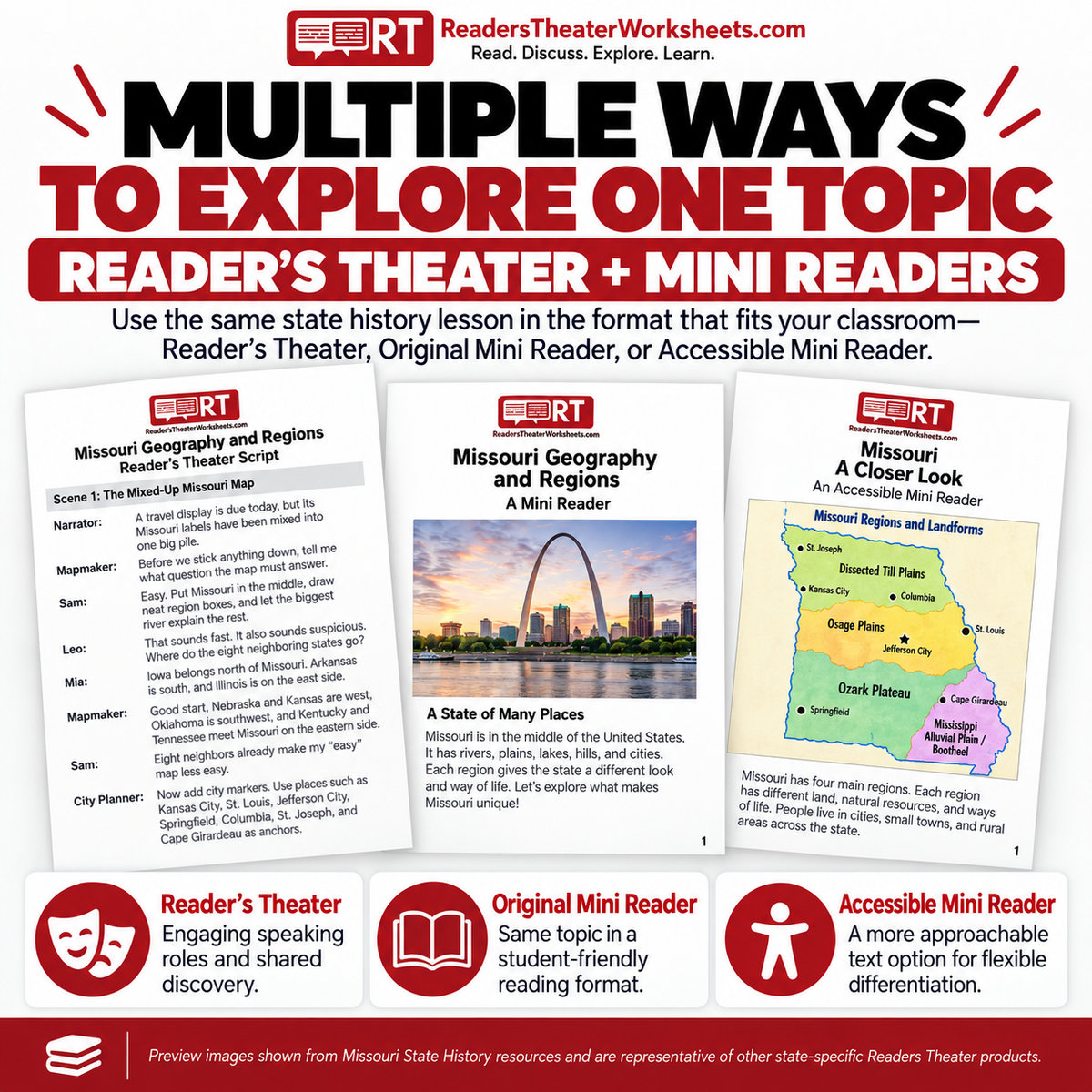
- Differentiation: Original Mini Reader and Accessible Mini Reader cover the same essential history at different reading loads.
- Digital access: separate student-facing and teacher answer materials supplied in the shared Google folder.
What’s Included
- Complete ten-scene Reader’s Theater script with casting guidance and teacher notes.
- Original Mini Reader: nonfiction background and historical explanation connected to the drama.
- Accessible Mini Reader: grade-appropriate companion with clearer syntax and the same core ideas.
- Ten vocabulary words with explanations and classroom discussion questions.
- Ten two-part short-answer questions and five two-part challenge questions, with teacher answer keys.
- Twenty multiple-choice questions in teacher-keyed and student-print versions; self-grading Google Forms quiz.
- Lesson pacing choices for one, two or three class periods, plus editable Google resources.
- A downloadable teacher guide and student resources available through the lesson’s shared folder.
Geography support: the Kansas instructional map identifies selected cities and regions. Its river paths are explicitly described as general references, not exact hydrographic traces.
Teaching and Differentiation
Start by introducing the people, place, and historical tension. Assign speaking roles, rehearse pronunciation as needed, and pause when characters disagree about evidence or consequences. After the performance, students read either Mini Reader and revisit a claim using the facts available in the text. The accessible version is not a childish retelling; it maintains the same Grade 7 concepts with a lighter sentence load.
Use a one-period performance-and-exit-quiz pathway, a two-period reading-and-written-evidence pathway, or a three-period option that adds historical-source discussion. Students can compare the choices the fictional characters make with the facts the documentary sources actually support.
Skills and Classroom Uses
- Historical cause-and-effect reasoning; evidence-based claims and perspective comparison.
- Readers’ Theater performance, oral interpretation, reading fluency and purposeful dialogue.
- Vocabulary in context, nonfiction comprehension, and comparison of source perspectives.
- Whole-class history lessons, small-group performances, sub plans, review, close reading, and formative assessment.
Standards and Historical Accuracy
Kansas HGSS 1.2, 5.2, 4.2 and 1.4; Grade 7 middle-level Kansas History.
All speaking parts are constructed for students; factual events and established chronology are differentiated from imagined conversations. The companion readings distinguish what historical evidence documents from what a dramatic scene plausibly illustrates. The Grade 7 standards focus on analysis, choices, rights, change over time, and supported claims rather than memorizing isolated dates.
All 10 Kansas State History Lessons
The complete series follows Kansas history chronologically. Each lesson is stand-alone and owns a different historical investigation, so students can use one lesson or the full sequence without repeating an identical storyline.
- Part 1: Where the Rivers Meet — FREE complete lesson
- Part 2: A Road Through Someone Else’s Land
- Part 3: Who Gets to Decide Kansas?
- Part 4: Four Constitutions, One State
- Part 5: Will They Let Us Fight?
- Part 6: The Cattle Can’t Stay Here!
- Part 7: The Promise of Nicodemus
- Part 8: A Vote on Who May Vote
- Part 9: When the Wheatfield Turned to Dust
- Part 10: The School They Could Not Enter
Try the free first lesson: Part 1, Where the Rivers Meet, is a complete free lesson in this series, with the same Reader’s Theater, differentiated Mini Readers, and evidence-based activities offered in the other parts.
How Digital Access Works
After purchase or download, open the included START HERE PDF and use the red shared-folder button to reach this lesson’s Google Drive resources. Make copies of the files before editing or assigning them so your school account owns the documents. Keep the teacher answer key separate from student copies. The PDF also explains what to do if school-domain sharing is restricted.
Built for Grade 7 classes studying Kansas History and for other middle-school readers working at a Grades 6–8 level. No special props, complicated room layout, or multiple parallel plots are required; the history develops through the characters’ choices and the accompanying evidence.
Share