Readers Theater Worksheets
Kentucky State History | Freedom Seekers & Ohio River RT Script + Mini Readers | Grade 8
Kentucky State History | Freedom Seekers & Ohio River RT Script + Mini Readers | Grade 8
Couldn't load pickup availability
Classroom Use at a Glance
Freedom seekers, the ohio river, and the dangers of fugitive-slave laws. 11 speaking roles, ten scenes, both Mini Readers, vocabulary, written questions, and self-grading quiz. The River That Made People Free?.
Classroom Uses Sub Plan, Small Groups, Whole Class, Fluency Practice, Close Reading, Discussion, Assessment, Review, Performance Reading, Content-Area Reading view all
- Sub Plan
- Small Groups
- Whole Class
- Fluency Practice
- Close Reading
- Discussion
- Assessment
- Review
- Performance Reading
- Content-Area Reading
Included Reader’s Theater Script, Original Mini Reader, Accessible Mini Reader, Teacher Guide, Student Worksheet, Answer Key, Quiz, Google Forms Quiz, Vocabulary, Discussion Questions, Challenge Questions, Slides view all
- Reader’s Theater Script
- Original Mini Reader
- Accessible Mini Reader
- Teacher Guide
- Student Worksheet
- Answer Key
- Quiz
- Google Forms Quiz
- Vocabulary
- Discussion Questions
- Challenge Questions
- Slides
Format DOCX, Google Docs, Google Slides, Google Forms, ZIP Download, Printable, Editable view all
- DOCX
- Google Docs
- Google Slides
- Google Forms
- ZIP Download
- Printable
- Editable
Differentiation Leveled Version, Accessible Version, Original Version, Mixed Reading Levels, Vocabulary Support, Small-Group Support view all
- Leveled Version
- Accessible Version
- Original Version
- Mixed Reading Levels
- Vocabulary Support
- Small-Group Support
A student newsroom prepares a headline promising that crossing the Ohio River always meant freedom. Its reporters quickly discover that free-state law and personal safety were not the same thing—and that the story must center the choices of people who resisted slavery.
Compare Kentucky and Ohio law, the 1793 and 1850 fugitive-slave acts, and the actions of the Hayden family, Henry Bibb, and John P. Parker; use the 1858 John Price case to examine danger even north of the river.
Part 8 of 10 — Kentucky State History, Grade 8. This is a complete, stand-alone lesson with differentiated reading and common assessments.
The Story Students Perform
The River That Made People Free? — A school newspaper is about to publish a headline claiming an Ohio River crossing automatically made a person free. The reporters discover why free-state rules did not guarantee security under federal fugitive-slave laws. Accounts of the Hayden family, Henry Bibb, John P. Parker and John Price lead the newsroom to a more careful story centered on freedom seekers’ actions and risks.
Historical Learning Focus
- Compare Kentucky and Ohio law, the 1793 and 1850 fugitive-slave acts, and the actions of the Hayden family, Henry Bibb, and John P. Parker.
- use the 1858 John Price case to examine danger even north of the river.
At a Glance
- Grade 8 Kentucky State History (within the Grades 6–8 reading band)
- 10-scene Reader’s Theater script with 11 speaking roles
- Approximately 2,173 words in the full Reader’s Theater script
- Original and Accessible Mini Readers covering the same essential facts
- 10 vocabulary terms; 10 two-part short-answer questions; 5 two-part challenge questions
- 20-question multiple-choice quiz, print version and answer key
- Google Docs, printable/exportable documents, Google Slides worksheets and a self-grading Google Forms quiz
What’s Included
- Reader’s Theater script and teacher casting breakdown
- Original Mini Reader and Accessible Mini Reader
- Teacher Guide with pacing options, instructions and cited sources
- Vocabulary list with definitions
- Digital and print student worksheets, plus written-response answer keys
- 20-question multiple-choice exit quiz, answer key and print version
- Self-grading Google Forms quiz and editable classroom copies
- Shared Google classroom folder access via a Start Here PDF
Teaching and Differentiation
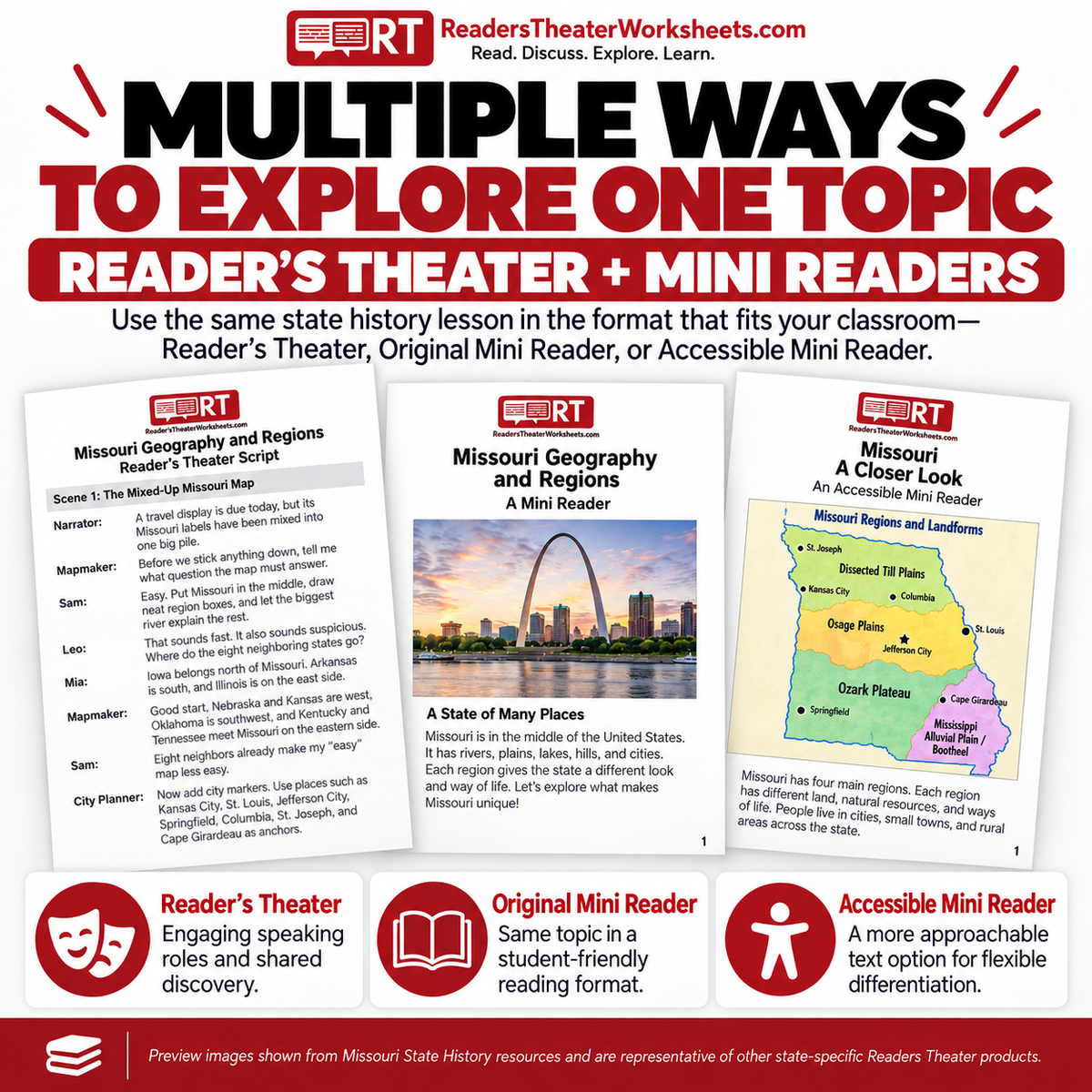
Assign characters for a dramatic reading, use either complete Mini Reader for individual or small-group work, and assess the same essential history at different reading supports. The Teacher Guide provides one-, two- and three-class-period pacing options, so teachers can choose a short lesson or a deeper inquiry without changing the core historical facts.
Skills and Classroom Uses
- Reading fluency and oral performance, vocabulary in context, comprehension, and text evidence
- Historical thinking: evaluate factual claims, distinguish evidence from interpretation, and explain historical causes and consequences
- Whole-class instruction, small groups, content-area reading, discussion, assessment, review, and substitute plans
Standards and Historical Accuracy
Kentucky Grade 8 standards 8.H.KH.1, 8.H.CO.4, and 8.G.MM.1 in a bounded antebellum case; source inquiry is conditional on using attributed source cards. The Teacher Guide lists the product-level alignments and source information. No map is included in this Kentucky series; students can follow the historical geography through readings and discussion.
All 10 Kentucky State History Lessons
- Kentucky Rivers, Regions & Native Homelands — Kentucky’s rivers, six physiographic regions, and Native homeland connections.
- Cumberland Gap, Wilderness Road & Land Claims — Cumberland Gap, Indigenous travel routes, the Wilderness Road, and disputed land claims.
- Boonesborough & Conflicting Claims — Boonesborough settlement, the Transylvania project, the 1778 siege, and conflicting claims.
- Blue Licks & Kentucky in the American Revolution — the Battle of Blue Licks, Revolutionary-era frontier fighting, and conflicting historical reports.
- From Virginia to Kentucky Statehood — The Missing Article — Kentucky statehood in 1792, its first constitution, and unequal political rights.
- Kentucky Rivers, Trade & Enslaved Labor — The Boat That Couldn’t Come Back — Kentucky river commerce, flatboats and steamboats, and enslaved labor in the early economy.
- Cherokee Removal Routes Through Kentucky — Two Clocks at Mantle Rock — Cherokee forced removal, sovereignty, treaties, and Kentucky transit routes.
- Freedom Seekers & the Ohio River — freedom seekers, the Ohio River, and the dangers of fugitive-slave laws.
- Kentucky Civil War Crossroads — Kentucky’s Civil War neutrality, competing governments, major battles, and slavery.
- Reconstruction & Unfinished Freedom — Reconstruction, the Reconstruction Amendments, Black education, and unequal school laws.
How Digital Access Works
Download the Start Here PDF and open its shared Google folder link. Make your own copies of editable files before assigning them in Google Classroom. The quiz is provided as a self-grading Google Form; the Teacher Guide and student resources are also available in classroom-friendly formats.
Text Summary
A student newsroom prepares a headline promising that crossing the Ohio River always meant freedom. Its reporters quickly discover that free-state law and personal safety were not the same thing—and that the story must center the choices of people who resisted slavery. Compare Kentucky and Ohio law, the 1793 and 1850 fugitive-slave acts, and the actions of the Hayden family, Henry Bibb, and John P. Parker; use the 1858 John Price case to examine danger even north of the river.
Preview the format for free: Start with Kentucky Part 1.
Share