

Readers Theater Worksheets
Missouri State History | Missouri in the Civil War RT Script & Mini Readers | Grades 3-5
Missouri State History | Missouri in the Civil War RT Script & Mini Readers | Grades 3-5
Couldn't load pickup availability
Classroom Use at a Glance
A Grade 3-focused Missouri State History lesson for grades 3–5 on Missouri as a divided Civil War border state, competing government claims, changing control, civilian consequences, Black military service, and emancipation with three reading paths and shared assessments.
Classroom Uses Whole Class, Small Groups, Fluency Practice, Content-Area Reading, Discussion, Assessment, Review view all
- Whole Class
- Small Groups
- Fluency Practice
- Content-Area Reading
- Discussion
- Assessment
- Review
Included Reader’s Theater Script, Original Mini Reader, Accessible Mini Reader, Teacher Guide, Student Worksheet, Answer Key, Quiz, Google Forms Quiz, Vocabulary, Discussion Questions, Challenge Questions view all
- Reader’s Theater Script
- Original Mini Reader
- Accessible Mini Reader
- Teacher Guide
- Student Worksheet
- Answer Key
- Quiz
- Google Forms Quiz
- Vocabulary
- Discussion Questions
- Challenge Questions
Format DOCX, Google Forms, ZIP Download, Printable, Editable view all
- DOCX
- Google Forms
- ZIP Download
- Printable
- Editable
Differentiation Accessible Version, Original Version, Mixed Reading Levels, ELL Support, Struggling Readers, Vocabulary Support, Small-Group Support view all
- Accessible Version
- Original Version
- Mixed Reading Levels
- ELL Support
- Struggling Readers
- Vocabulary Support
- Small-Group Support
Bring Missouri State History to life with a Grade 3-focused Reader’s Theater script and two differentiated Mini Readers for grades 3–5. A school history newsroom repairs misleading Civil War headlines as students investigate Missouri’s divided loyalties, changing control, civilian consequences, Black military service, and the end of slavery.
Mia, Leo, and Sam join a school history newsroom that must repair a series of misleading Missouri Civil War headlines before going on air. The team discovers that Missouri was a slaveholding border state whose elected convention rejected secession, even while strong pro-Confederate support remained. They trace competing government claims, changing control around Jefferson City, Boonville, Wilson’s Creek, and Lexington, divided military service, civilian consequences under guerrilla warfare and General Order No. 11, Black military participation at Island Mound and beyond, the limited scope of the Emancipation Proclamation in Missouri, the state’s January 1865 abolition of slavery, and the later Thirteenth Amendment. The recurring task is to distinguish political status, regional military control, documented consequences, and legal change without reducing Missouri to one side or one battle.
Lesson 8 of the 10-lesson Missouri State History bundle. Explore the complete Missouri State History Mini Unit Bundle here.
View the Full 10-Lesson Missouri Bundle
Classroom Use
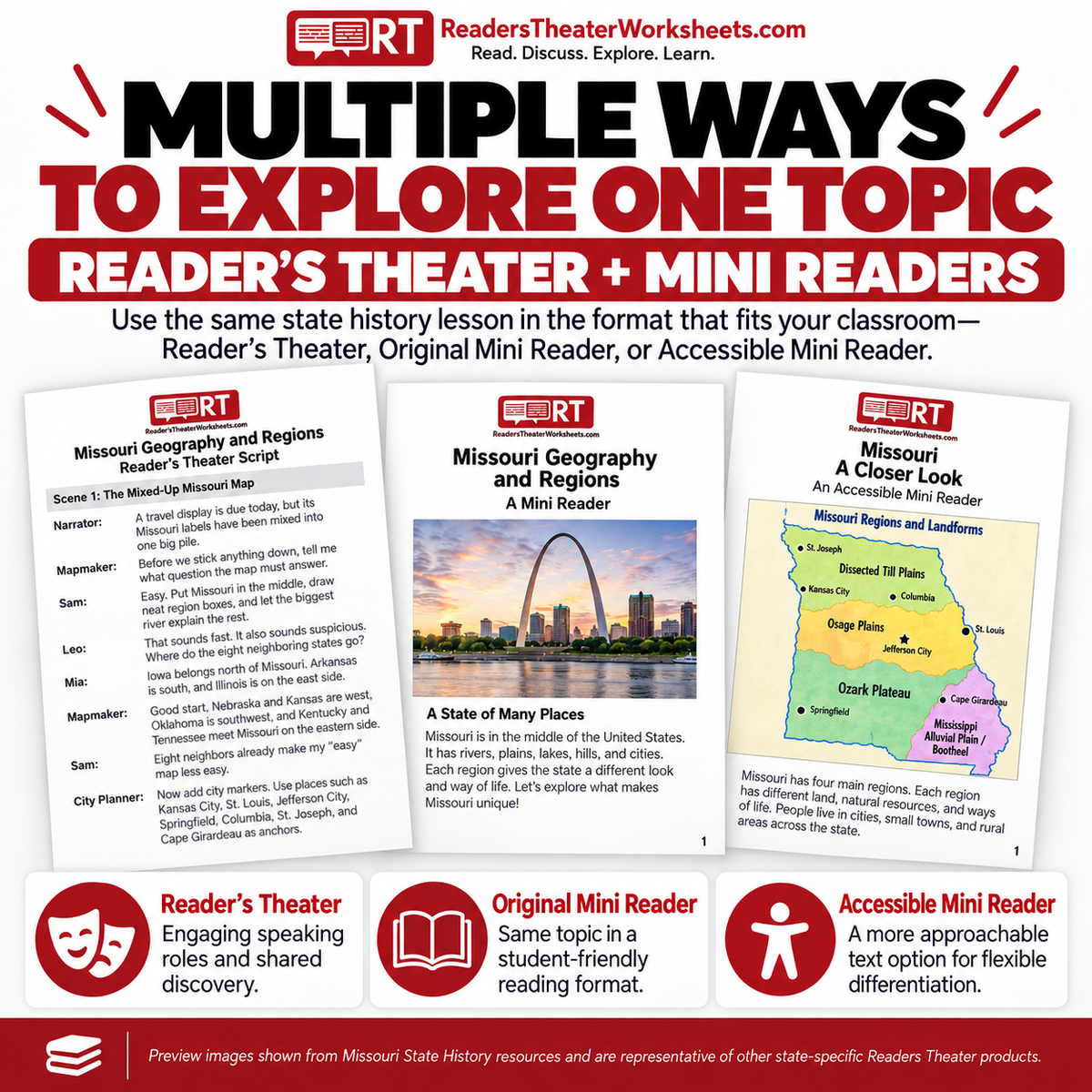
Use the Reader’s Theater for whole-class performance, partner or small-group fluency practice, content-area reading, discussion, review, sub plans, or assessment. The included Original and Accessible Mini Readers let students work from different reading paths while studying the same core history.
What’s Included
- 10-scene Reader’s Theater Script
- Original Mini Reader
- Accessible Mini Reader
- Teacher Guide and answer keys
- Vocabulary, 10 Short Answer questions, and 5 Challenge questions
- 20-question multiple-choice exit quiz
- Digital and print worksheet options
- Self-graded Google Forms quiz
- Pre-reading and post-reading discussion questions
Standards Alignment
The Teacher Guide aligns this lesson to Missouri Learning Standards for Grade 3 social studies, including 3.H.3.G, 3.EG.5.G. CCSS literacy connections support informational reading, text evidence, vocabulary in context, speaking and listening, discussion, and concise explanatory writing.
Perfect For
- Grade 3 Missouri history and social studies
- Grades 3–5 mixed-reading-level classrooms
- Whole-class Reader’s Theater and fluency practice
- Small groups, intervention, enrichment, and review
- Google Classroom, sub plans, and no-prep lessons
Flexible Differentiation
All three student-text options share the same essential evidence, vocabulary, questions, and quiz system. Teachers can assign the Reader’s Theater, Original Mini Reader, or Accessible Mini Reader without splitting the class into different content.
Skills Addressed
Reading fluency, vocabulary in context, comprehension, text evidence, historical thinking, cause and effect, compare and contrast, discussion, and explanatory writing.
Text Summary
Mia, Leo, and Sam join a school history newsroom that must repair a series of misleading Missouri Civil War headlines before going on air. The team discovers that Missouri was a slaveholding border state whose elected convention rejected secession, even while strong pro-Confederate support remained. They trace competing government claims, changing control around Jefferson City, Boonville, Wilson’s Creek, and Lexington, divided military service, civilian consequences under guerrilla warfare and General Order No. 11, Black military participation at Island Mound and beyond, the limited scope of the Emancipation Proclamation in Missouri, the state’s January 1865 abolition of slavery, and the later Thirteenth Amendment. The recurring task is to distinguish political status, regional military control, documented consequences, and legal change without reducing Missouri to one side or one battle.
Lessons Included in the Missouri State History Bundle
- 1. Missouri Geography and Regions — Missouri regions, rivers, landforms, map skills, cities, environmental adaptation, and human-environment interaction.
- 2. Native Nations in Missouri — Missouri Native Nations, ancient sites, homelands, trade networks, contact-era change, tribal continuity, and evidence.
- 3. French and Spanish Missouri — French and Spanish colonial Missouri, Ste. Genevieve, St. Louis, river trade, changing governments, slavery, and colonial records.
- 4. Louisiana Purchase and Lewis & Clark — the Louisiana Purchase, political transfer at St. Louis, Lewis and Clark, the Corps of Discovery, Missouri River geography, and expedition goals.
- 5. Missouri Statehood and Government — Missouri statehood, the Missouri Compromise, the 1820 constitution, 1821 admission, three branches of government, and civic participation.
- 6. Missouri: Gateway West — Missouri gateway towns, the Santa Fe, Oregon, and California routes, westward migration, trade, geography, and Native homelands.
- 7. Dred Scott and Freedom Suits — Dred and Harriet Scott, Missouri freedom suits, legal precedent, court levels, citizenship, manumission, and constitutional change.
- 8. Missouri in the Civil War — Missouri as a divided Civil War border state, competing government claims, changing control, civilian consequences, Black military service, and emancipation.
- 9. Postwar Missouri — postwar railroads, river transportation, cities, communication, public education, Lincoln Institute, opportunity, and unequal access.
- 10. Significant Missourians — George Washington Carver, Mark Twain, Scott Joplin, Laura Ingalls Wilder, Susan Blow, Harry S. Truman, historical significance, and source evidence.
Share