
Readers Theater Worksheets
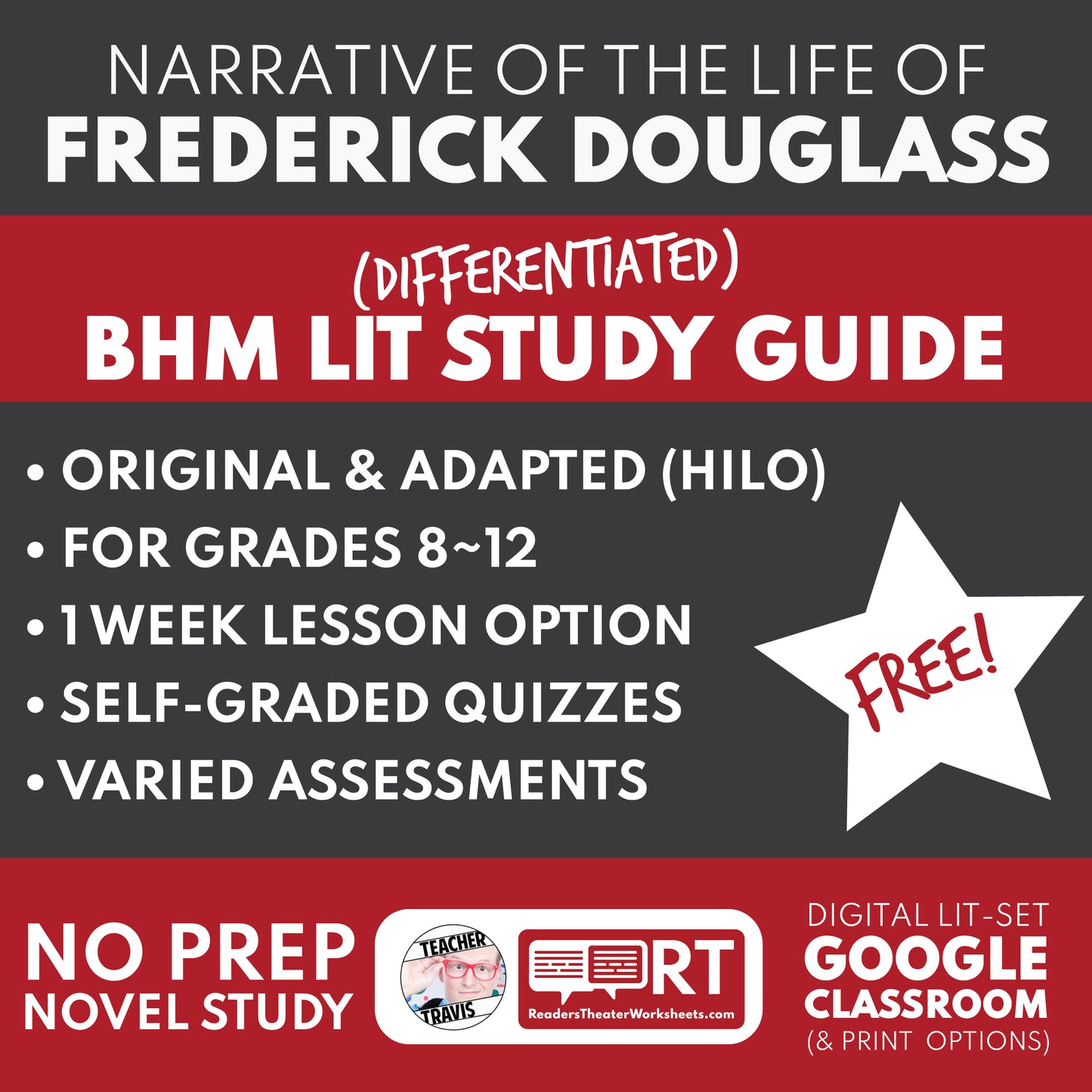
Free Narrative of the Life of Frederick Douglass Differentiated Study Guide for High School
Free Narrative of the Life of Frederick Douglass Differentiated Study Guide for High School
Couldn't load pickup availability
Classroom Use at a Glance
A differentiated literature study guide for grades 9–12 using Narrative of the Life of Frederick Douglass. Built to support mixed reading levels, close reading, vocabulary, discussion, assessment, and no-prep ELA instruction.
Classroom Uses Close Reading, Discussion, Assessment, Whole Class, Homework, Sub Plan view all
- Close Reading
- Discussion
- Assessment
- Whole Class
- Homework
- Sub Plan
Included Original Text, Leveled Text, Teacher Guide, Student Worksheet, Answer Key, Quiz, Google Forms Quiz, Vocabulary, Discussion Questions, Writing Prompt view all
- Original Text
- Leveled Text
- Teacher Guide
- Student Worksheet
- Answer Key
- Quiz
- Google Forms Quiz
- Vocabulary
- Discussion Questions
- Writing Prompt
Format PDF, DOCX, Google Docs, Google Forms, Online Library Access, Printable, Editable view all
- DOCX
- Google Docs
- Google Forms
- Online Library Access
- Printable
- Editable
Differentiation Original Version, Leveled Version, Mixed Reading Levels, Vocabulary Support, Struggling Readers, Advanced Readers view all
- Original Version
- Leveled Version
- Mixed Reading Levels
- Vocabulary Support
- Struggling Readers
- Advanced Readers
PROBLEM: Most classic literature study guides break down in real classrooms for two reasons: the original text is long and demanding, and student reading levels inside one class are rarely uniform—so teachers end up building separate tracks or simplifying discussions until the unit loses rigor.
If you want to extend this topic, teachers often pair it with Frederick Douglass Reader's Theater Script, Rosa Parks Reader's Theater Script, or Civil Rights Leaders Bundle for a stronger next-step lesson sequence.
SOLUTION: This differentiated novel study / digital lit-set for Narrative of the Life of Frederick Douglass by Frederick Douglass solves that problem by giving you both the complete original text and a condensed, five-part adapted version, so you can keep the class moving together while students read at the level that fits.
Every discussion question, multiple-choice exit quiz, short-answer item, and challenge question works for both tracks, so you can run one coherent unit without rewriting prompts or splitting your class into separate novel study paths.
Perfect for Grades 9–10 English Language Arts classrooms that want rigorous, text-dependent analysis of argument, craft, and moral complexity—while still supporting mixed reading levels through a dual-track structure that keeps the whole class aligned.
Quick Guide for Teachers
Adapted-Only Track (Fastest: 5-Day Model)
Best for Grades 9–12 classes that need a manageable, one-week novel experience. Day 1–5: Students read one adapted part per day and use the matching Main Ideas & Themes Discussion Questions and self-grading multiple-choice quiz. End the week with the Final Worksheet (Vocabulary Words, Short Answer Questions, and Challenge Questions). This track keeps lessons tight, predictable, and complete in five days.
Original-Only Track (Longer: Multi-Day Per Section)
Ideal for stronger readers or classes ready for original language and sentence structure. Students read the original chapters aligned to each adapted Part Use the same Discussion Questions, MC exit quizzes, and Final Worksheet; all items are text-accurate for both versions. Vocabulary Words (10) are usable for both tracks, because each word appears in both the adapted text and the corresponding original chapters. This track preserves the full descriptive style and classic voice while giving you ready-made, age-appropriate assessments.
Dual-Track Differentiation (Mixed Readers, Flexible Timelines)
Lets your entire class study the same plot, scenes, and themes at the same time—even when some students need the adapted text and others handle the full novel. Assign adapted Part 1 to students who need a shorter, clearer text and original corresponding chapters to students reading the full text; repeat this pattern through Parts 2–5 (timing will depend on your classroom's reading level) Give original-text students multiple days per section while adapted-text students reread key scenes, complete vocabulary tasks, and tackle discussion questions in pairs or small groups.
This product includes a zip file consisting of
NOTE: All files are editable and include (PDF, DOCX, PPTX, Google Docs/Slides/Forms)
Full Original Text: ~40000 words | 8.75 Flesch-Kincaid GL
- Lexile Ranges: ~1050L - 1200L | CEFR ~B2
- Great for advanced readers (or 8–10 graders), extension groups, longer-term novel studies.
Adapted Version Text: ~14000 words | 5.8 Flesch-Kincaid GL
- Lexile Ranges: ~830L - 950L | CEFR ~B1
- Designed for Grades -12 with support and access while preserving core plot & themes
- Supported readers who need a shorter text with the same plot, themes, and assessment alignment.
- *Both versions tell the same story, allowing students to participate in shared discussions even when reading different texts.
FREE BONUS ALERT!
Access Code included to the original and adapted/abridged text on the LEVELED-LIT CLASSICS Library Platform.
Student Final Worksheet/Quizzes (PPTX, Google Slides/Forms)
- 10 Vocabulary Words
- 10 Short Answer Recall/Comprehension
- 5 Challenge Questions (synthesis, analysis, themes, real life connection)
- 5 Multiple Choice Quizzes (20 Questions) (1 per part)
Teacher’s Guide & Answer Key
- 5 Sets of Daily Discussion Questions (1 per part)
- 5 Sets of Self-Graded Exit Quizzes (1 per part, 20Qs each)
- Answer Keys for Vocab, Short Answer, and Challenge Questions
- Key Figures & Places reference sheets to help students track characters and settings
Get all 5 BHM Study Guides & Save 40% here!
What’s the Tradeoff of Using the Adapted Version?
Pros:
Reduces the novel to a fraction of its original length, fitting neatly into a one-week unit. Well suited for shorter attention spans and developing readers in Grades 9-10 Preserves core narrative elements, characters, and themes Far better than skipping the book entirely due to time limits or reading-level concerns. Works for whole-class read-alouds, small-group novel studies, independent reading, or focused close-reading lessons.
Cons:
Omits some original language, side scenes, and descriptive passages for brevity, so students do not see every nuance of the original author's style. Leaves fewer opportunities for deep line-by-line stylistic analysis than a full-length, multi-week novel study.
Adapted Version Summary (and source chapters)
Part 1 – Framing the Witness; Childhood Under the Lash
Adapted from: PREFACE; CHAPTER I–CHAPTER II of the original text.
Douglass opens with allies framing his story as testimony meant to confront denial and moral comfort. He then shows slavery’s earliest tactics: stealing identity facts, separating families before bonds can form, and punishing curiosity as “improper” and “impertinent.” The part builds a concrete picture of plantation hierarchy, hunger, surveillance, and the way outsiders misread songs as happiness. It ends by establishing that slavery is organized terror presented as ordinary life.
Part 2 – The Plantation System and Its Violence
Adapted from: CHAPTER III–CHAPTER V of the original text.
Douglass explains how fear of spies and retaliation forces enslaved people to speak in safe praise rather than truth. He describes systems of “proof” that make punishment easier and shows how lethal violence can be treated as acceptable by the community. Daily deprivation is depicted as intentional and humiliating, especially for children. The part closes with a major shift: Douglass is sent to Baltimore, a move he recognizes as a potential “gateway” to something different.
Part 3 – Baltimore and the Battle for Literacy
Adapted from: CHAPTER VI–CHAPTER VIII of the original text.
In Baltimore, Douglass encounters an opening to learn, then watches it get shut down once literacy is exposed as a threat to slavery. He continues anyway, trading small resources for lessons and using daily observation as a classroom for writing. Reading deepens his awareness: it clarifies the meaning of abolition, sharpens his sense of injustice, and makes the system’s logic harder to endure. Ownership changes and family decisions then threaten to pull him away from the city’s fragile opportunities.
Part 4 – Hunger, Hypocrisy, and the Slave-Breaker’s Test
Adapted from: CHAPTER IX–CHAPTER X of the original text.
Douglass returns to severe hunger and shows how slaveholding “religion” can become a protective disguise for cruelty. Under a slave-breaker’s control, he faces a regimen designed to crush resistance, culminating in a decisive struggle that restores self-respect. He also shows how slavery steals labor through controlled work arrangements and wages surrendered by force. The part widens the argument: even when conditions shift, ownership keeps the same power underneath.
Part 5 – Escape, Reinvention, and the Moral Argument
Adapted from: CHAPTER XI; APPENDIX; A PARODY of the original text.
Douglass describes his successful escape while guarding details that could endanger others, then shows how freedom can still feel precarious because capture and betrayal remain possible. He adopts a new name as protection and begins building a life while facing discrimination in work and trade access. He explains his movement into public witness for the anti-slavery cause and why testimony matters. The Appendix and closing parody draw a final moral line, separating genuine Christianity from slaveholding religion and exposing hypocrisy as the system’s signature contradiction.
Frequently Asked Questions
Can I use the adapted text for reluctant or below-level readers without losing rigor?
Yes. The adapted version totals ~14,000 words at a Flesch-Kincaid Grade Level of 5.8, so students can access the full argument and turning points with clearer modern phrasing while still completing Grade 9-level, text-dependent analysis tasks.
Is this resource aligned to high school CCSS expectations?
Yes. Tasks align to RL.9–10 standards focused on evidence-based analysis, theme development, craft/structure, and point of view, plus SL.9–10.1 for discussion and L.9–10.4 for vocabulary and meaning in context.
How does differentiation work if students read different versions?
Both versions follow the same Part 1–5 chapter mapping, and every assessment prompt is designed to be answerable from either track. That means students can read the full 1845 text or the adapted five-part version while completing the same discussions, quizzes, short answers, and challenge questions in one unified sequence.
This is a complete, no-prep unit that keeps your whole class together with a dual-track structure—one set of assessments, two reading pathways, and a coherent Part 1–5 progression.
Standards
Reading Literature: CCSS RL.9-10.1, CCSS RL.9-10.2, CCSS RL.9-10.3, CCSS RL.9-10.4, CCSS RL.9-10.5, CCSS RL.9-10.6
Writing: CCSS W.9-10.1, CCSS W.9-10.2
Speaking & Listening: CCSS SL.9-10.1
Language: CCSS L.9-10.4
Anchor Standards: CCRA.R.1, CCRA.R.2, CCRA.R.3, CCRA.R.4, CCRA.R.5, CCRA.W.1, CCRA.W.2, CCRA.SL.1, CCRA.L.4
Share