
Readers Theater Worksheets
Pennsylvania State History | The Keystone State Challenge RT Script and Mini Readers | Grades 3-5
Pennsylvania State History | The Keystone State Challenge RT Script and Mini Readers | Grades 3-5
Couldn't load pickup availability
Classroom Use at a Glance
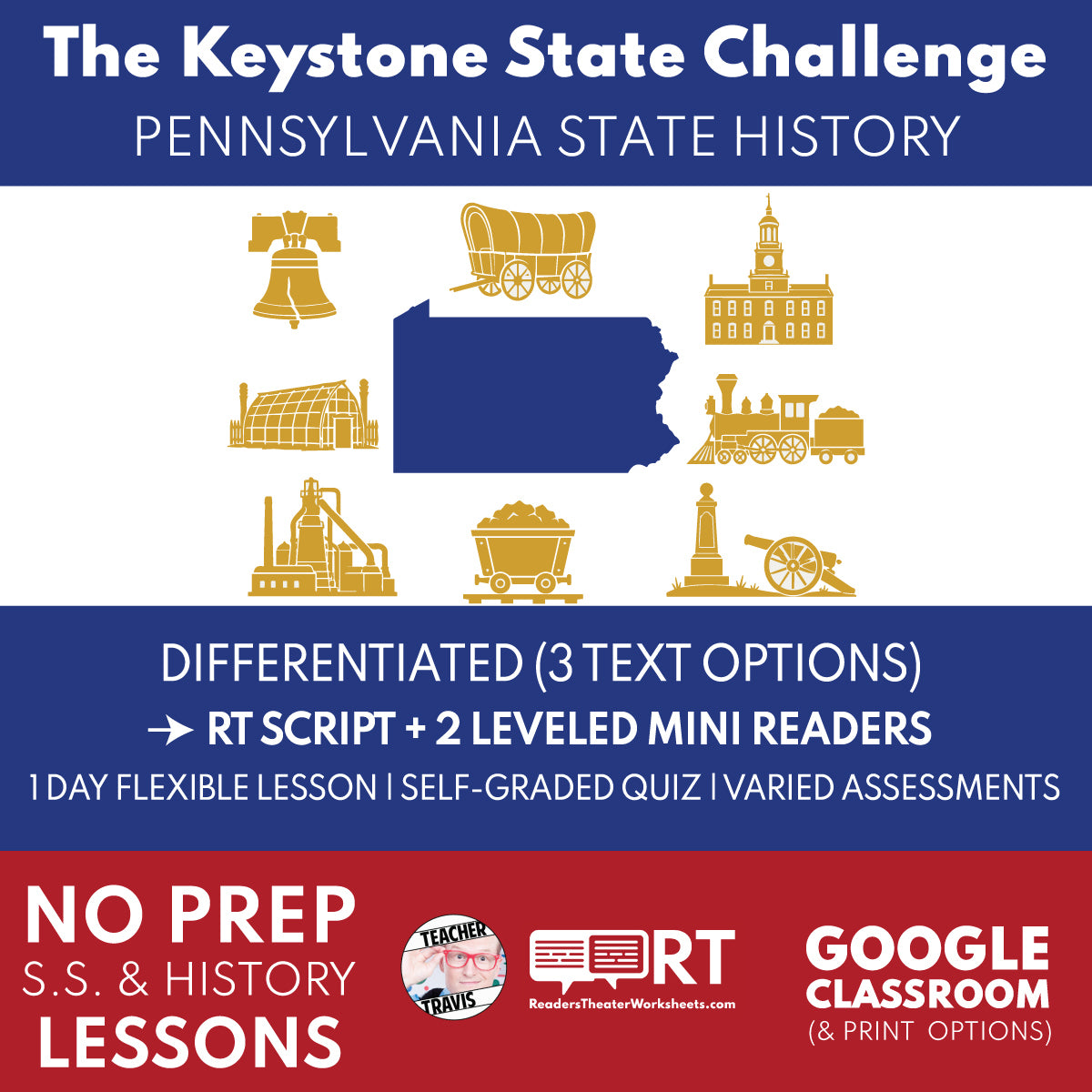
A Pennsylvania civics lesson for grades 3–5 on the state constitution, three branches, lawmaking, public services, citizen participation, capitals, and state symbols.
Classroom Uses Whole Class, Small Groups, Fluency Practice, Content-Area Reading, Discussion, Assessment, Review view all
- Whole Class
- Small Groups
- Fluency Practice
- Content-Area Reading
- Discussion
- Assessment
- Review
Included Reader’s Theater Script, Original Mini Reader, Accessible Mini Reader, Teacher Guide, Student Worksheet, Answer Key, Quiz, Google Forms Quiz, Vocabulary, Discussion Questions, Challenge Questions, Primary Source Extension view all
- Reader’s Theater Script
- Original Mini Reader
- Accessible Mini Reader
- Teacher Guide
- Student Worksheet
- Answer Key
- Quiz
- Google Forms Quiz
- Vocabulary
- Discussion Questions
- Challenge Questions
- Primary Source Extension
Format PDF, DOCX, Google Forms, ZIP Download, Printable, Editable view all
- DOCX
- Google Forms
- ZIP Download
- Printable
- Editable
Differentiation Accessible Version, Original Version, Mixed Reading Levels, ELL Support, Struggling Readers, Vocabulary Support, Small-Group Support view all
- Accessible Version
- Original Version
- Mixed Reading Levels
- ELL Support
- Struggling Readers
- Vocabulary Support
- Small-Group Support
Make Pennsylvania civics concrete with a challenge that asks students to connect founding documents, state government, lawmaking, public services, citizen participation, and symbols. The lesson turns government vocabulary into decisions students can trace and explain.
Students examine Pennsylvania's constitution and federal ratification, follow the movement of the state capital, identify the roles of the legislative, executive, and judicial branches, trace how state laws are made, connect government services to public needs, and distinguish civic participation from the symbols that represent the Commonwealth.
Part 8 of the 10-script Pennsylvania State History bundle. Get the complete Pennsylvania State History Mini Unit Bundle here.
View the Full 10-Script Pennsylvania Bundle
Classroom Use
Every assessment option is answerable from the Reader's Theater Script, the Original Mini Reader, or the Accessible Mini Reader. Teachers can differentiate reading paths while keeping the class on the same essential history, vocabulary, questions, and quiz.
Standards Alignment
The Teacher Guide documents Pennsylvania Civics and Government 5.1.4.B-D and F plus 5.3.4.A-D, covering laws, civic ideals and documents, symbols, branches, lawmaking, services, and public authority. The guide does not identify specific CCSS codes, so this description does not claim any; the lesson nevertheless provides reading, vocabulary, discussion, text-evidence, and explanatory-writing practice that teachers can connect to their own CCSS literacy goals.
Perfect For
- Pennsylvania State History and Grade 4 social studies
- Pennsylvania government, constitutions, three branches, lawmaking, public services, civic participation, and state symbols
- Content-area literacy and historical thinking
- Whole-class lessons, small groups, sub plans, review, intervention, or enrichment
- Mixed reading levels in grades 3–5
Flexible Differentiation
- Use the Reader's Theater script for whole-class participation, small-group performance, oral fluency, and discussion.
- Use the Original Mini Reader for independent reading, homework, centers, or students ready for added detail.
- Use the Accessible Mini Reader for mixed-level classes, multilingual learners, intervention, or students who benefit from shorter sentences and clearer structure.
- All three reading paths preserve the same assessed facts, so students can complete the shared worksheet and quiz.
Skills Addressed
- Reading fluency and vocabulary in context
- Comprehension and text evidence
- Chronology, cause and effect, and continuity and change
- Historical thinking and evidence-based discussion
- Concise explanatory writing
What's Included
- 10-scene Reader's Theater script with 12 speaking roles
- Original Mini Reader
- Accessible Mini Reader
- Vocabulary support and student worksheet
- 10 two-part comprehension questions and 5 two-part challenge questions
- 20-question multiple-choice quiz and answer key
- Self-grading Google Forms quiz support
- Teacher Guide with Pennsylvania standards, discussion prompts, and source support
All 10 Pennsylvania State History Lessons
- 1. The Wrinkled Map Mystery — Pennsylvania geography, maps, rivers, landforms, resources, and transportation.
- 2. Before Pennsylvania Had a Name — Native Nations, homelands, archaeology, trade, diplomacy, and living continuity.
- 3. Pennsylvania Before Penn — the Delaware Valley, New Sweden, New Netherland, Lenape trade, and changing colonial control before 1681.
- 4. The Holy Experiment — William Penn, Quaker beliefs, the 1681 charter, Philadelphia, representative government, diplomacy, and the limits of founding ideals.
- 5. The Walk That Wasn't Really a Walk — the 1737 Walking Purchase, disputed evidence, surveying, Lenape objections, dispossession, and damaged trust.
- 6. The Three-Rivers Prize — the Forks of the Ohio, French and British rivalry, Native alliance choices, forts, campaigns, and changing control in the 1750s.
- 7. The Bell, the Hall, and the Winter Army — Revolutionary Pennsylvania, the State House, Declaration, bell, Philadelphia Campaign, Valley Forge, and public memory.
- 8. The Keystone State Challenge — Pennsylvania government, constitutions, three branches, lawmaking, public services, civic participation, and state symbols.
- 9. The Records Hidden in the Cemetery — gradual abolition, freedom seekers, Black-led vigilance, William Still, the Fugitive Slave Act, Gettysburg, and historical memory.
- 10. The Mountain Railroad and the Oil Well — transportation, coal, petroleum, steel, workers, labor conflict, industrial costs, reclamation, and industrial heritage.
Text Summary
Make Pennsylvania civics concrete with a challenge that asks students to connect founding documents, state government, lawmaking, public services, citizen participation, and symbols. The lesson turns government vocabulary into decisions students can trace and explain. Students examine Pennsylvania's constitution and federal ratification, follow the movement of the state capital, identify the roles of the legislative, executive, and judicial branches, trace how state laws are made, connect government services to public needs, and distinguish civic participation from the symbols that represent the Commonwealth.
Want the connected sequence? Get all 10 Pennsylvania State History Reader's Theater and Mini Reader lessons in the complete bundle.
Share