
Readers Theater Worksheets
Romantic & Victorian Poetry Mini Unit | Differentiated Study Guide & Analysis | Keats, Tennyson
Romantic & Victorian Poetry Mini Unit | Differentiated Study Guide & Analysis | Keats, Tennyson
Couldn't load pickup availability
Classroom Use at a Glance
A no-prep differentiated study guide for Romantic & Victorian Poetry Mini Unit. Includes reading support, comprehension and analysis activities, quiz materials, and teacher-ready classroom materials for mixed-ability ELA classes.
Classroom Uses Sub Plan, Small Groups, Close Reading, Discussion, Assessment, Review, Enrichment, Intervention, Homework view all
- Sub Plan
- Small Groups
- Close Reading
- Discussion
- Assessment
- Review
- Enrichment
- Intervention
- Homework
Included Original Text, Leveled Text, Teacher Guide, Student Worksheet, Quiz, Google Forms Quiz, Answer Key, Vocabulary, Discussion Questions, Writing Prompt view all
- Original Text
- Leveled Text
- Teacher Guide
- Student Worksheet
- Quiz
- Google Forms Quiz
- Answer Key
- Vocabulary
- Discussion Questions
- Writing Prompt
Format PDF, DOCX, Google Docs, Google Forms, Online Library Access, Printable, Editable view all
- DOCX
- Google Docs
- Google Forms
- Online Library Access
- Printable
- Editable
Differentiation Original Version, Leveled Version, Accessible Version, Mixed Reading Levels, Vocabulary Support, Struggling Readers, Advanced Readers view all
- Original Version
- Leveled Version
- Accessible Version
- Mixed Reading Levels
- Vocabulary Support
- Struggling Readers
- Advanced Readers
PROBLEM: Many poetry units fall apart in real classrooms because the original poems can be dense and syntactically challenging, and students often read at different levels—so teachers end up reteaching constantly or simplifying until the poem’s voice and imagery get flattened.
SOLUTION: This differentiated one-week poetry mini-unit solves that problem by giving you both the complete original poems and a close-verse, five-part adapted version (two poems per day), so your class can move together while students read at the level that fits. The adaptation preserves major images, tone, and stanza structure while smoothing archaic phrasing so students can follow the speaker’s meaning without getting lost.
Dual-track assurance: Every discussion prompt, quiz item, and short-answer question is designed to be answerable from the adapted poem text while still mapping cleanly to the corresponding original poems for extension reading and evidence practice.
Perfect for: grades 8–12 (also strong for mixed-level high school classes, intervention support, ELL/ML learners, and co-taught settings).
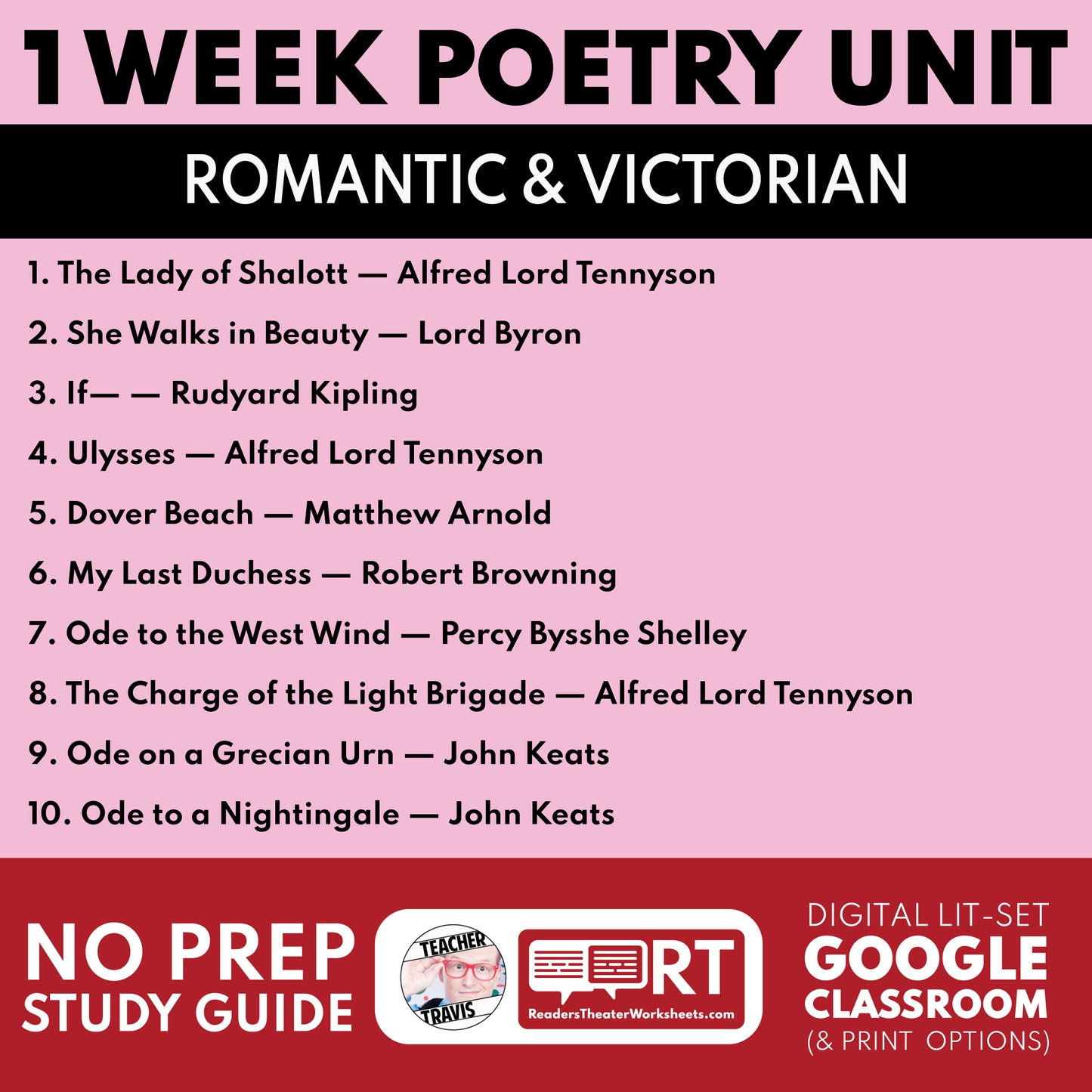
1 Week Summary
Day 1 — Isolation & Beauty
- The Lady of Shalott (Alfred Lord Tennyson, 1832)
- She Walks in Beauty (Lord Byron, 1814)
- Focus: Isolation and idealized beauty collide—Tennyson’s speaker watches life from a distance with growing tension, while Byron praises outward beauty as a reflection of inner balance, letting students compare description, tone, and perspective.
Day 2 — Purpose & Perseverance
- If— (Rudyard Kipling, 1910)
- Ulysses (Alfred Lord Tennyson, 1842)
- Focus: Purpose is defined through voice and resolve—Kipling outlines disciplined character under pressure, and Ulysses insists on continual striving—so students track argument moves, repetition, and motivational tone.
Day 3 — Loss & Control
- Dover Beach (Matthew Arnold, 1867)
- My Last Duchess (Robert Browning, 1842)
- Focus: Two speakers reveal inward conflict—Arnold mourns fading certainty and urges faithfulness, while Browning exposes power and control through a chilling dramatic monologue—supporting analysis of speaker reliability, subtext, and tone shifts.
Day 4 — Force & Sacrifice
- Ode to the West Wind (Percy Bysshe Shelley, 1819)
- The Charge of the Light Brigade (Alfred Lord Tennyson, 1854)
- Focus: Power moves through nature and conflict—Shelley begs the wind for renewal and transformative energy, while Tennyson honors courage and sacrifice in the face of danger—highlighting rhythm, urgency, and collective voice.
Day 5 — Art & Escape
- Ode on a Grecian Urn (John Keats, 1819)
- Ode to a Nightingale (John Keats, 1819)
- Focus: Keats weighs lasting beauty against human pain—art’s timeless stillness and song’s temporary escape—so students examine imagery, contrast, and the emotional “turns” that reshape meaning.
Quick Guide for Teachers
Adapted-Only Track (Fastest: 5-Day Model)
- Best for Grades 8–12 classes that need accessible language while keeping mature themes.
- Day 1–5: Students read the adapted versions of the two poems for the day and complete the matching Main Ideas & Themes Discussion Questions and the 12-question self-grading exit quiz.
- End the week with the Final Worksheet (Vocabulary Words, Short Answer Questions, and Challenge Questions).
- This track keeps the unit tight, predictable, and finishable in one week.
Original-Only Track (5-Day Close Reading)
- Ideal for strong readers or classes ready for original diction and syntax.
- Day 1–5: Students read the original poems for the day and use the same Discussion Questions, exit quizzes, and Final Worksheet—because all items are built on shared meaning, imagery, and argument moves present in both versions.
- Vocabulary Words (10) work for this track because each word appears in both the adapted and original texts.
Dual-Track Differentiation
- Use the same Day 1–5 schedule for everyone.
- Assign the adapted poems to supported readers and the original poems to advanced readers.
- All students complete the same Discussion Questions, daily exit quiz, and Final Worksheet because prompts target analysis that transfers across both versions (tone, symbolism, speaker stance, and thematic claim).
- If original-text readers need extra time, they can extend with annotation targets and evidence-based responses while adapted-text readers reread, strengthen vocabulary work, and draft higher-quality analytical answers.
This product includes a zip file consisting of:
NOTE: All files are editable and include (PDF, DOCX, PPTX, Google Docs/Slides/Forms)
Full Original Text: 4,900 words | 9.5 Flesch-Kincaid GL
• Lexile Range (est.): 1050–1200L | CEFR (est.): B2
• Best for on-grade readers and for close-reading extensions.
Adapted Version Text: 4,900 words | 8.5 Flesch-Kincaid GL
• Lexile Range (est.): 950–1100L | CEFR (est.): B1–B2
• Supported readers who need a clearer syntax path while keeping the same imagery, tone, and assessment alignment.
• Both versions tell the same content, allowing students to participate in shared discussions even when reading different texts.
Student Final Worksheet/Quizzes (PPTX, Google Slides/Forms)
- 10 Vocabulary Words
- 10 Short Answer Recall/Comprehension
- 5 Challenge Questions (synthesis, analysis, themes, real life connection)
- 5 Multiple Choice Quizzes (12 Questions per day)
Teacher’s Guide & Answer Key
- 5 Sets of Daily Discussion Questions (1 per part)
- 5 Sets of Self-Graded Exit Quizzes (1 per part, 12Qs each)
- Answer Keys for Vocab, Short Answer, and Challenge Questions
- Key Figures & Places reference sheets to help students track characters and settings
How can I confirm the quality of this resource? WANT MORE?
FREE BONUS ALERT!
- Free Access Code to the text on the Leveled-Lit Classics Library!
Frequently Asked Questions
Can students answer everything using only the adapted version?
Yes. All discussion prompts, short answers, and quiz items are written to be supported by the adapted poems.
What if some students read the original and others read the adapted?
That’s the intended use. The unit is dual-track, and each day includes 1–2 optional comparison items that quote both lines in the stem.
Do the adaptations keep stanza structure and tone?
Yes. The close-verse approach preserves stanza breaks and major images while simplifying syntax and archaic vocabulary for access.
Share