

Dynamic History
Texas State History - Grade 4 - Spindletop & the Oil Boom - Week 17 Full Curriculum
Texas State History - Grade 4 - Spindletop & the Oil Boom - Week 17 Full Curriculum
Couldn't load pickup availability
Classroom Use at a Glance
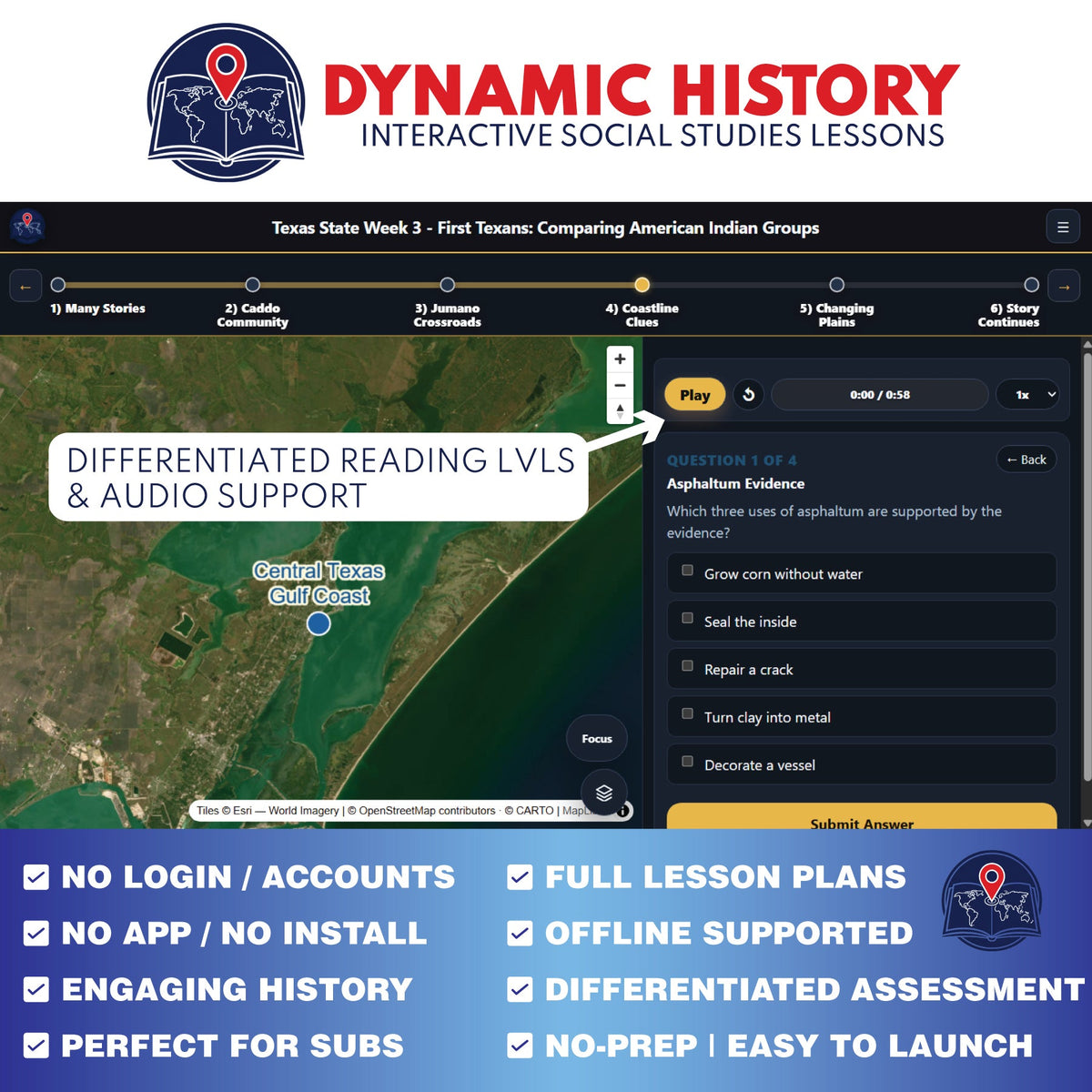
A complete Grade 4 Texas State History Week 17 resource built around the Dynamic History Spindletop and the Oil Boom interactive module. Includes a 6-stop investigation with 24 structured evidence tasks, stop-scoped clickable map evidence and historical image galleries, Standard and Accessible reading paths, six Accessible Read Intro TTS transcript files, 22-page Standard and 26-page Accessible print modules, a 23-page all-in-one Teacher Guide and Answer Key, a 5-page Spindletop Video Evidence Investigation with a built-in no-video fallback, and a 9-page Spindletop and the Texas Oil Boom Readers Theater Student Script with 10 scenes and 16 speaking roles. The Teacher Guide contains a Day 4 assessment bank with 10 vocabulary terms, 10 short-answer questions, 5 challenge questions, and 20 multiple-choice questions, plus a Day 5 final assessment bank with the same 10/10/5/20 structure and complete answer guidance.
Classroom Uses Whole Class, Small Groups, Content-Area Reading, Discussion, Assessment, Review, Homework, Sub Plan view all
- Whole Class
- Small Groups
- Content-Area Reading
- Discussion
- Assessment
- Review
- Homework
- Sub Plan
Included Reader’s Theater Script, Teacher Guide, Student Worksheet, Answer Key, Quiz, Vocabulary, Discussion Questions, Challenge Questions view all
- Reader’s Theater Script
- Teacher Guide
- Student Worksheet
- Answer Key
- Quiz
- Vocabulary
- Discussion Questions
- Challenge Questions
Format DOCX, ZIP Download, Printable, Editable view all
- DOCX
- ZIP Download
- Printable
- Editable
Differentiation Accessible Version, Mixed Reading Levels, ELL Support, Struggling Readers, Vocabulary Support, Small-Group Support view all
- Accessible Version
- Mixed Reading Levels
- ELL Support
- Struggling Readers
- Vocabulary Support
- Small-Group Support
Teach Grade 4 Texas history through a complete five-day Week 17 built around a 6-stop Dynamic History map investigation. Students investigate why Spindletop became a turning point even though Texas had producing oil before 1901, trace how clues, rotary drilling, investment, skilled workers, transportation, refineries, and growing cities formed a connected oil system, and weigh economic opportunity against environmental and community costs.
This Week 17 resource coordinates the interactive Dynamic History module with Standard and Accessible print companions, a Spindletop Video Evidence Investigation with a built-in no-video fallback, the complete Spindletop and the Texas Oil Boom (1901–1930) Readers Theater, and complete Day 4 and Day 5 assessment banks with answer keys inside the weekly Teacher Guide.
Will this resource meet your needs?
Try the full week 1 curriculum - 100% FREE DOWNLOAD
What students practice
- Turning points and evidence: distinguish the first Texas oil discoveries from the much larger change triggered by Spindletop in 1901.
- Clues versus proof: examine Oil Springs, Corsicana, Sour Lake, Saratoga, and Spindletop to decide what surface clues could suggest and what only drilling could prove.
- Technology, teamwork, and investment: connect Pattillo Higgins, Anthony Lucas, rotary drilling, skilled drillers, and financial backing to the Lucas Gusher.
- Boomtown movement: trace workers and production through Batson and Humble and explain why people followed new fields.
- Transportation and industry: connect oil fields to storage, rail tank cars, pipelines, Port Arthur, Sabine Pass, refineries, ports, and distant buyers.
- Economic and environmental tradeoffs: compare jobs, investment, and city growth with pollution, land disturbance, crowded services, and other costs of rapid development.
The five-day week
- Day 1: Dynamic History Stops 1–3 - early Texas oil, surface clues, Higgins and Lucas, rotary drilling, financing, and the January 10, 1901 gusher.
- Day 2: Dynamic History Stops 4–6 - boom fields, migration, transportation, refining, ports, urban growth, and environmental costs.
- Day 3: five-page Spindletop Video Evidence Investigation using historical visual evidence to connect the gusher to jobs, transportation, city growth, industry, and tradeoffs; a no-video fallback is built into the packet.
- Day 4: Spindletop and the Texas Oil Boom (1901–1930) Readers Theater with 10 scenes and 16 speaking roles, followed by a complete script-based assessment bank.
- Day 5: review and a complete standalone final assessment focused on Spindletop as a turning point and the larger oil system it accelerated.
What's included
- Dynamic History interactive module access with 6 guided stops and 24 structured evidence tasks.
- Stop-scoped clickable map evidence, historical image galleries, Standard and Accessible reading paths, and six Accessible Read Intro TTS transcript files.
- 22-page Standard and 26-page Accessible print-module companions with the same six stops, evidence, and assessed learning targets.
- 23-page all-in-one Teacher Guide and Answer Key with week-at-a-glance planning, substitute-ready daily lesson plans, differentiation, standards alignment, Day 3 answer guidance, Readers Theater support, and complete Day 4 and Day 5 assessment keys.
- Five-page Day 3 Spindletop Video Evidence Investigation with visual observation, evidence reasoning, a systems chain, written responses, and a no-video fallback.
- Nine-page Day 4 Readers Theater Student Script with 10 scenes and 16 speaking roles.
- Day 4 Readers Theater assessment bank with 10 vocabulary terms, 10 short-answer questions, 5 challenge questions, and a 20-question multiple-choice quiz.
- Day 5 final assessment bank with 10 vocabulary terms, 10 short-answer questions, 5 challenge questions, and a 20-question multiple-choice quiz.
- Complete model responses, direct answer keys, misconceptions, map-link support, and discussion guidance inside the weekly Teacher Guide.
Built for flexible classrooms
Use the complete five-day sequence or select individual components to fit your schedule. Standard and Accessible print modules preserve the same evidence and learning targets while giving students different reading supports. The Day 3 packet can be taught with the selected video or entirely from the included historical evidence.
Assessment options
Days 1–2 provide 24 structured Dynamic History evidence tasks. Day 3 uses observation and written evidence reasoning. Day 4 includes a complete Readers Theater assessment bank, and Day 5 includes a separate standalone final assessment bank so teachers can select the amount and format of assessment that fits their class.
Best fit
Designed for Grade 4 Texas Social Studies and aligned to Week 17 learning targets for Spindletop, Pattillo Higgins, Anthony Lucas, oil and gas development, industrialization, urbanization, transportation, natural resources, innovation, and positive and negative consequences of environmental change. This resource works well for whole-class instruction, small groups, partner work, independent practice, substitute plans, review, and blended print/digital classrooms.
Technology note: The Dynamic History interactive module requires internet access. The Standard and Accessible print modules, Day 3 evidence packet, Readers Theater script, and assessment banks provide substantial offline alternatives.
Share