
Readers Theater Worksheets
Texas State History | European Explorers in Texas Readers Theater Script | Grades 3-5
Texas State History | European Explorers in Texas Readers Theater Script | Grades 3-5
Couldn't load pickup availability
Classroom Use at a Glance
A no-prep state history Reader’s Theater script about European Explorers in Texas for elementary social studies classes. Designed for content-area reading, fluency practice, discussion, review, and quick assessment in one class period.
Classroom Uses Sub Plan, Small Groups, Fluency Practice, Performance Reading, Content-Area Reading, Review, Discussion, Assessment view all
- Sub Plan
- Small Groups
- Fluency Practice
- Performance Reading
- Content-Area Reading
- Review
- Discussion
- Assessment
Included Reader’s Theater Script, Teacher Guide, Student Worksheet, Quiz, Google Forms Quiz, Answer Key, Discussion Questions, Writing Prompt view all
- Reader’s Theater Script
- Teacher Guide
- Student Worksheet
- Quiz
- Google Forms Quiz
- Answer Key
- Discussion Questions
- Writing Prompt
Format PDF, DOCX, Google Docs, Google Forms, Printable, Editable view all
- DOCX
- Google Docs
- Google Forms
- Printable
- Editable
Differentiation Mixed Reading Levels, Vocabulary Support, Small-Group Support view all
- Mixed Reading Levels
- Vocabulary Support
- Small-Group Support
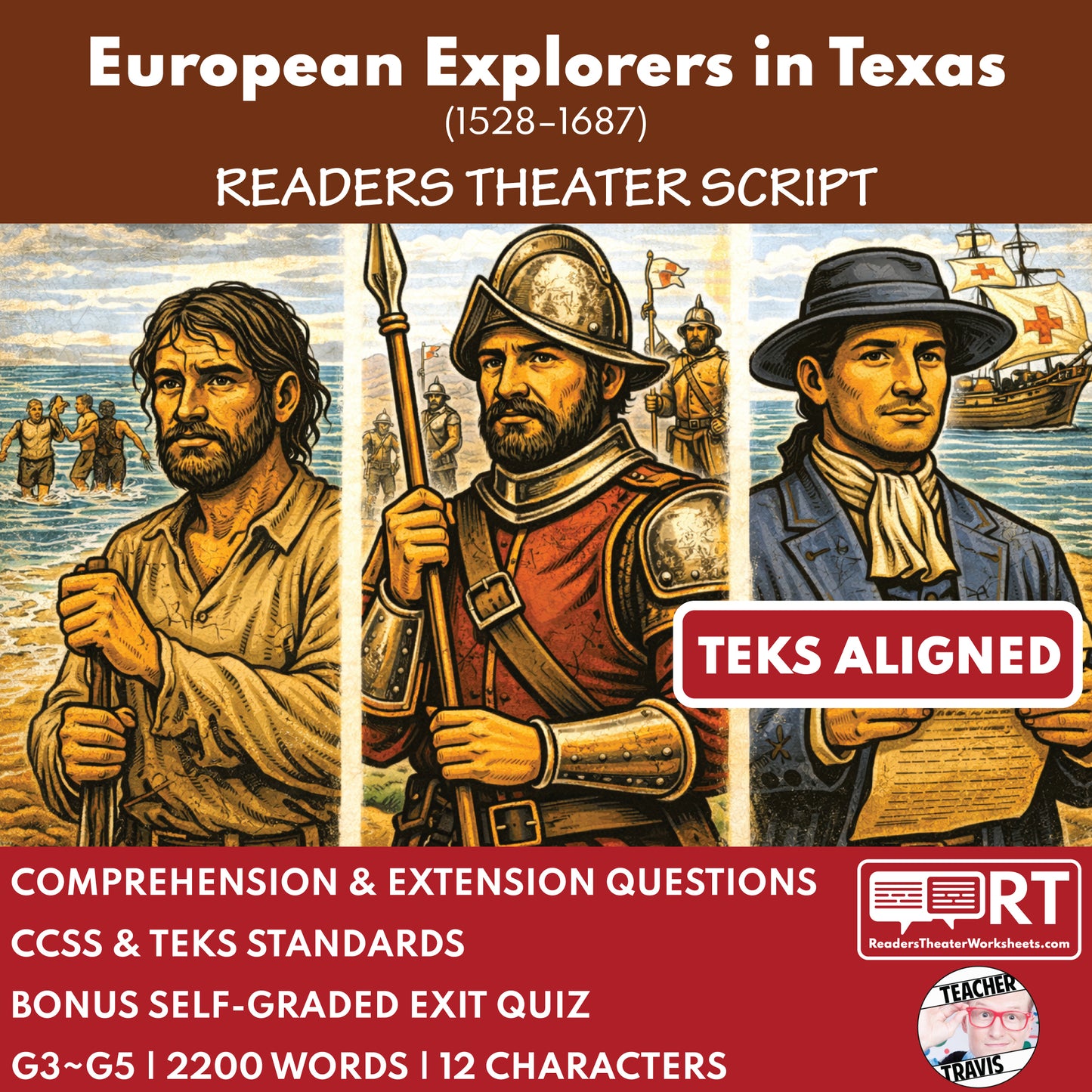
Teach early Texas exploration like a story your students can perform and explain. This 10-scene Readers Theater script brings three Grade 4 must-know explorers to life—Cabeza de Vaca, Coronado, and La Salle—through a fun press-meeting format and a clear cause-and-effect timeline.
Students learn motivations for exploration (survival, wealth, expansion, rivalry) and explain impact on later settlement patterns and Spanish-French competition, while also hearing an Indigenous perspective that reinforces Texas as a lived homeland.
SAVE 40% & GET THIS SCRIPT IN THE BUNDLE!
Wait! Is this resource really worth it?
Try the FREE Karankawa People of the Gulf Coast Script first to see if these will meet your needs.
Perfect For
- Texas History exploration units (Grades 3–5)
- Cause-and-effect writing from text evidence
- Readers Theater performances and fluency practice
- Small-group reading, discussion, and collaboration
What’s Included
(a single PDF with links to Google Docs/Slides, if print format is preferred you can download from your Google Drive to word/pdf/ppt/etc)
- Student Script: Editable, ~10 pages, ~2000 words, 10 scenes, casting breakdown, student intro (DOCX/PDF/Google Doc).
- Teacher Guide: Editable, ~12 pages, lesson tips, main ideas, answer keys, standards, casting with lexical levels (DOCX/PDF/Google Doc).
- Student Worksheet: Editable, ~20 slides, vocabulary (10 terms), short-answer (10), challenge (5), optional extensions (5) (Google Slides/PPTX).
- Self-Graded Exit Quiz: 20 multiple-choice questions (Google Forms).
Teacher’s Script Summary
- Joel and Amanda learn the three explorer names and the big idea that Texas was already home to many peoples.
- The class starts a press meeting and learns the explorers’ different reasons for coming and what “impact” means.
- Cabeza de Vaca’s group struggles to survive on the Texas coast and must rely on Native help and knowledge.
- The class explains how Cabeza de Vaca’s story spread and why more outsiders could bring major changes.
- Coronado follows a rumor about riches, showing how wealth and rivalry can drive risky choices.
- Coronado fails to find treasure, but the class explains how the trip still shaped later plans and claims.
- La Salle reaches the Texas coast and attempts a French colony, often taught as Fort St. Louis, but life is hard.
- Spain hears the news, sees a threat, and responds because of rivalry with France.
- Students build a cause-and-effect chain on a timeline connecting the three explorers to later Spanish action.
- The class summarizes motivations, impacts, and the need to study exploration with honesty and respect.
Standards Addressed
Texas State Standards (TEKS)
- TEKS 4.2(B): Identify accomplishments and explain the impact of significant explorers on the settlement of Texas, including Cabeza de Vaca, Coronado, and La Salle. (Vocabulary #1–#10, SAQs #1–#10, Quiz #1–#20, and Theme discussions.)
- TEKS 4.2(A): Explain motivations for European exploration and colonization, including economic opportunity, competition, and desire for expansion. (SAQs #2–#6, Quiz #2–#10, Challenge #11–#15, and Theme discussions.)
CCSS
- RL.4.1: Refer to details and examples in a text when explaining what the text says explicitly and when drawing inferences from the text.
- RL.4.2: Determine a theme of a story, drama, or poem from details in the text; summarize the text.
- RL.4.3: Describe in depth a character, setting, or event in a story or drama, drawing on specific details in the text (e.g., a character’s thoughts, words, or actions).
- RI.4.1: Refer to details and examples in a text when explaining what the text says explicitly and when drawing inferences from the text.
- RI.4.2: Determine the main idea of a text and explain how it is supported by key details; summarize the text.
- RI.4.3: Explain events, procedures, ideas, or concepts in a historical, scientific, or technical text, including what happened and why, based on specific information in the text.
- RF.4.4: Read with sufficient accuracy and fluency to support comprehension.
- SL.4.4: Report on a topic or text in an organized manner, using appropriate facts and relevant details; speak clearly at an understandable pace.
- L.4.4: Determine or clarify the meaning of unknown and multiple-meaning words and phrases based on grade 4 reading and content, choosing flexibly from a range of strategies.
CCRA
- CCRA.R.1: Read closely to determine what the text says explicitly and to make logical inferences from it; cite specific textual evidence.
- CCRA.R.2: Determine central ideas or themes of a text and analyze their development; summarize key supporting details and ideas.
- CCRA.R.3: Analyze how and why individuals, events, and ideas develop and interact over the course of a text.
- CCRA.W.2: Write informative/explanatory texts to examine and convey complex ideas and information clearly and accurately.
- CCRA.SL.1: Prepare for and participate effectively in a range of conversations and collaborations.
- CCRA.L.4: Determine or clarify the meaning of unknown and multiple-meaning words and phrases by using context clues and word parts.
Share