
Readers Theater Worksheets
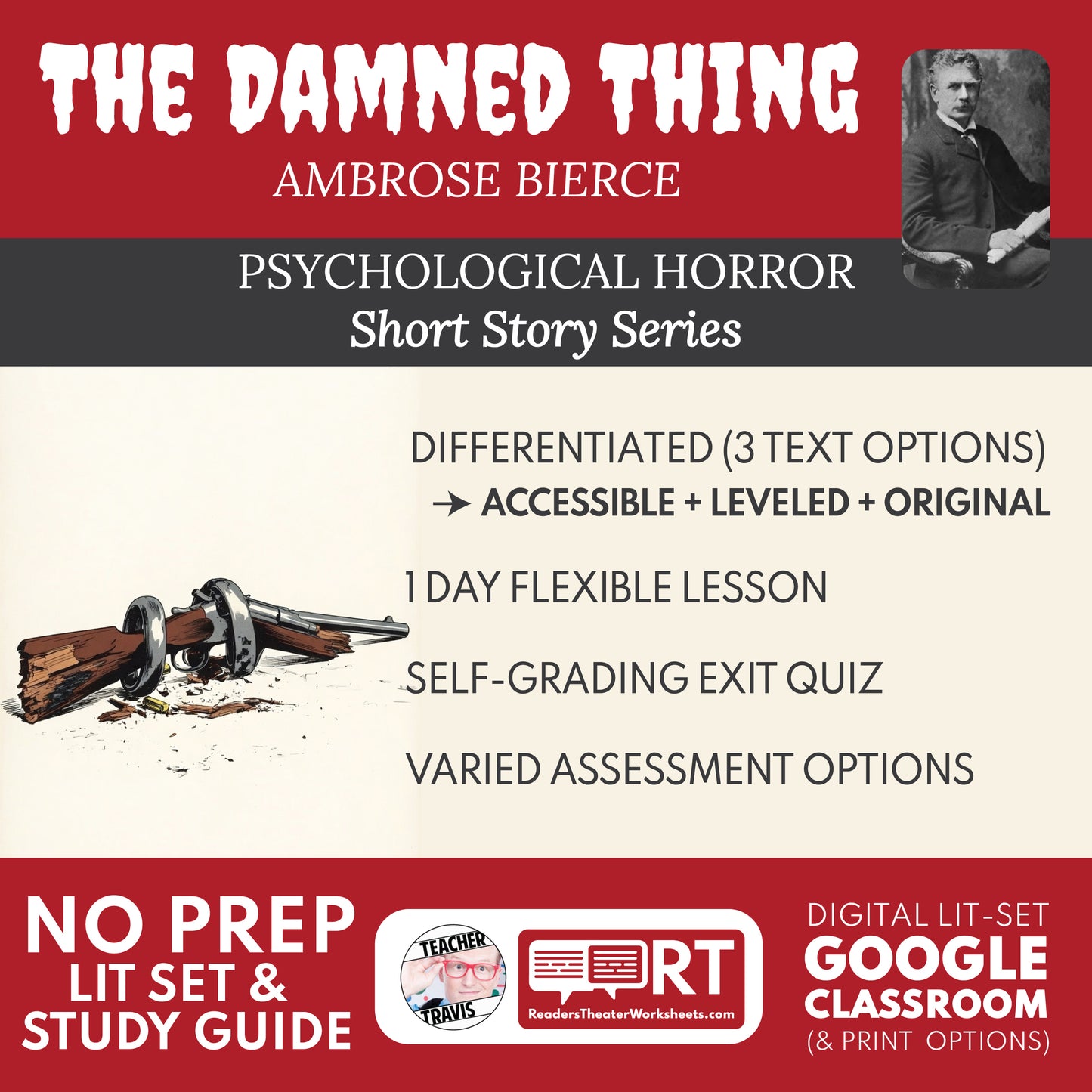
The Damned Thing Differentiated Short Story Study Guide & Analysis | Ambrose Bierce
The Damned Thing Differentiated Short Story Study Guide & Analysis | Ambrose Bierce
Couldn't load pickup availability
Classroom Use at a Glance
A no-prep differentiated short story study guide for The Damned Thing. Includes original and leveled reading support, comprehension and analysis activities, vocabulary work, discussion prompts, quiz materials, and teacher support for mixed-ability ELA classes.
Classroom Uses Close Reading, Discussion, Assessment, Review, Homework, Sub Plan view all
- Close Reading
- Discussion
- Assessment
- Review
- Homework
- Sub Plan
Included Original Text, Leveled Text, Teacher Guide, Student Worksheet, Quiz, Google Forms Quiz, Answer Key, Vocabulary, Discussion Questions, Writing Prompt view all
- Original Text
- Leveled Text
- Teacher Guide
- Student Worksheet
- Quiz
- Google Forms Quiz
- Answer Key
- Vocabulary
- Discussion Questions
- Writing Prompt
Format PDF, DOCX, Google Docs, Google Forms, Printable, Editable view all
- DOCX
- Google Docs
- Google Forms
- Printable
- Editable
Differentiation Original Version, Leveled Version, Mixed Reading Levels, Vocabulary Support, Struggling Readers, Advanced Readers view all
- Original Version
- Leveled Version
- Mixed Reading Levels
- Vocabulary Support
- Struggling Readers
- Advanced Readers
Bring a classic of psychological horror into your classroom without losing students to text complexity. This differentiated, standards-friendly unit for Ambrose Bierce’s The Damned Thing (1893) supports mixed reading levels while preserving the story’s tension, tone, and big ideas.
PROBLEM: In real classrooms, the original text can be a stretch for many readers, and mixed reading levels can stall the whole-group conversation—forcing constant reteaching or oversimplifying the story.
SOLUTION: This differentiated short story study for The Damned Thing keeps your class together by providing the complete Original Text plus two aligned options—the Accessible Text (HILO) and the Leveled Text—so students can read the version that best supports comprehension today while still completing the same discussions and assessments. The aligned versions keep the inquest frame and key evidence consistent so students can analyze structure and theme without getting lost in complexity.
Perfect for: Grades 7–12 whole-class short story study, mixed reading levels, inclusive classrooms, intervention groups, multilingual learners, sub plans, and fast-prep lesson days. Some teachers also use it for older students when they want rigorous themes with a more accessible reading load.
Cross-version alignment: Every Discussion Question and every Multiple Choice Exit Quiz item is designed to be answerable from the Accessible Text (HILO), the Leveled Text, or the Original Text, while still mapping cleanly to the original story for extension reading and evidence practice.
Try before you buy: The preview images and sample file are from the FREE Study Guide for The Most Dangerous Game so you can see the format. Download the free resource here and give it a real test drive: The Most Dangerous Game (FREE).
Quick Guide for Teachers (Daily Schedule)
- Reading: Students read the assigned text as small groups or independent reading (Accessible, Leveled, or Original) based on student levels.
- Whole-class discussion: Bring everyone together for the Discussion Questions (works across all text versions).
- Assessment: Assign the shared 10-question Multiple Choice Exit Quiz (printable or digital).
- Finishers/homework: Use the Vocabulary Words, Short Answer Questions, and Challenge Questions for early finishers—or assign as homework if time runs out.
- All components can be mixed and matched for flexible schedules and can be used in class or as homework.
This product includes a zip file consisting of:
NOTE: All files are editable and include (PDF, DOCX, PPTX, Google Docs/Slides/Forms)
Original Text: ~3,270 words | ~7.4 FKGL
- Lexile Range (est.): 970L–1185L | CEFR (est.): B1–B2
- Great for on-grade and advanced readers, close reading, and original-language extension work.
Leveled Text: ~2,370 words | ~5.4 FKGL
- Lexile Range (est.): 830L–1010L | CEFR (est.): B1
- Keeps the tone and major plot beats while simplifying sentence structure and vocabulary.
Accessible Text (HILO): ~1,520 words | ~4.8 FKGL
- Lexile Range (est.): 740L–950L | CEFR (est.): A2–B1
- Shorter and written in very simple language to reduce cognitive load and support comprehension.
- *All three versions tell the same story, allowing students to participate in shared discussions even when reading different texts.
Student Final Worksheet/Quizzes (PPTX, Google Slides/Forms)
- 10 Vocabulary Words
- 10 Short Answer Recall/Comprehension
- 5 Challenge Questions (analysis, themes, craft)
- 1 Multiple Choice Exit Quiz (10 Questions, cross-version aligned)
Teacher’s Guide & Answer Key
- 1 set of Discussion Questions
- 1 self-graded Exit Quiz (10Qs)
- Answer keys for Vocabulary, Short Answer, and Challenge Questions
FREE BONUS ALERT
Access Code Included to read on the Leveled-Lit Classics Library Platform!
Get the Bundle & Save 40%
Summary
An inquest investigates the death of Hugh Morgan, who feared something in the ravine. Witness William Harker describes a hunt where Morgan is suddenly seized and killed by an attacker no one can see. Though the jury calls it a mountain lion, Morgan’s diary argues that human senses are limited—and that an unseen creature could exist in a color beyond human sight.
Searchable Teacher Keywords
- The Damned Thing study guide (Ambrose Bierce)
- Invisible monster / unseen threat lesson
- Frame narrative and inquest structure analysis
- Differentiated short story resource (HILO + leveled text)
- Self-grading Google Forms exit quiz + printable option
- Theme: limits of perception (evidence-based discussion)
Frequently Asked Questions
How do students handle the inquest / testimony structure?
The discussion questions walk students through the frame (the inquest), the key witness account, and the diary entry so they can sequence events and explain how structure affects suspense.
Does the resource explain the ‘color beyond sight’ idea?
Yes—students explore the claim as a theme about the limits of human senses and how that uncertainty drives the horror. Prompts focus on evidence and reasoning rather than “right answers.”
Will Accessible (HILO) readers still succeed on the quiz?
Yes. The quiz items are cross-version aligned and written so students can prove understanding from any version while still mapping to the original for extension.
Common Core State Standards
- RL.8.1 / RL.9-10.1 / RL.CCR.1 — Cite textual evidence to support analysis of what the text says explicitly as well as inferences drawn from the text.
- RL.8.2 / RL.9-10.2 / RL.CCR.2 — Determine a theme or central idea of a text and analyze its development over the course of a text; provide an objective summary of the text.
- RL.8.3 / RL.9-10.3 / RL.CCR.3 — Analyze how and why individuals, events, and ideas develop and interact over the course of a text.
- RL.8.4 / RL.9-10.4 / RL.CCR.4 — Determine the meaning of words and phrases as they are used in the text, including figurative and connotative meanings; analyze the impact of word choice on meaning and tone.
- RL.8.5 / RL.9-10.5 / RL.CCR.5 — Analyze how an author’s choices about structure and sequencing create effects such as mystery, tension, or surprise and contribute to meaning and style.
- RL.8.6 / RL.9-10.6 / RL.CCR.6 — Analyze how point of view and perspective shape what the reader knows and how the text creates effects such as suspense or irony.
- RL.8.10 / RL.9-10.10 / RL.CCR.10 — Read and comprehend literature at the appropriate grade-level text complexity band independently and proficiently.
- W.8.1 / W.9-10.1 / W.CCR.1 — Write arguments to support claims with clear reasons and relevant evidence.
- W.8.2 / W.9-10.2 / W.CCR.2 — Write informative/explanatory texts to examine a topic and convey ideas clearly through selection, organization, and analysis of relevant content.
- W.8.9 / W.9-10.9 / W.CCR.9 — Draw evidence from literary texts to support analysis, reflection, and research.
- SL.8.1 / SL.9-10.1 / SL.CCR.1 — Engage effectively in collaborative discussions, building on others’ ideas and expressing one’s own clearly.
- L.8.4 / L.9-10.4 / L.CCR.4 — Determine or clarify the meaning of unknown and multiple-meaning words and phrases using context and a range of strategies.
Share