Readers Theater Worksheets
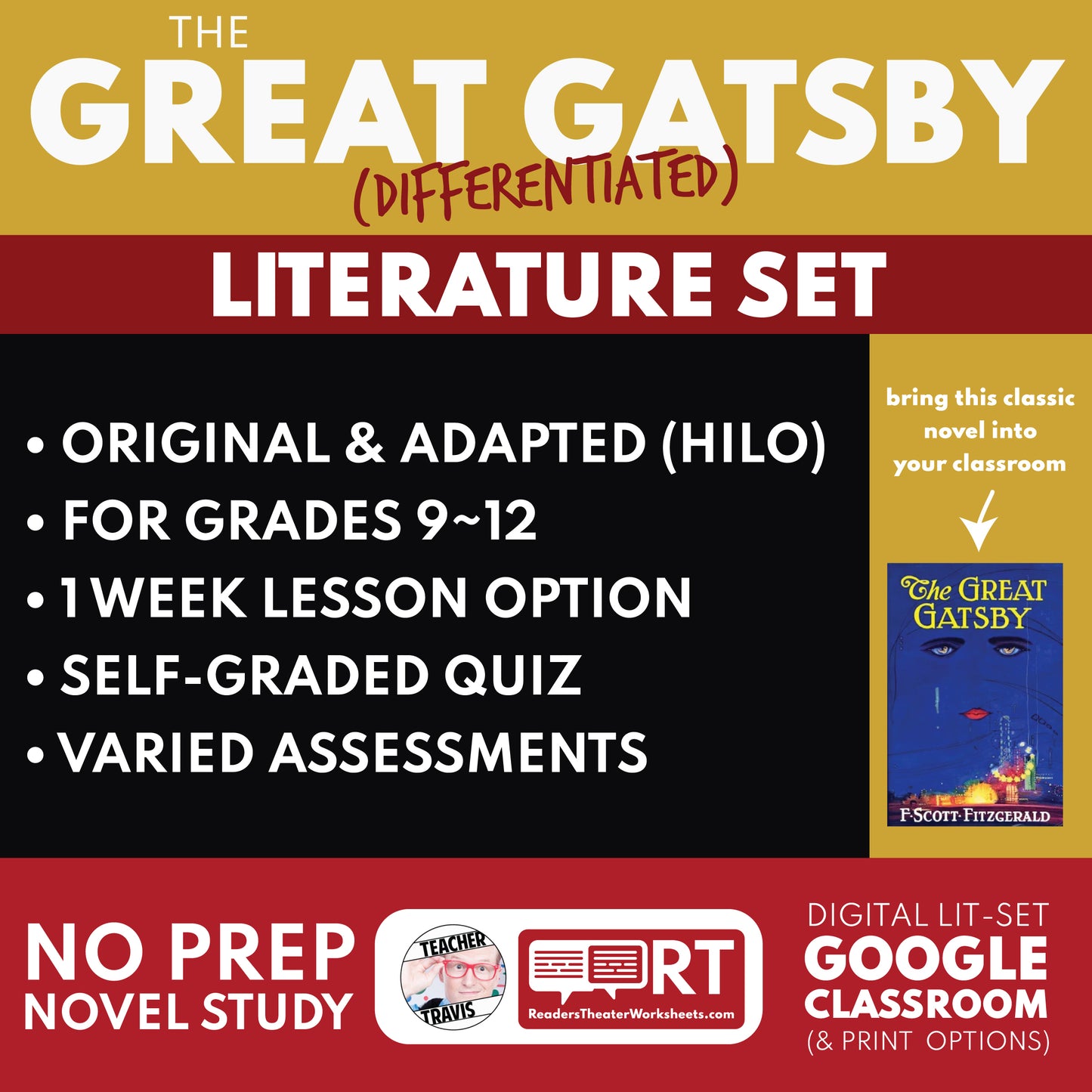
The Great Gatsby Differentiated Novel Study | ELA Unit | Literature Set for High School
The Great Gatsby Differentiated Novel Study | ELA Unit | Literature Set for High School
Couldn't load pickup availability
Classroom Use at a Glance
A differentiated literature study guide for grades 9–12 using The Great Gatsby. Built to support mixed reading levels, close reading, vocabulary, discussion, assessment, and no-prep ELA instruction.
Classroom Uses Close Reading, Discussion, Assessment, Whole Class, Homework, Sub Plan view all
- Close Reading
- Discussion
- Assessment
- Whole Class
- Homework
- Sub Plan
Included Original Text, Leveled Text, Teacher Guide, Student Worksheet, Answer Key, Quiz, Google Forms Quiz, Vocabulary, Discussion Questions, Writing Prompt view all
- Original Text
- Leveled Text
- Teacher Guide
- Student Worksheet
- Answer Key
- Quiz
- Google Forms Quiz
- Vocabulary
- Discussion Questions
- Writing Prompt
Format PDF, DOCX, Google Docs, Google Forms, Online Library Access, Printable, Editable, ZIP Download view all
- DOCX
- Google Docs
- Google Forms
- Online Library Access
- Printable
- Editable
- ZIP Download
Differentiation Original Version, Leveled Version, Mixed Reading Levels, Vocabulary Support, Struggling Readers, Advanced Readers view all
- Original Version
- Leveled Version
- Mixed Reading Levels
- Vocabulary Support
- Struggling Readers
- Advanced Readers
Problem: You want your students to experience classic literature, but you do not have weeks (or months) to push through a 48,000-word novel with mixed reading levels in the room.
Here’s the solution: a differentiated novel study, or “digital lit-set.” This resource gives you both the complete original The Great Gatsby by F. Scott Fitzgerald and a tightly adapted 5-part version totaling about 13,000 words. This dual-track design lets you match the reading path to every student without changing your assessments or losing instructional time. The adapted and original versions align part-for-part using a clear chapter map (Parts 1–5).
Every discussion question, multiple-choice exit quiz, short-answer item, and challenge question works for both tracks. Mixed-ability classrooms can stay on the same scenes, characters, and themes—even while students read different versions of the text.
Perfect for a Great Gatsby mini-reader unit in Grades 8–10, this resource supports CCSS reading, speaking/listening, language, and written response skills while keeping pacing realistic for real classrooms.
Quick Guide for Teachers:
Adapted-Only Track (Fastest: 5-Day Model)
- Best for Grades 9–10 classes that need a manageable, one-week novel experience.
- Day 1–5: Students read one adapted part per day and use the matching Main Ideas & Themes Discussion Questions and self-grading multiple-choice quiz.
- End the week with the Final Worksheet (Vocabulary Words, Short Answer Questions, and Challenge Questions).
- This track keeps lessons tight, predictable, and complete in five days.
Original-Only Track (Longer: Multi-Day Per Section)
- Ideal for stronger readers or classes ready for original language and sentence structure.
- Students read the original chapters aligned to each adapted Part
- Use the same Discussion Questions, MC exit quizzes, and Final Worksheet; all items are text-accurate for both versions.
- Vocabulary Words (10) are usable for both tracks, because each word appears in both the adapted text and the corresponding original chapters.
- This track preserves the full descriptive style and classic voice while giving you ready-made, age-appropriate assessments.
Dual-Track Differentiation (Mixed Readers, Flexible Timelines)
- Lets your entire class study the same plot, scenes, and themes at the same time—even when some students need the adapted text and others handle the full novel.
- Assign adapted Part 1 to students who need a shorter, clearer text and original corresponding chapters to students reading the full text; repeat this pattern through Parts 2–5 (timing will depend on your classroom's reading level)
- Give original-text students multiple days per section while adapted-text students reread key scenes, complete vocabulary tasks, and tackle discussion questions in pairs or small groups.
- All assessments are usable for both tracks: Discussion Questions, MC Exit Quizzes for each Part, and the Final Worksheet (Vocabulary, Short Answer, and Challenge Questions).
What’s the Tradeoff of Using the Adapted Version?
Pros:
- Reduces the novel to a fraction of its original length, fitting neatly into a one-week unit.
- Well suited for shorter attention spans and developing readers in Grades 9-10
- Preserves core narrative elements, characters, and themes
- Far better than skipping the book entirely due to time limits or reading-level concerns.
- Works for whole-class read-alouds, small-group novel studies, independent reading, or focused close-reading lessons.
Cons:
Omits some original language, side scenes, and descriptive passages for brevity, so students do not see every nuance of the original author's style.
Leaves fewer opportunities for deep line-by-line stylistic analysis than a full-length, multi-week novel study.
Bottom Line:
If you have the time and budget, nothing beats the feel of a real paperback in every student’s hands. But when time, copies, and reading levels are real constraints, a digital literature set like this—adapted text + original text mapping + shared assessments—lets you bring this classic novel into your classroom instead of leaving it on the “maybe someday” shelf. If you were to buy traditional paperbacks at about $7 per book for 30 students, that is a $210 investment. This digital lit-set gives you a reusable, print-friendly alternative you can adapt for many years and multiple groups.
This product includes a zip file consisting of:
NOTE: All files are editable and include (PDF, DOCX, PPTX, Google Docs/Slides/Forms)
Full Original Text: ~48,000 words | 6.8 Flesch-Kincaid GL
- Lexile Ranges: ~900L - 1100L | CEFR ~B1
- Great for advanced readers, extension groups, longer-term novel studies.
-
BONUS: Free Access to the text on our LEVELED-LIT CLASSICS Library Platform.
Adapted Version Text: ~13,000 words | 5.7 Flesch-Kincaid GL
- Lexile Ranges: ~800L - 1000L | CEFR ~A2+ / B1-
- Supported Grades 8/9 readers
- Divided into 5 parts for easy daily reading sessions
*Both versions tell the same story, allowing students to participate in shared discussions even when reading different texts.
Student Final Worksheet/Quizzes (PPTX, Google Slides/Forms)
- 10 Vocabulary Words
- 10 Short Answer Recall/Comprehension
- 5 Challenge Questions (synthesis, analysis, themes, real life connection)
- 5 Multiple Choice Quizzes (20 Questions) (1 per part)
Teacher’s Guide & Answer Key
- 5 Sets of Daily Discussion Questions (1 per part)
- 5 Sets of Self-Graded Exit Quizzes (1 per part, 20Qs each)
- Answer Keys for Vocab, Short Answer, and Challenge Questions
- Key Figures & Places reference sheets to help students track characters and settings
Adapted Version Summary (and source chapters)
Part 1 – First Impressions and Hidden Fault Lines
Adapted from: Chapters I–II of the original novel.
Nick Carraway arrives in the East and visits the Buchanans, where wealth and charm quickly reveal tension, cruelty, and an affair that disrupts the surface calm. He passes through the valley of ashes and meets George and Myrtle Wilson, whose lives expose the human cost beneath polished comfort. Nick also glimpses Gatsby for the first time, noticing a private longing aimed across the bay. The Part establishes the social layers and the pattern of power without accountability.
Part 2 – Spectacle, Rumors, and a Plan
Adapted from: Chapters III–IV of the original novel.
Nick enters Gatsby’s party world, where crowds consume luxury while rumors build Gatsby into a shifting public myth. Nick meets Gatsby and sees how carefully Gatsby manages his image, offering a polished life story supported by selective “proof.” Through Jordan’s account, Nick learns the earlier connection between Gatsby and Daisy and the pressure surrounding Daisy’s marriage choice. Gatsby’s private purpose becomes clear: he wants Nick to arrange a reunion that looks “accidental” and socially safe.
Part 3 – The Reunion and the Shrinking Dream
Adapted from: Chapters V–VI of the original novel.
Gatsby and Daisy reunite at Nick’s house, and the awkwardness of the meeting exposes the gap between long-held fantasy and real human presence. Gatsby uses his mansion and possessions as evidence that he has remade himself into someone “worthy,” and Daisy’s reaction is intense but complicated. The green light’s meaning shifts as distance collapses into reality, making Gatsby’s dream feel less limitless. The Part ends with the sense that Gatsby will not be satisfied with reunion—he wants the past restored on his terms.
Part 4 – Confrontation, Control, and Catastrophe
Adapted from: Chapter VII of the original novel.
As Gatsby’s hope becomes public, Tom grows aggressive and treats Gatsby as a threat to his dominance and security. In the city, Gatsby demands Daisy erase her past feelings and declare an absolute loyalty she cannot give. Heat, pressure, and pride push hidden truths into the open, and the conflict collapses on the drive back toward Long Island. Myrtle’s death turns private choices into irreversible consequences and forces characters to choose protection or responsibility.
Part 5 – Judgment and Aftermath
Adapted from: Chapters VIII–IX of the original novel.
Nick visits Gatsby the next morning and finds Gatsby still waiting for Daisy’s call, clinging to the dream even as danger approaches. Wilson’s grief turns into desperate pursuit and ends in violence that kills Gatsby. Nick then confronts the emptiness behind Gatsby’s social world when almost no one appears for the funeral, revealing how shallow the spectacle was. The novel closes with Nick leaving the East and delivering a final reflection on striving, memory, and the past’s pull against human hope.
Frequently Asked Questions About the Adapted Great Gatsby Novel Study
How can I use adapted The Great Gatsby for reluctant or below-level readers?
The adapted text totals approximately 13,000 words at a 5.7 reading level and is divided into five Parts for a short, structured unit. Each Part pairs with discussion questions and a 20-question exit quiz so students can show comprehension and inference without getting overwhelmed by the original’s length or style.
Is this Great Gatsby novel study aligned with CCSS for Grades 8–10?
Yes—this unit supports RL.9–10, SL.9–10, and L.9–10 through text-based comprehension, character and theme analysis, symbolism and craft study (including narration), academic discussion, and written responses. The assessments are designed to require evidence-based thinking rather than simple plot recall.
Can I use this for differentiated Great Gatsby instruction?
Yes—both the original and adapted versions are used with a clear part-by-part mapping so the entire class stays aligned on the same scenes and turning points. You can run one shared set of assessments and discussions while students read the version that best fits them.
This one classical literature mini-reader set gives you a complete, no-prep unit for teaching The Great Gatsby to Grades 8–10 in manageable, high-engagement steps—whether your students read the adapted version, the original, or both.
Share