
Readers Theater Worksheets
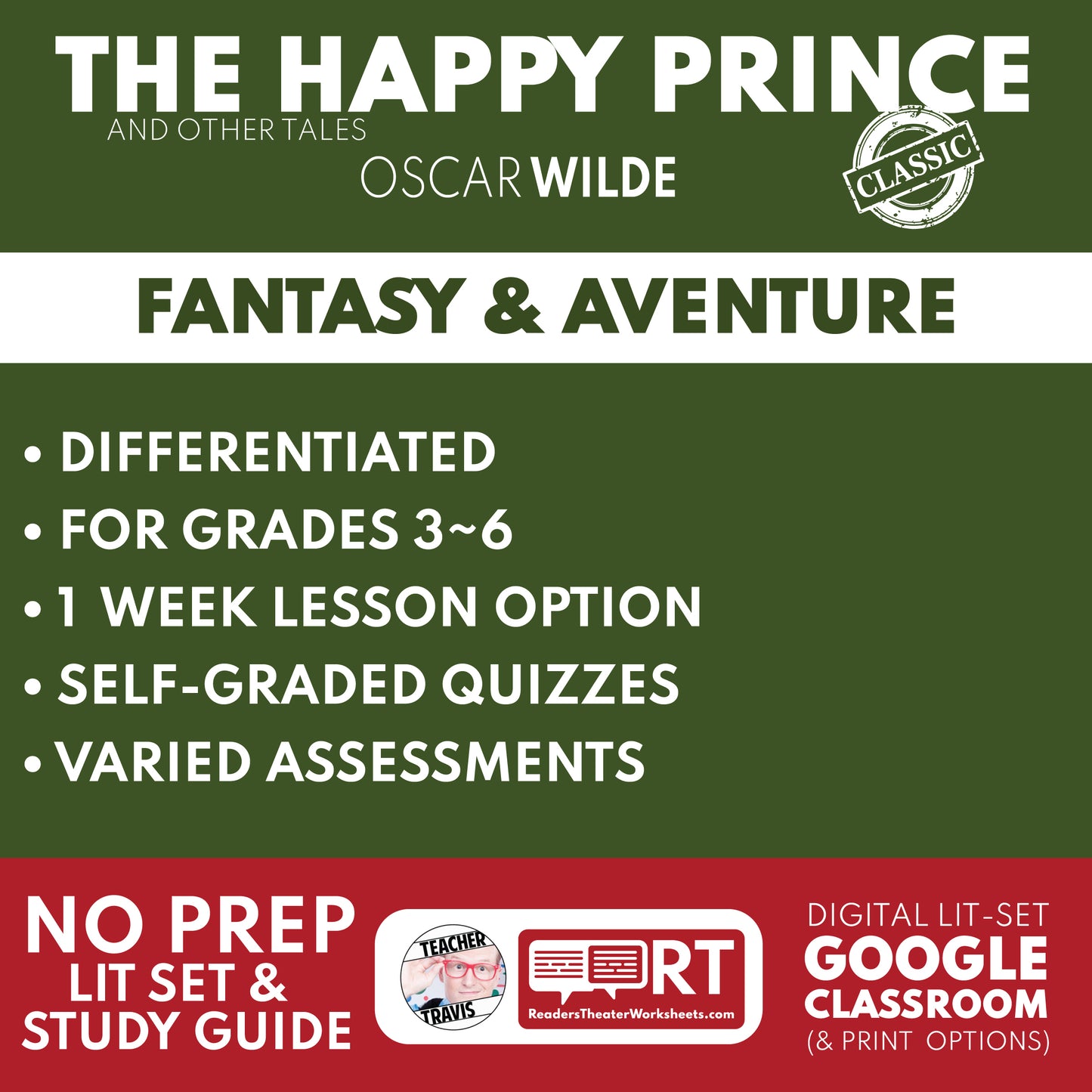
The Happy Prince and Other Tales by Oscar Wilde Differentiated Study Guide Lit Set for Grades 3 to 5
The Happy Prince and Other Tales by Oscar Wilde Differentiated Study Guide Lit Set for Grades 3 to 5
Couldn't load pickup availability
Classroom Use at a Glance
A no-prep differentiated literature study guide for The Happy Prince and Other Tales. Includes original and leveled reading support, comprehension and analysis activities, vocabulary work, discussion prompts, quiz materials, and teacher support for mixed-ability ELA classes.
Classroom Uses Close Reading, Discussion, Assessment, Review, Homework, Sub Plan view all
- Close Reading
- Discussion
- Assessment
- Review
- Homework
- Sub Plan
Included Original Text, Leveled Text, Teacher Guide, Student Worksheet, Quiz, Google Forms Quiz, Answer Key, Vocabulary, Discussion Questions, Writing Prompt view all
- Original Text
- Leveled Text
- Teacher Guide
- Student Worksheet
- Quiz
- Google Forms Quiz
- Answer Key
- Vocabulary
- Discussion Questions
- Writing Prompt
Format PDF, DOCX, Google Docs, Google Forms, Printable, Editable view all
- DOCX
- Google Docs
- Google Forms
- Printable
- Editable
Differentiation Original Version, Leveled Version, Mixed Reading Levels, Vocabulary Support, Struggling Readers, Advanced Readers view all
- Original Version
- Leveled Version
- Mixed Reading Levels
- Vocabulary Support
- Struggling Readers
- Advanced Readers
PROBLEM: Many classic literature units fall apart in real elementary classrooms because the original text can be long and challenging, and students often read at different levels—so teachers end up reteaching constantly or simplifying until the story loses its power.
SOLUTION: This differentiated novel study for The Happy Prince and Other Tales (Oscar Wilde) solves that problem by giving you both the complete original text and a condensed, five-part adapted version, so your class can move together while students read at the level that fits. The adaptation keeps the major plot events, character choices, and core themes (compassion, sacrifice, selfishness, pride, and what people value) so your discussions stay meaningful and text-based.
Dual-track assurance: Every discussion prompt, quiz item, and short-answer question is designed to be answerable from the adapted Part text while still mapping cleanly to the corresponding original chapter range for extension reading and evidence practice.
Perfect for: Upper elementary and middle school ELA (whole-class, small group, intervention, ELL support, and extension). Strong fit for classrooms that need one shared pacing plan while honoring different reading levels.
This product includes a zip file consisting of:
NOTE: All files are editable and include (PDF, DOCX, PPTX, Google Docs/Slides/Forms)
Full Original Text: 16,200 words | 8.0 Flesch-Kincaid GL
- Lexile Range (est.): ~900L–1100L | CEFR (est.): ~A2–B2
- Great for Grades 6–8 readers, or Grades 4–5 as a teacher-read / extension option.
Adapted Version Text: 7,300 words | 4.9 Flesch-Kincaid GL
- Lexile Range (est.): ~650L–850L | CEFR (est.): ~A2–B1
- Great for Grades 3–6 readers as an anchor text.
- Supports readers who need a shorter, clearer text with the same plot, themes, and assessment alignment.
- Both versions track the same major events, so students can participate in shared discussions even when reading different texts.
Student Final Worksheet/Quizzes (PPTX, Google Slides/Forms)
- 10 Vocabulary Words
- 10 Short Answer Recall/Comprehension
- 5 Challenge Questions (synthesis, analysis, themes, real life connection)
- 5 Multiple Choice Quizzes (20 Questions) (1 per part)
Teacher’s Guide & Answer Key
- 5 Sets of Daily Discussion Questions (1 per part)
- 5 Sets of Self-Graded Exit Quizzes (1 per part, 20Qs each)
- Answer Keys for Vocab, Short Answer, and Challenge Questions
- Key Figures & Places reference sheets to help students track characters and settings
Will this resource meet your classroom needs?
- Try a similar free resource: Journey to the Center of the Earth
- Get this in the Fantasy & Adventure Bundle (8) & SAVE 40%
FREE BONUS ALERT!
- Free Access Code to the text on the Leveled-Lit Classics Library!
- See all companion Study Guides in the Library here.
Quick Guide for Teachers:
Adapted-Only Track (Fastest: 5-Day Model)
- Best for Grades 3–6 classes that need a manageable, one-week novel experience.
- Day 1–5: Students read one adapted part per day and use the matching Main Ideas & Themes Discussion Questions and self-grading multiple-choice quiz.
- End the week with the Final Worksheet (Vocabulary Words, Short Answer Questions, and Challenge Questions).
- This track keeps lessons tight, predictable, and complete in five days.
Original-Only Track (Longer: Multi-Day Per Section)
- Ideal for stronger readers or classes ready for original language and sentence structure.
- Students read the original chapters aligned to each adapted Part
- Use the same Discussion Questions, MC exit quizzes, and Final Worksheet; all items are text-accurate for both versions.
- Vocabulary Words (10) are usable for both tracks, because each word appears in both the adapted text and the corresponding original chapters.
- This track preserves the full descriptive style and classic voice while giving you ready-made, age-appropriate assessments.
Dual-Track Differentiation (Mixed Readers, Flexible Timelines)
- Lets your entire class study the same plot, scenes, and themes at the same time—even when some students need the adapted text and others handle the full novel.
- Assign adapted Part 1 to students who need a shorter, clearer text and original corresponding chapters to students reading the full text; repeat this pattern through Parts 2–5 (timing will depend on your classroom's reading level)
- Give original-text students multiple days per section while adapted-text students reread key scenes, complete vocabulary tasks, and tackle discussion questions in pairs or small groups.
- All assessments are usable for both tracks: Discussion Questions, MC Exit Quizzes for each Part, and the Final Worksheet (Vocabulary, Short Answer, and Challenge Questions).
What’s the Tradeoff of Using the Adapted Version?
Pros:
- Reduces the novel to a fraction of its original length, fitting neatly into a one-week unit.
- Well suited for shorter attention spans and developing readers
- Preserves core narrative elements, characters, and themes
- Far better than skipping the book entirely due to time limits or reading-level concerns.
- Works for whole-class read-alouds, small-group novel studies, independent reading, or focused close-reading lessons.
Cons:
Omits some original language, side scenes, and descriptive passages for brevity, so students do not see every nuance of the original author's style.
Leaves fewer opportunities for deep line-by-line stylistic analysis than a full-length, multi-week novel study.
Adapted Version Summary
Part 1 – Pity, Sacrifice, and What the City Hides
Adapted from: “The Happy Prince” (original story).
A Swallow looking for warmth meets a statue who can finally see the city’s pain. Together they choose compassion over comfort, giving away beauty and safety to help others—until the ending asks what is truly “precious.”
Part 2 – Love, Cost, and Misread Gifts
Adapted from: “The Nightingale and the Rose” (original story).
A Student wants a red rose to win a dance, and a Nightingale treats love as something holy and worth sacrifice. The rose is made at great cost, but the people who asked for it do not value it, revealing a sharp truth about love, status, and meaning.
Part 3 – Possession, Welcome, and the Return of Spring
Adapted from: “The Selfish Giant” (original story).
A Giant shuts children out of his garden, and the garden freezes in endless winter. When he finally welcomes others, spring returns, and the story turns kindness into a life-changing—then deeply spiritual—lesson.
Part 4 – Exploitation Disguised as Morality
Adapted from: “The Devoted Friend” (original story).
A Miller uses “friendship” words to pressure Hans into giving more and more, even when it hurts him. The story exposes how good-sounding language can hide selfish control—and how unequal relationships can be normalized as “duty.”
Part 5 – Vanity, Self-Delusion, and Comic Collapse
Adapted from: “The Remarkable Rocket” (original story).
A Rocket believes he is destined for applause and keeps talking about his “feelings” and greatness. Reality repeatedly contradicts him, and the ending delivers a funny, sharp lesson about pride without substance.
Frequently Asked Questions
Can I teach this as a whole-class unit if my students read at different levels?
Yes. Use the adapted Parts as the shared anchor and pacing spine for everyone, then offer the mapped original stories for extension and evidence work.
Are the assessments truly text-dependent?
Yes. The quizzes and short-answer prompts require plot knowledge, motivation analysis, theme/symbolism thinking, and craft-based reasoning grounded in the Part text (and supported by the mapped original range).
What pacing works best?
A common pacing is one Part per week (5 weeks), with discussion mid-week and the exit quiz + short answers at the end of each Part.
Standards
Reading Literature: CCSS RL.3.1, CCSS RL.3.2, CCSS RL.3.3, CCSS RL.3.4, CCSS RL.3.5, CCSS RL.4.1, CCSS RL.4.2, CCSS RL.4.3, CCSS RL.4.4, CCSS RL.4.5, CCSS RL.5.1, CCSS RL.5.2, CCSS RL.5.3, CCSS RL.5.4, CCSS RL.5.5
Writing: CCSS W.3.1, CCSS W.3.2, CCSS W.4.1, CCSS W.4.2, CCSS W.4.9, CCSS W.5.1, CCSS W.5.2, CCSS W.5.9
Anchor Standards: CCRA.R.1, CCRA.R.2, CCRA.R.3, CCRA.R.4, CCRA.R.5, CCRA.W.1, CCRA.W.2, CCRA.SL.1, CCRA.L.4
Planning lessons with your department? Ask your school administrator about the Complete Leveled Lit Classics Library & Study Guide Bundle, with discounted one-time licensing options for teaching teams.
Share