
Readers Theater Worksheets
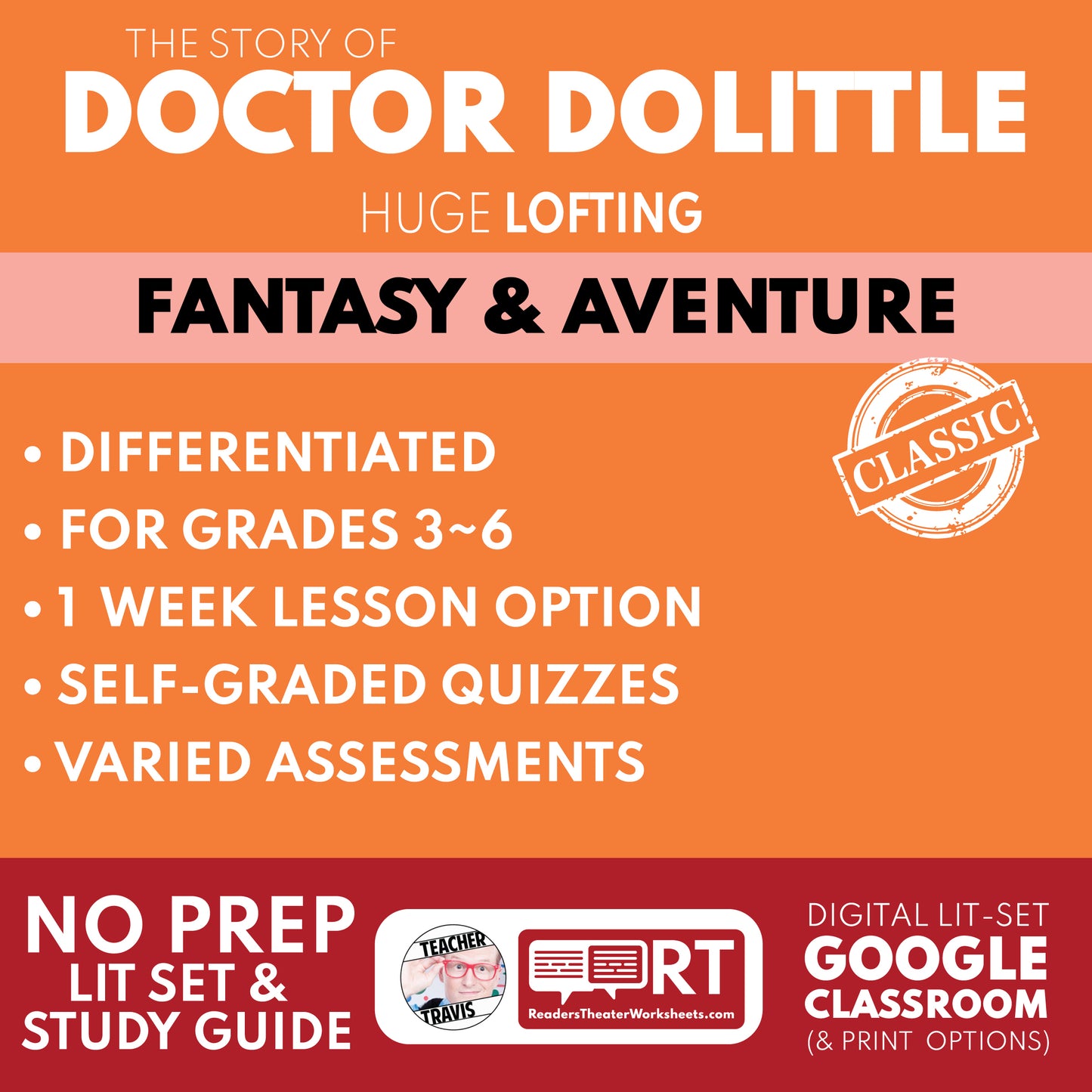
The Story of Doctor Dolittle by Hugh Lofting Differentiated Study Guide Lit Set for Grades 3 to 5
The Story of Doctor Dolittle by Hugh Lofting Differentiated Study Guide Lit Set for Grades 3 to 5
Couldn't load pickup availability
Classroom Use at a Glance
A no-prep differentiated literature study guide for The Story of Doctor Dolittle. Includes original and leveled reading support, comprehension and analysis activities, vocabulary work, discussion prompts, quiz materials, and teacher support for mixed-ability ELA classes.
Classroom Uses Close Reading, Discussion, Assessment, Review, Homework, Sub Plan view all
- Close Reading
- Discussion
- Assessment
- Review
- Homework
- Sub Plan
Included Original Text, Leveled Text, Teacher Guide, Student Worksheet, Quiz, Google Forms Quiz, Answer Key, Vocabulary, Discussion Questions, Writing Prompt view all
- Original Text
- Leveled Text
- Teacher Guide
- Student Worksheet
- Quiz
- Google Forms Quiz
- Answer Key
- Vocabulary
- Discussion Questions
- Writing Prompt
Format PDF, DOCX, Google Docs, Google Forms, Printable, Editable view all
- DOCX
- Google Docs
- Google Forms
- Printable
- Editable
Differentiation Original Version, Leveled Version, Mixed Reading Levels, Vocabulary Support, Struggling Readers, Advanced Readers view all
- Original Version
- Leveled Version
- Mixed Reading Levels
- Vocabulary Support
- Struggling Readers
- Advanced Readers
PROBLEM: Many classic literature units fall apart in real elementary classrooms because the original text can be long and challenging, and students often read at different levels—so teachers end up reteaching constantly or simplifying until the story loses its power.
SOLUTION: This differentiated novel study for The Story of Doctor Dolittle solves that problem by giving you both the complete original text and a condensed, five-part adapted version, so your class can move together while students read at the level that fits. The adaptation keeps the major plot events, character choices, and core themes so your discussions stay meaningful and text-based.
Dual-track assurance: Every discussion prompt, quiz item, and short-answer question is designed to be answerable from the adapted Part text while still mapping cleanly to the corresponding original chapter range for extension reading and evidence practice.
Perfect for: Grades 4–6 ELA, whole-class novel pacing, small groups/literature circles, intervention support with shared class discussions, and quick formative checks at the end of each Part.
This product includes a zip file consisting of:
NOTE: All files are editable and include (PDF, DOCX, PPTX, Google Docs/Slides/Forms)
Full Original Text: 25,282 words | 6.5 Flesch-Kincaid GL
- Lexile Range (est.): 900L–1050L | CEFR (est.): B1
- Great for stronger on-grade readers, extension groups, and evidence-citation practice.
Adapted Version Text: 10,203 words | 5.2 Flesch-Kincaid GL
- Lexile Range (est.): 800L–950L | CEFR (est.): A2–B1
- Great for on-level and supported readers who need a shorter text with the same plot, themes, and assessment alignment.
- Supported readers who need a shorter text with the same plot, themes, and assessment alignment.
- *Both versions tell the same story, allowing students to participate in shared discussions even when reading different texts.
Student Final Worksheet/Quizzes (PPTX, Google Slides/Forms)
- 10 Vocabulary Words
- 10 Short Answer Recall/Comprehension
- 5 Challenge Questions (synthesis, analysis, themes, real life connection)
- 5 Multiple Choice Quizzes (20 Questions) (1 per part)
Teacher’s Guide & Answer Key
- 5 Sets of Daily Discussion Questions (1 per part)
- 5 Sets of Self-Graded Exit Quizzes (1 per part, 20Qs each)
- Answer Keys for Vocab, Short Answer, and Challenge Questions
- Key Figures & Places reference sheets to help students track characters and settings
Will this resource meet your classroom needs?
- Try a similar free resource: Journey to the Center of the Earth
- Get this in the Fantasy & Adventure Bundle (8) & SAVE 40%
FREE BONUS ALERT!
- Free Access Code to the text on the Leveled-Lit Classics Library!
- See all companion Study Guides in the Library here.
Quick Guide for Teachers:
Adapted-Only Track (Fastest: 5-Day Model)
- Best for Grades 3–6 classes that need a manageable, one-week novel experience.
- Day 1–5: Students read one adapted part per day and use the matching Main Ideas & Themes Discussion Questions and self-grading multiple-choice quiz.
- End the week with the Final Worksheet (Vocabulary Words, Short Answer Questions, and Challenge Questions).
- This track keeps lessons tight, predictable, and complete in five days.
Original-Only Track (Longer: Multi-Day Per Section)
- Ideal for stronger readers or classes ready for original language and sentence structure.
- Students read the original chapters aligned to each adapted Part
- Use the same Discussion Questions, MC exit quizzes, and Final Worksheet; all items are text-accurate for both versions.
- Vocabulary Words (10) are usable for both tracks, because each word appears in both the adapted text and the corresponding original chapters.
- This track preserves the full descriptive style and classic voice while giving you ready-made, age-appropriate assessments.
Dual-Track Differentiation (Mixed Readers, Flexible Timelines)
- Lets your entire class study the same plot, scenes, and themes at the same time—even when some students need the adapted text and others handle the full novel.
- Assign adapted Part 1 to students who need a shorter, clearer text and original corresponding chapters to students reading the full text; repeat this pattern through Parts 2–5 (timing will depend on your classroom's reading level)
- Give original-text students multiple days per section while adapted-text students reread key scenes, complete vocabulary tasks, and tackle discussion questions in pairs or small groups.
- All assessments are usable for both tracks: Discussion Questions, MC Exit Quizzes for each Part, and the Final Worksheet (Vocabulary, Short Answer, and Challenge Questions).
What’s the Tradeoff of Using the Adapted Version?
Pros:
- Reduces the novel to a fraction of its original length, fitting neatly into a one-week unit.
- Well suited for shorter attention spans and developing readers
- Preserves core narrative elements, characters, and themes
- Far better than skipping the book entirely due to time limits or reading-level concerns.
- Works for whole-class read-alouds, small-group novel studies, independent reading, or focused close-reading lessons.
Cons:
Omits some original language, side scenes, and descriptive passages for brevity, so students do not see every nuance of the original author's style.
Leaves fewer opportunities for deep line-by-line stylistic analysis than a full-length, multi-week novel study.
Adapted Version Summary
Part 1 – The Doctor Who Chose Animals
Adapted from: CHAPTER I – CHAPTER IV.
Doctor Dolittle’s home fills with animals until people stop visiting and his income disappears. Polynesia teaches him to understand animal language, turning his care from guesswork into true listening. When the house sinks into real poverty, the animals work together to help. Then a message arrives from Africa: the monkeys are dying, and the Doctor has a mission worth risking everything for.
Part 2 – Shipwreck, Prison, and the Bridge of Apes
Adapted from: CHAPTER V – CHAPTER VII.
The journey to Africa turns dangerous as storms batter the ship and a wreck strands the group near shore. They push forward anyway, but the King of the Jolliginki blocks their path and imprisons the Doctor. Polynesia uses a daring trick to frighten the King into releasing them. Chased by soldiers, they escape across a cliff by trusting a living bridge formed by the monkeys themselves.
Part 3 – The Monkey Plague and a Dangerous Fame
Adapted from: CHAPTER VIII – CHAPTER XI.
In the monkeys’ land, the Doctor becomes an organizer as much as a healer, separating the sick, vaccinating the well, and building order out of panic. Some animals refuse to help at first, but the crisis forces pride to bend into responsibility. As the work succeeds, Dolittle’s reputation spreads beyond the jungle. That growing fame draws him into human politics and danger that medicine alone cannot solve.
Part 4 – Warnings, Magic, and the Barbary Dragon
Adapted from: CHAPTER XII – CHAPTER XVI.
Danger follows the group as rumor, superstition, and human power tighten around them. A warning from the rats pushes the Doctor to act before disaster, and Too-Too’s careful listening becomes a tool for survival. The Doctor must outthink threats while staying loyal to the animals who depend on him. By choosing mercy and strategy over revenge, he forces a change in people who have harmed others and keeps the group moving toward safety.
Part 5 – The Long Way Back
Adapted from: CHAPTER XVII – CHAPTER XXI.
The group faces new tests on the way home, including a mysterious locked room and a child in need of rescue. Ocean creatures, sharp senses, and stubborn teamwork help them solve problems that none of them could solve alone. When they finally return, home does not feel like the old life, because the Doctor has changed. His work with animals is now his true calling, and the adventure leaves him with a clearer purpose than before.
Frequently Asked Questions
Can students answer everything using only the adapted text?
Yes. All discussion prompts, quizzes, and short-answer questions are written to be fully answerable from the adapted Parts while still aligning to the original chapter ranges for extension.
How do I use this with mixed reading levels?
Use the adapted Parts as the shared anchor for whole-class pacing, then let advanced readers pull evidence from the original chapter range for deeper citations and comparisons.
What’s the easiest pacing plan?
Teach one Part at a time: read the Part text, discuss the theme questions, then use the Part quiz and short answers as a quick comprehension and analysis check.
Standards
Reading Literature: CCSS RL.3.1, CCSS RL.3.2, CCSS RL.3.3, CCSS RL.3.4, CCSS RL.3.5, CCSS RL.4.1, CCSS RL.4.2, CCSS RL.4.3, CCSS RL.4.4, CCSS RL.4.5, CCSS RL.5.1, CCSS RL.5.2, CCSS RL.5.3, CCSS RL.5.4, CCSS RL.5.5
Writing: CCSS W.3.1, CCSS W.3.2, CCSS W.4.1, CCSS W.4.2, CCSS W.4.9, CCSS W.5.1, CCSS W.5.2, CCSS W.5.9
Anchor Standards: CCRA.R.1, CCRA.R.2, CCRA.R.3, CCRA.R.4, CCRA.R.5, CCRA.W.1, CCRA.W.2, CCRA.SL.1, CCRA.L.4
Planning lessons with your department? Ask your school administrator about the Complete Leveled Lit Classics Library & Study Guide Bundle, with discounted one-time licensing options for teaching teams.
Share