Readers Theater Worksheets
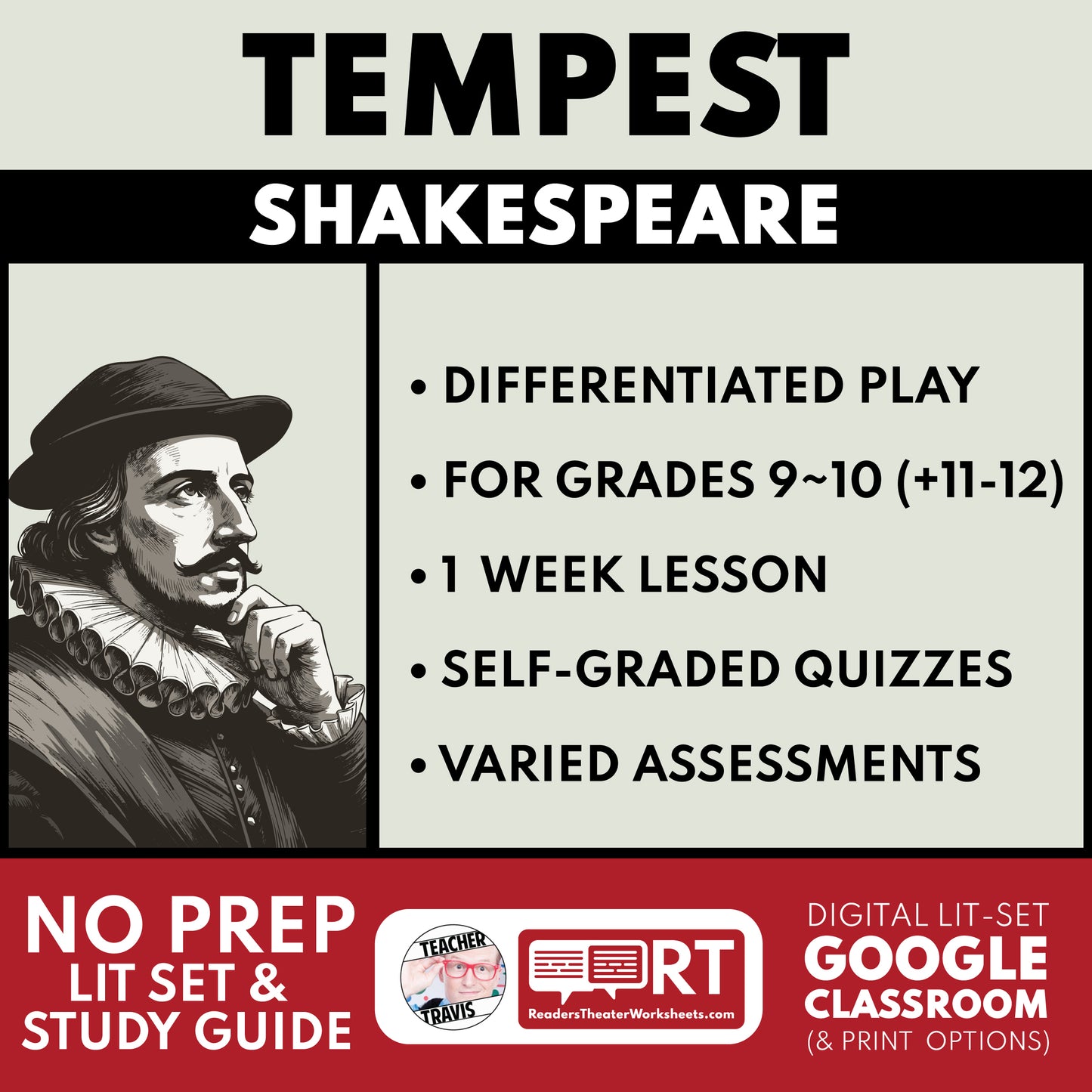
The Tempest Differentiated Study Guide & Analysis for Grades 9~12 | No Prep Plays | Shakespeare
The Tempest Differentiated Study Guide & Analysis for Grades 9~12 | No Prep Plays | Shakespeare
Couldn't load pickup availability
Classroom Use at a Glance
A differentiated drama study guide for grades 9–12 using The Tempest. Designed to support mixed reading levels with original and leveled text options, discussion, assessment, and teacher-ready lesson materials.
Classroom Uses Close Reading, Discussion, Assessment, Whole Class, Homework, Sub Plan view all
- Close Reading
- Discussion
- Assessment
- Whole Class
- Homework
- Sub Plan
Included Original Text, Leveled Text, Teacher Guide, Student Worksheet, Answer Key, Quiz, Google Forms Quiz, Vocabulary, Discussion Questions, Writing Prompt view all
- Original Text
- Leveled Text
- Teacher Guide
- Student Worksheet
- Answer Key
- Quiz
- Google Forms Quiz
- Vocabulary
- Discussion Questions
- Writing Prompt
Format PDF, DOCX, Google Docs, Google Forms, Online Library Access, Printable, Editable view all
- DOCX
- Google Docs
- Google Forms
- Online Library Access
- Printable
- Editable
Differentiation Original Version, Leveled Version, Mixed Reading Levels, Vocabulary Support, Struggling Readers, Advanced Readers view all
- Original Version
- Leveled Version
- Mixed Reading Levels
- Vocabulary Support
- Struggling Readers
- Advanced Readers
PROBLEM: Many classic literature units fall apart in real elementary classrooms because the original text can be long and challenging, and students often read at different levels—so teachers end up reteaching constantly or simplifying until the story loses its power.
SOLUTION: This differentiated novel study for The Tempest solves that problem by giving you both the complete original text and a condensed, five-part adapted version, so your class can move together while students read at the level that fits. The adaptation keeps the major plot events, character choices, and core themes so your discussions stay meaningful and text-based.
Dual-track assurance: Every discussion prompt, quiz item, and short-answer question is designed to be answerable from the adapted Part text while still mapping cleanly to the corresponding original Act range for extension reading and evidence practice.
Perfect for: Grades 9–12 whole-class drama study, supported/struggling readers, ELL support, reader’s theater performance units, and sub plans.
How can be sure this will meet my classroom's needs?
- Download the Hamlet Study Guide 100% FREE first and try one before you buy one :)
- Download 5+ Free Lit Study Guides just like this one and see for yourself :)
Want More?
- This resource is included in the Top 8 Plays for Grades 9-10 Students.
- SAVE 40% and get the 8 Week Unit Bundle here!
FREE BONUS ALERT!
- Free Access Code to the text on the Leveled-Lit Classics Library!
Casting & Classroom Size Note:
Most plays don’t have 25–35 distinct speaking roles. If your class has more students than characters, you have two strong options.
- *NOTE: Casting Breakdown tables are for the adapted script only. The original text contains the same characters in the same sections, but line counts will vary.
Quick Guide for Teachers
Adapted-Only Track (Fastest: 5-Day Model)
- Best for Grades 8–12 classes that need accessible language while keeping mature themes.
- Day 1–5: Students read one adapted Part per day and complete the matching Main Ideas & Themes Discussion Questions and the self-grading exit quiz.
- End the week with the Final Worksheet (Vocabulary Words, Short Answer Questions, and Challenge Questions).
- This track keeps the unit tight, predictable, and finishable in one week.
Original-Only Track (5-Day Close Reading)
- Ideal for strong readers or classes ready for original diction and syntax.
- Day 1–5: Students read the original text for the same Part range and use the same Discussion Questions, exit quizzes, and Final Worksheet—because all items are built on shared meaning, plot beats, and theme development present in both versions.
- Vocabulary Words (10) work for this track because each word appears in both the adapted and original texts.
Dual-Track Differentiation
- Use the same Day 1–5 schedule for everyone.
- Assign the adapted Parts to supported readers and the original text to advanced readers.
- All students complete the same Discussion Questions, daily exit quiz, and Final Worksheet because prompts target analysis that transfers across both versions (tone, symbolism, speaker stance, and thematic claim).
- If original-text readers need extra time, they can extend with annotation targets and evidence-based responses while adapted-text readers reread, strengthen vocabulary work, and draft higher-quality analytical answers.
This product includes a zip file consisting of:
NOTE: All files are editable and include (PDF, DOCX, PPTX, Google Docs/Slides/Forms)
Full Original Text: 17,400 words | 7.0 Flesch-Kincaid GL
- - Lexile Range (est.): 1050L–1300L | CEFR (est.): B2–C1
- - Great for on-grade and advanced readers, close reading, and original-language extension work.
Adapted Version Text: 8,600 words | 4.0 Flesch-Kincaid GL
- - Lexile Range (est.): 800L–1000L | CEFR (est.): B1
- - Designed for supported readers who need a shorter text with the same plot, themes, and assessment alignment.
- - *Both versions tell the same story, allowing students to participate in shared discussions even when reading different texts.
Student Final Worksheet/Quizzes (PPTX, Google Slides/Forms)
- 10 Vocabulary Words
- 10 Short Answer Recall/Comprehension
- 5 Challenge Questions (synthesis, analysis, themes, real life connection)
- 5 Multiple Choice Quizzes (20 Questions per day)
Teacher’s Guide & Answer Key
- 5 Sets of Daily Discussion Questions (1 per part)
- 5 Sets of Self-Graded Exit Quizzes (1 per part, 20Qs each)
- Answer Keys for Vocab, Short Answer, and Challenge Questions
- Key Figures & Places reference sheets to help students track characters and settings
Adapted Version Summary
Part 1 (Act 1): A storm brings the court to the island, and Prospero reveals the past betrayal that exiled him while beginning his plan to test and restore.
Part 2 (Act 2): Two plots grow in parallel—Antonio tempts Sebastian toward murder, and Caliban recruits Stephano and Trinculo into a comic but dangerous coup.
Part 3 (Act 3): Love is tested and chosen, the drunk plotters are steered by music and greed, and a vanishing feast forces the guilty nobles to face consequence.
Part 4 (Act 4): Prospero blesses the marriage with a masque, then breaks the celebration to stop violence and moves toward giving up controlling magic.
Part 5 (Act 5): Prospero chooses mercy, restores identities and order, frees Ariel, acknowledges Caliban, and ends by asking the audience for release.
Frequently Asked Questions
Do I have to teach the original Shakespeare text to use this?
No. The questions and quizzes are designed to be answerable from the adapted Parts, with Act-based mapping for optional extension and evidence practice.
Can I use this for performance (reader’s theater)?
Yes. The final DOCX includes casting breakdown tables for all five parts so you can assign roles quickly and plan the week.
What if my class has mixed reading levels?
Use the adapted Parts for shared pacing and discussion, and offer the original Act range to advanced readers for deeper language analysis and quoting practice.
Common Core State Standards
- RL.11-12.1 — Cite strong and thorough textual evidence to support analysis of what the text says explicitly as well as inferences drawn from the text.
- RL.11-12.2 — Determine two or more themes or central ideas of a text and analyze their development over the course of the text.
- RL.11-12.3 — Analyze the impact of the author’s choices regarding how to develop and relate elements of a story or drama (e.g., where a story is set, how the action is ordered, how the characters are introduced and developed).
- RL.11-12.4 — Determine the meaning of words and phrases as they are used in the text; analyze the impact of specific word choices on meaning and tone (including satire and humor).
- RL.11-12.5 — Analyze how an author’s choices concerning how to structure specific parts of a text contribute to its overall structure and meaning, as well as its aesthetic impact (e.g., how Act/Scene structure and entrances/exits shape tension and comedy).
- RL.11-12.6 — Analyze a case in which understanding a point of view requires distinguishing what is directly stated from what is really meant (e.g., satire, sarcasm, irony).
- RL.11-12.10 — By the end of grade 11, read and comprehend literature, including dramas, at the high end of the grades 11–CCR text complexity band independently and proficiently.
- SL.11-12.1 — Initiate and participate effectively in a range of collaborative discussions, building on others’ ideas and expressing one’s own clearly and persuasively.
- W.11-12.2 — Write informative/explanatory texts to examine and convey complex ideas, concepts, and information clearly and accurately.
- W.11-12.9 — Draw evidence from literary texts to support analysis, reflection, and research.
Share