Readers Theater Worksheets
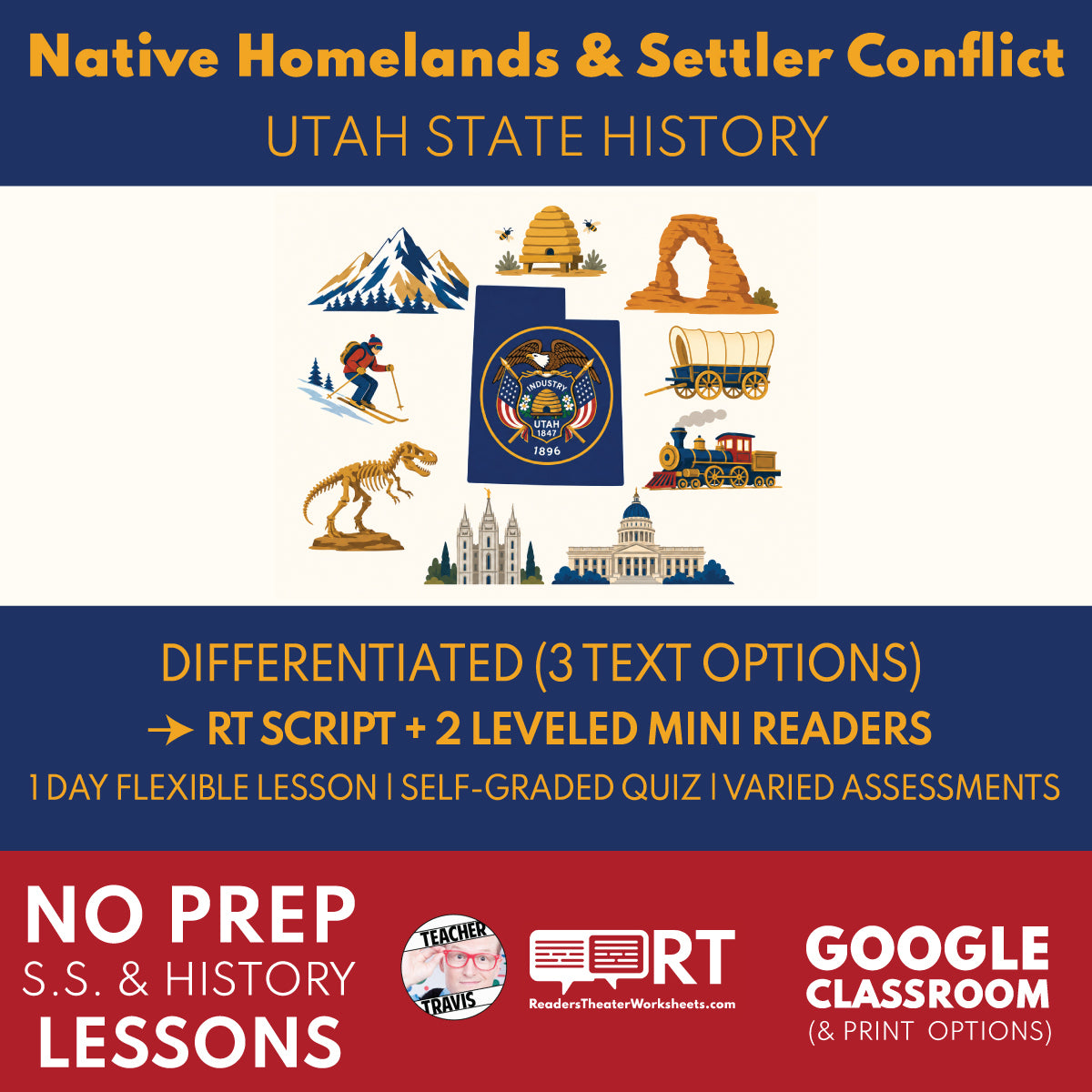
Utah State History | Native Homelands and Settler Conflict RT Script and Mini Readers | Grades 3-5
Utah State History | Native Homelands and Settler Conflict RT Script and Mini Readers | Grades 3-5
Couldn't load pickup availability
Classroom Use at a Glance
A Utah Grade 4 lesson on Native Homelands and Settler Conflict with Reader’s Theater, differentiated Mini Readers, shared assessment, and teacher support.
Classroom Uses Whole Class, Small Groups, Fluency Practice, Content-Area Reading, Discussion, Assessment, Review view all
- Whole Class
- Small Groups
- Fluency Practice
- Content-Area Reading
- Discussion
- Assessment
- Review
Included Reader’s Theater Script, Original Mini Reader, Accessible Mini Reader, Teacher Guide, Student Worksheet, Answer Key, Quiz, Google Forms Quiz, Vocabulary, Discussion Questions, Challenge Questions view all
- Reader’s Theater Script
- Original Mini Reader
- Accessible Mini Reader
- Teacher Guide
- Student Worksheet
- Answer Key
- Quiz
- Google Forms Quiz
- Vocabulary
- Discussion Questions
- Challenge Questions
Format PDF, DOCX, Google Forms, ZIP Download, Printable, Editable view all
- DOCX
- Google Forms
- ZIP Download
- Printable
- Editable
Differentiation Accessible Version, Original Version, Mixed Reading Levels, ELL Support, Struggling Readers, Vocabulary Support, Small-Group Support view all
- Accessible Version
- Original Version
- Mixed Reading Levels
- ELL Support
- Struggling Readers
- Vocabulary Support
- Small-Group Support
A museum team must replace five broken captions that incorrectly blend different Native peoples, conflicts, places, and government policies into one story. This Grade 4 lesson pairs a student-led Reader’s Theater with Original and Accessible Mini Readers so mixed-level students can study the same Utah history.
Joel, Amanda, and a museum exhibit team discover that five short captions have blended different Native peoples, conflicts, places, and government policies into one inaccurate story. Across ten scenes they connect settlement expansion with changing access to land and resources, separate the Walker War from the Black Hawk War, examine Ute reservation and removal policy, locate and explain the Bear River Massacre at Boa Ogoi, keep Goshute, Paiute, Navajo, Ute, and Shoshone histories specific, and end with living sovereignty and the Northwestern Band of the Shoshone Nation’s Wuda Ogwa restoration project.
Part 5 of the 10-script Utah State History bundle. Get the complete Utah State History Mini Unit Bundle here.
View the Full 10-Script Utah Bundle
Classroom Use
Students can use the Reader’s Theater for oral reading and discussion or work from either Mini Reader for independent, small-group, intervention, or homework use. The shared vocabulary, written questions, challenge questions, and multiple-choice quiz keep the class on the same historical content.
Standards Alignment
Utah Grade 4 Social Studies standards documented in the Teacher Guide include 4.3.2, 4.3.5, 4.5.1. CCSS literacy connections are supported through informational reading, text evidence, vocabulary, collaborative discussion, and written response tasks.
Perfect For
- Settlement pressure on land and resources
- Walker War
- Bear River Massacre at Boa Ogoi
- Ute reservation and removal policy
- Black Hawk War
- Grade 4 Utah State History and content-area literacy
- Whole-class lessons, small groups, sub plans, review, intervention, or enrichment
Flexible Differentiation
- Use the Reader’s Theater script for collaborative oral reading, fluency, and discussion.
- Use the Original Mini Reader for independent or shared Grade 4 reading.
- Use the Accessible Mini Reader for supported Grade 3 language, ELL support, intervention, or mixed-level classes.
- Use the student worksheet, challenge questions, print quiz, or self-grading Google Forms quiz for assessment and review.
Skills Addressed
- Reading Fluency
- Vocabulary in Context
- Comprehension
- Text Evidence
- Historical Thinking
- Cause and Effect
- Compare and Contrast
What’s Included
Student Text Options
- Reader’s Theater Script with differentiated character roles
- Original Mini Reader
- Accessible Mini Reader
Assessment Materials
- Vocabulary in context
- 10 two-part comprehension questions
- 5 two-part challenge questions
- 20-question multiple-choice quiz
- Self-grading Google Forms quiz
Teacher Materials
- Teacher Guide and Utah standards alignment
- Answer keys
- Discussion prompts
- Sources Used & Further Reading
- Printable and editable classroom files
Explore All 10 Utah State History Scripts
This lesson is part of a connected ten-product sequence. Teach the complete sequence as a mini unit or select individual lessons to match your pacing guide.
- 1. Great Salt Lake, Mountains, Deserts, and Utah Geography
- 2. Fremont, Ancestral Pueblo, and Utah Tribal Nations
- 3. Explorers, Traders, and Early Trails
- 4. Mormon Pioneer Migration and Settlement
- 5. Native Homelands and Settler Conflict
- 6. Utah Territory and Federal Power
- 7. The Transcontinental Railroad Changes Utah
- 8. Mining, Immigration, and New Communities
- 9. Utah Statehood and the Constitution
- 10. World War II, Japanese American Incarceration, Public Lands, and Modern Utah
Get the Complete Utah State History Bundle
Text Summary
Joel, Amanda, and a museum exhibit team discover that five short captions have blended different Native peoples, conflicts, places, and government policies into one inaccurate story. Across ten scenes they connect settlement expansion with changing access to land and resources, separate the Walker War from the Black Hawk War, examine Ute reservation and removal policy, locate and explain the Bear River Massacre at Boa Ogoi, keep Goshute, Paiute, Navajo, Ute, and Shoshone histories specific, and end with living sovereignty and the Northwestern Band of the Shoshone Nation’s Wuda Ogwa restoration project.
Share