
Readers Theater Worksheets
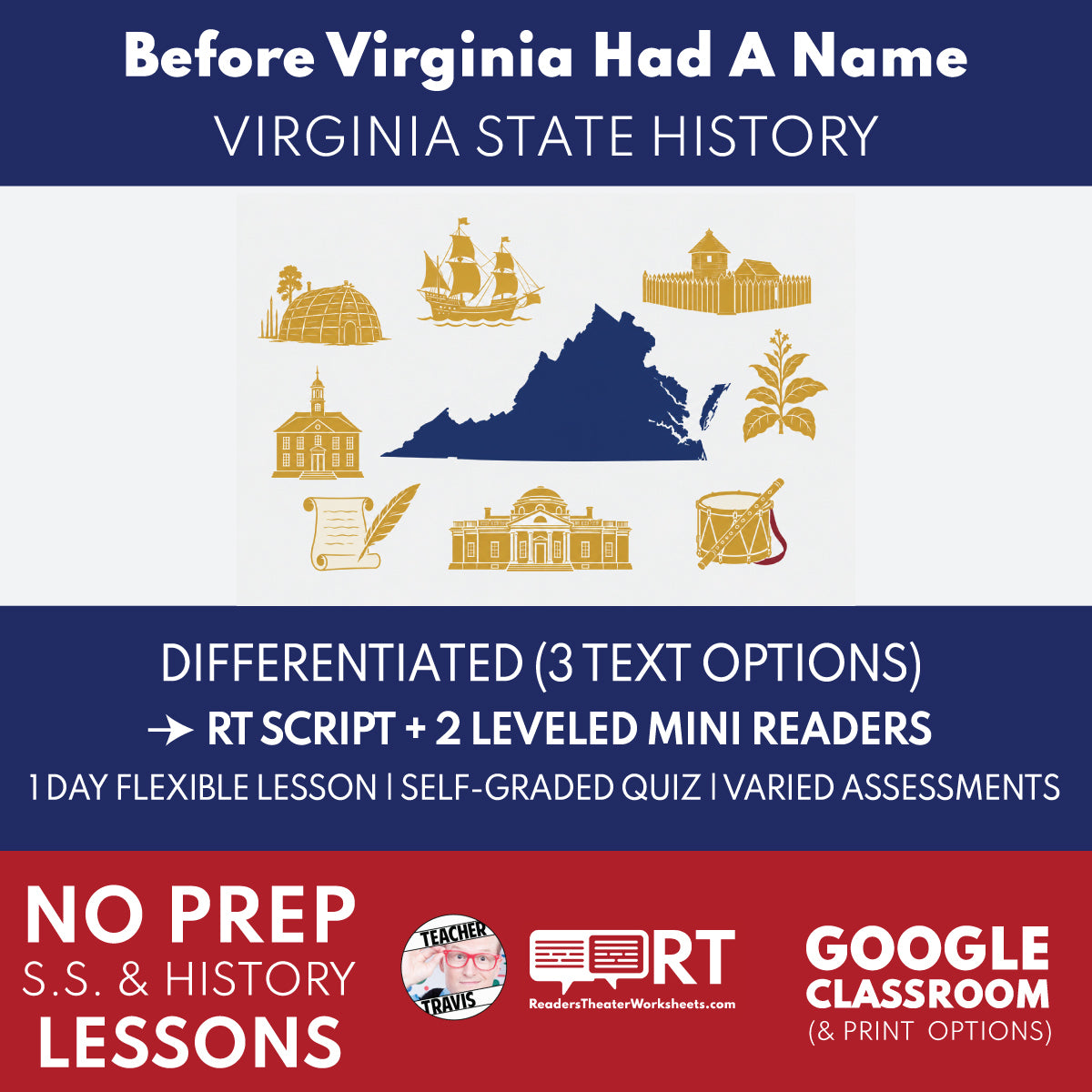
Virginia State History | Before Virginia Had a Name RT Script and Mini Readers | Grades 3-5
Virginia State History | Before Virginia Had a Name RT Script and Mini Readers | Grades 3-5
Couldn't load pickup availability
Classroom Use at a Glance
A Virginia First Peoples, archaeology, Werowocomoco, Tsenacomoco, sovereignty, and continuity lesson for grades 3–5 with Reader’s Theater, original and accessible Mini Readers, worksheets, and assessments.
Classroom Uses Whole Class, Small Groups, Fluency Practice, Content-Area Reading, Discussion, Assessment, Review view all
- Whole Class
- Small Groups
- Fluency Practice
- Content-Area Reading
- Discussion
- Assessment
- Review
Included Reader’s Theater Script, Original Mini Reader, Accessible Mini Reader, Teacher Guide, Student Worksheet, Answer Key, Quiz, Google Forms Quiz, Vocabulary, Discussion Questions, Challenge Questions, Primary Source Extension view all
- Reader’s Theater Script
- Original Mini Reader
- Accessible Mini Reader
- Teacher Guide
- Student Worksheet
- Answer Key
- Quiz
- Google Forms Quiz
- Vocabulary
- Discussion Questions
- Challenge Questions
- Primary Source Extension
Format PDF, DOCX, Google Forms, ZIP Download, Printable, Editable view all
- DOCX
- Google Forms
- ZIP Download
- Printable
- Editable
Differentiation Accessible Version, Original Version, Mixed Reading Levels, ELL Support, Struggling Readers, Vocabulary Support, Small-Group Support view all
- Accessible Version
- Original Version
- Mixed Reading Levels
- ELL Support
- Struggling Readers
- Vocabulary Support
- Small-Group Support
Teach Virginia's First Peoples with a careful, evidence-based Reader's Theater and differentiated Mini Reader lesson for grades 3-5.
Students use archaeology, maps, language-group evidence, geography, political networks, and present-day Nation concepts to explain diversity, Tsenacomoco, sovereignty, and continuity.
Part 2 of the 10-script Virginia State History bundle. Get the complete Virginia State History Mini Unit Bundle here.
View the Full 10-Script Virginia Bundle
Classroom Use
Every assessment option is answerable from the Reader’s Theater Script, the Original Mini Reader, or the Accessible Mini Reader. Teachers can place students in different reading paths while keeping the class on the same essential Virginia history, vocabulary, questions, and quiz.
Standards Alignment
The Teacher Guide identifies applicable CCSS literacy connections (CCSS.ELA-LITERACY.RI.4.1, CCSS.ELA-LITERACY.RI.4.2, CCSS.ELA-LITERACY.RI.4.3, CCSS.ELA-LITERACY.RI.4.7) and Virginia Studies standards (VS.1, VS.2), including the lesson-specific history, geography, civics, economics, and inquiry applications.
Perfect For
- Virginia First Peoples and Indigenous history
- Archaeology and artifact-evidence lessons
- Werowocomoco and Tsenacomoco
- Language groups, sovereignty, and continuity
- Source evaluation and evidence-based claims
Flexible Differentiation
- Use the Reader’s Theater script for whole-class participation, small-group performance, oral fluency, and discussion.
- Use the Original Mini Reader for stronger independent readers, homework, or deeper content-area reading.
- Use the Accessible Mini Reader for mixed-level classes, ELL support, intervention, struggling readers, or faster one-day use.
- Use selected questions for a shorter lesson or the worksheet, challenge questions, print quiz, and self-graded Google Forms quiz for fuller assessment.
Skills Addressed
- Analyzing artifacts and site evidence
- Distinguishing broad language groups from single cultures
- Connecting geography with farming, hunting, fishing, trade, and diplomacy
- Evaluating what one source can and cannot show
- Building careful claims from several evidence types
What's Included
Student Text Options
- Reader’s Theater Script with 12 differentiated character roles
- Original Mini Reader
- Accessible Mini Reader
Assessment Materials
- Vocabulary in context
- 10 two-part comprehension questions
- 5 two-part challenge questions
- 20-question multiple-choice quiz
- Self-graded Google Forms quiz
Teacher Materials
- Teacher Guide and standards alignment
- Answer keys and discussion prompts
- Primary-source or evidence extension
- Printable and editable classroom files
Explore All 10 Virginia State History Scripts
This individual lesson is part of a connected ten-script sequence. Use the complete bundle as a mini unit, or select individual episodes to match your pacing guide.
- 1. The Map That Explains Virginia — Compare Virginia’s five regions, waterways, resources, routes, and important places through a layered map challenge.
- 2. Before Virginia Had a Name — Use archaeology and geographic evidence to study Virginia First Peoples, Tsenacomoco, sovereignty, and continuity.
- 3. Jamestown Survives - But at What Cost — Trace Jamestown survival, Powhatan-English relations, the Starving Time, tobacco, labor, and the changes of 1619.
- 4. The Legend, the Evidence, and the Real Person — Separate Pocahontas history from legend through sources, context, diplomacy, captivity, and careful interpretation.
- 5. Tobacco, Laws, and Power — Connect tobacco to land, labor systems, colonial laws, representative government, and Williamsburg.
- 6. Give Me Liberty to Yorktown — Follow Virginia from protest and independence through intelligence work, French alliance, Yorktown, and peace.
- 7. The Documents That Talked to America — Compare Virginia founding documents, rights, religious freedom, self-government, the Constitution, and amendments.
- 8. Virginia Divided — Explain slavery, secession, divided loyalties, emancipation, Black service, Richmond, and Appomattox.
- 9. Barbara Johns Walks Out — Connect Walker, Morgan, Johns, Davis, Brown, Massive Resistance, integration, and Wilder through civic action.
- 10. The Commonwealth Challenge — Study Virginia government, five-region economic connections, official symbols, public service, and citizenship.
Get the Complete Virginia State History Bundle
Text Summary
Before Virginia Had a Name begins at a public archaeology open house connected to Werowocomoco. A student evidence team studies a teaching replica, a site map, language-group cards, geography evidence, routes, political-network evidence, and present-day Nation concepts to decide what one object can and cannot show. Across all three student texts, readers learn that Algonquian, Siouan, and Iroquoian are broad language-group terms, not three single cultures. They connect land and water with farming, hunting, fishing, trade, and diplomacy; examine Tsenacomoco as a paramount chiefdom of many connected communities; and use nation, sovereignty, and continuity to connect Virginia Indigenous history with the present. The lesson ends by supporting a careful claim with several evidence types rather than one oversized guess.
Share