Dynamic History
Texas State History - Grade 4 - When Disagreement Became Revolution - Week 9 Full Curriculum
Texas State History - Grade 4 - When Disagreement Became Revolution - Week 9 Full Curriculum
Couldn't load pickup availability
Classroom Use at a Glance
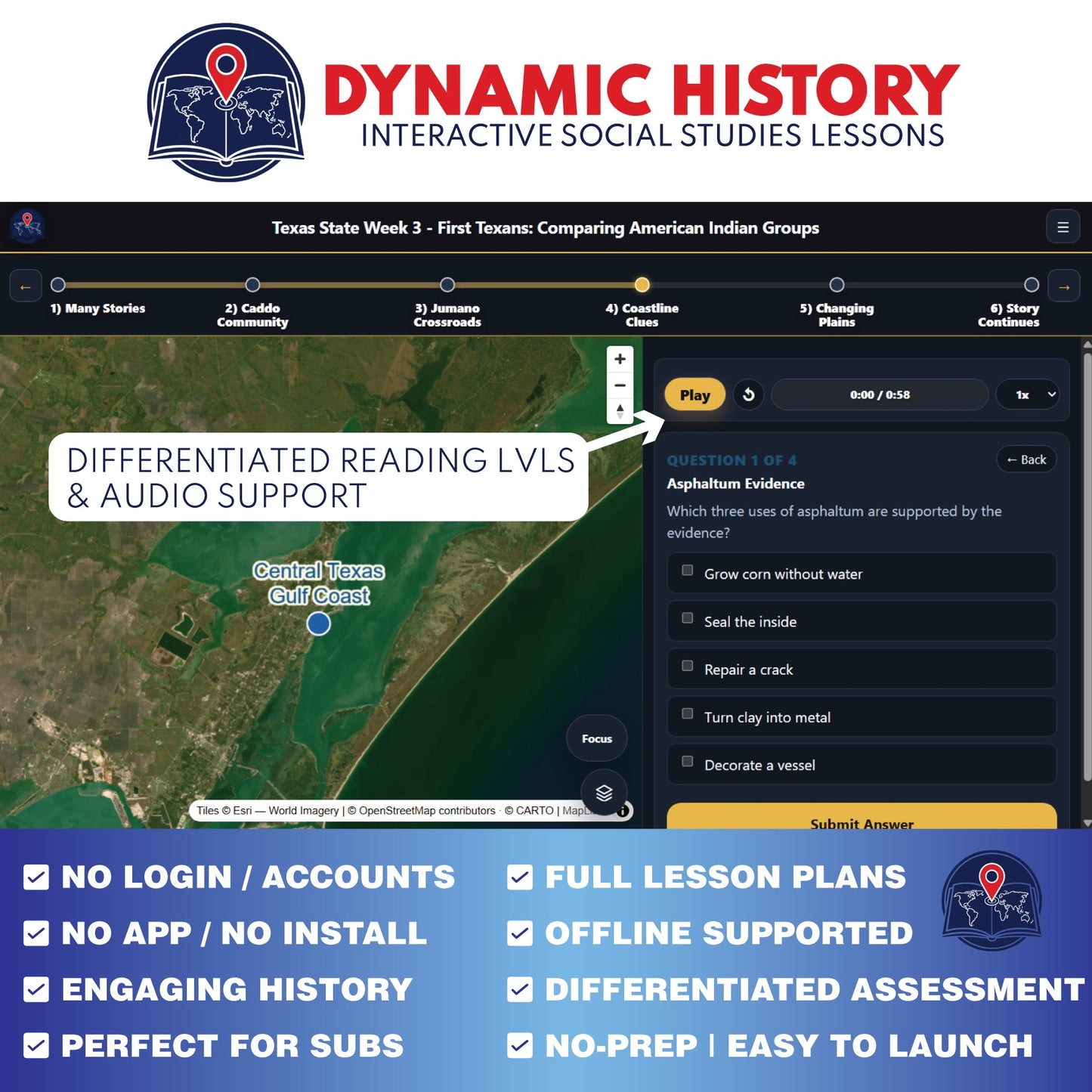
A complete Grade 4 Texas State History Week 9 curriculum built around the six-stop When Disagreement Became Revolution Dynamic History module. Includes 30 guided auto-graded tasks, historical-voices narration, clickable map and place evidence, Standard and Accessible reading paths, Standard and Accessible print companions, a 38-page Teacher Guide and Answer Key, a Day 3 Road to Revolution Video Evidence Timeline, a Day 4 Road to Revolution Evidence Council with eight evidence cards, perspective tracking and escalation-ranking materials, and separate Day 3, Day 4, and Day 5 assessment banks with vocabulary, short-answer, challenge, and 20-question multiple-choice options. Printable materials and self-grading Google Forms support whole-class, small-group, substitute, and mixed-reading-level use.
Classroom Uses Whole Class, Small Groups, Content-Area Reading, Discussion, Assessment, Review, Homework, Sub Plan view all
- Whole Class
- Small Groups
- Content-Area Reading
- Discussion
- Assessment
- Review
- Homework
- Sub Plan
Included Teacher Guide, Student Worksheet, Answer Key, Quiz, Google Forms Quiz, Vocabulary, Discussion Questions, Challenge Questions view all
- Teacher Guide
- Student Worksheet
- Answer Key
- Quiz
- Google Forms Quiz
- Vocabulary
- Discussion Questions
- Challenge Questions
Format PDF, DOCX, Google Docs, Google Slides, Google Forms, PowerPoint, ZIP Download, Printable, Editable view all
- DOCX
- Google Docs
- Google Slides
- Google Forms
- PowerPoint
- ZIP Download
- Printable
- Editable
Differentiation Accessible Version, Mixed Reading Levels, ELL Support, Struggling Readers, Vocabulary Support, Small-Group Support view all
- Accessible Version
- Mixed Reading Levels
- ELL Support
- Struggling Readers
- Vocabulary Support
- Small-Group Support
Teach the causes of the Texas Revolution with a complete five-day Grade 4 Texas state history week that traces how a settlement plan intended to strengthen Mexican Texas developed into political crisis, armed conflict, and formal separation.
Week 9 coordinates a six-stop Dynamic History historical-voices and map-evidence investigation with Standard and Accessible print alternatives, a Road to Revolution Video Evidence Timeline, a collaborative Evidence Council, and flexible final assessment options. Teachers can use the complete sequence or select components to fit their schedule.
Will this resource meet your needs?
Try the full week 1 curriculum - 100% FREE DOWNLOAD
What students practice
- Chronology and multiple causes: connect borderland concern, immigration restrictions, reform petitions, customs enforcement, federalism, centralism, organized resistance, and the Declaration of Independence.
- Map and place evidence: investigate Nacogdoches, Natchitoches, San Felipe, Saltillo, Mexico City, Anahuac, Turtle Bayou, San Antonio de Béxar, Monclova, Gonzales, and Washington-on-the-Brazos.
- Changing political goals: distinguish reform inside Mexico, separate Mexican statehood, defense of federalism, armed resistance, and independence.
- Multiple perspectives: examine documented viewpoints connected to Manuel de Mier y Terán, Stephen F. Austin, Antonio López de Santa Anna, Juan N. Seguín, Lorenzo de Zavala, Mexican officials, Tejanos, settlers, and American Indian communities.
- Primary-source reasoning: use reports, petitions, laws, resolutions, constitutions, and declarations while identifying what each source can and cannot prove alone.
- Civil discussion and evidence-based writing: rank developments, defend claims with evidence, respond to other interpretations, and state source limits.
The five-day week
- Day 1: Dynamic History Stops 1-3 - borderland inspection, reform petitions, and government enforcement at Anahuac.
- Day 2: Dynamic History Stops 4-6 - Juan Seguín and federalism, Austin's changing position, open fighting, and the Texas Declaration of Independence.
- Day 3: Road to Revolution Video Evidence Timeline with dated events, cause-and-effect notes, perspective tracking, and a two-sentence claim.
- Day 4: Road to Revolution Evidence Council using eight evidence cards, a perspective tracker, escalation ranking, source limits, and civil-discourse stems.
- Day 5: discussion, review, and a flexible final assessment focused on chronology, cause and effect, perspective, geography, and source reasoning.
What's included
- Dynamic History interactive module access with 6 guided stops and 30 auto-graded tasks.
- Historical-voices narration, clickable map evidence, solid route and boundary lines, city and place markers, historical portraits, documents, and source-focused evidence panels.
- Standard and Accessible reading paths with equivalent learning targets.
- Standard and Accessible print-module companions for classrooms that need a paper option.
- 38-page all-in-one Teacher Guide and Answer Key with week-at-a-glance planning, substitute-ready daily lesson plans, stop-by-stop teaching guidance, differentiation, model reasoning, map support, and complete assessment keys.
- Day 3 Road to Revolution Video Evidence Timeline worksheet with selected-video guidance, timestamps, transcript fallback, perspective notes, and claim writing.
- Day 4 Road to Revolution Evidence Council with eight short evidence cards, a perspective tracker, escalation-ranking materials, claim-and-evidence writing, teacher source notes, and a civil-discourse checklist.
- Separate Day 3, Day 4, and Day 5 assessment banks with vocabulary, short-answer questions, challenge questions, and 20-question multiple-choice quizzes.
- Printable student worksheets and multiple-choice quiz versions for the Day 3, Day 4, and Day 5 assessments.
- Self-grading Google Forms for the Day 3, Day 4, and Day 5 multiple-choice quizzes through the shared classroom folder.
- Complete answer keys, model responses, standards alignment, discussion guidance, and flexible quick, standard, and extended assessment options.
Google Forms note: Self-grading Google Forms are cloud-native and are provided through the shared Google folder. They do not appear inside a downloaded desktop ZIP.
Built for flexible classrooms
Use the complete five-day sequence, shorten the week by selecting one assessment format, or use the Standard and Accessible print modules when devices are limited. Both reading paths teach the same assessed ideas, so students can work at different reading levels without being assigned different learning targets.
Assessment options
The Dynamic History module uses 30 guided, auto-graded formative tasks across Days 1-2. The Day 3 video assessment, Day 4 Evidence Council assessment, and Day 5 final assessment remain separate so teachers can choose the mix of chronology, map evidence, source analysis, civil discussion, written response, printable multiple choice, and self-grading Google Forms that fits their classroom.
Best fit
Designed for Grade 4 Texas Social Studies and aligned to TEKS 4.3(A), 4.3(B), 4.13(A), 4.19(A), 4.19(C), and 4.20(B). This resource works well for whole-class instruction, partner work, independent practice, small-group evidence councils, substitute plans, review, and blended print/digital classrooms.
Technology note: Dynamic History and Google-native files require internet access. The Standard and Accessible print modules, video worksheet, Evidence Council packet, and printable assessments provide substantial offline alternatives.
Share