
Readers Theater Worksheets
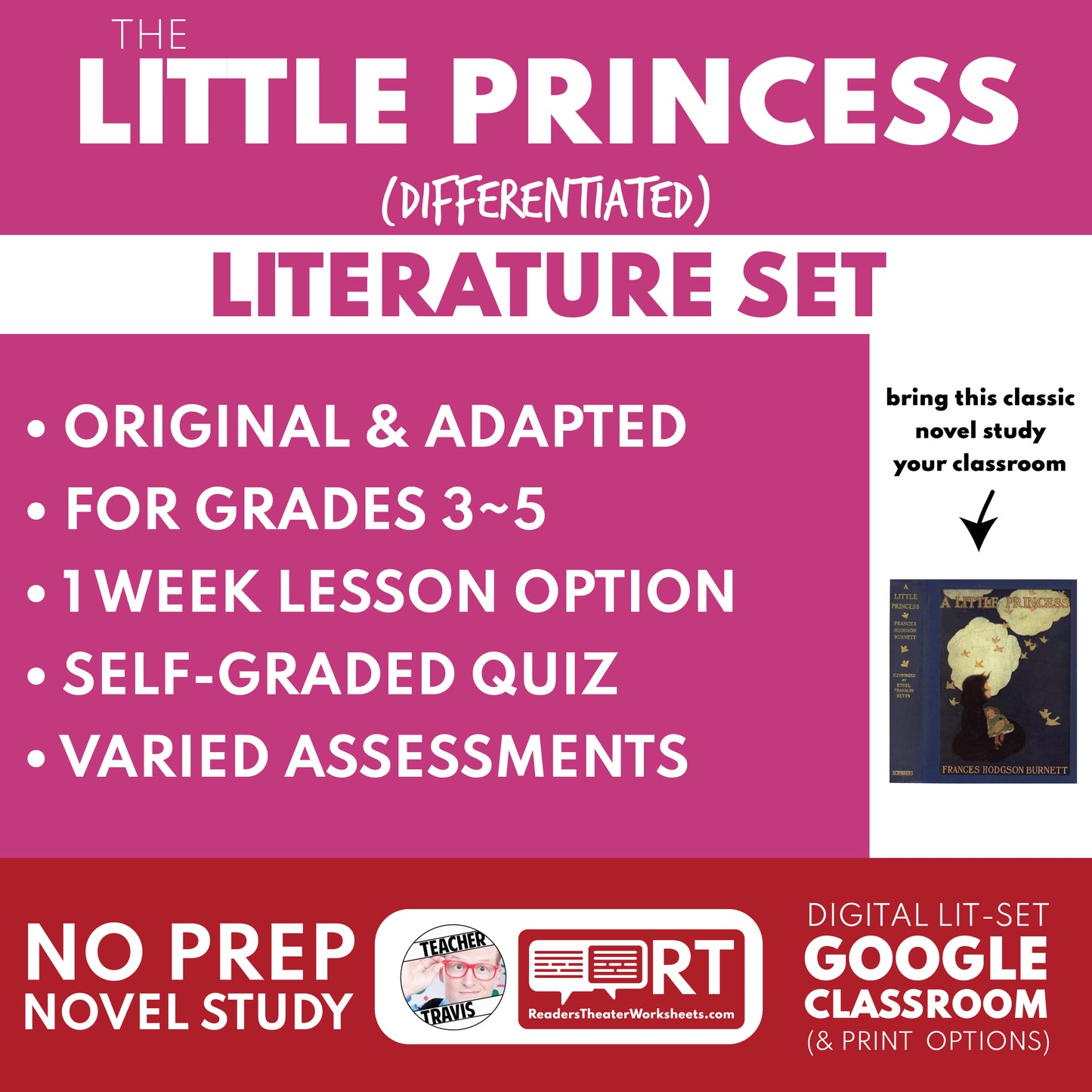
A Little Princess Differentiated Novel Study | Burnett | Literature Set for Grades 3 to 5
A Little Princess Differentiated Novel Study | Burnett | Literature Set for Grades 3 to 5
Couldn't load pickup availability
Classroom Use at a Glance
A differentiated literature study guide for grades 3–5 using A Little Princess Differentiated Novel Study. Supports mixed reading levels with original and leveled reading options, vocabulary, comprehension questions, discussion, written response, quizzes, and teacher support.
Classroom Uses Whole Class, Close Reading, Discussion, Assessment, Review, Enrichment, Intervention, Homework, Sub Plan view all
- Whole Class
- Close Reading
- Discussion
- Assessment
- Review
- Enrichment
- Intervention
- Homework
- Sub Plan
Included Original Text, Leveled Text, Teacher Guide, Student Worksheet, Answer Key, Quiz, Google Forms Quiz, Vocabulary, Discussion Questions, Writing Prompt view all
- Original Text
- Leveled Text
- Teacher Guide
- Student Worksheet
- Answer Key
- Quiz
- Google Forms Quiz
- Vocabulary
- Discussion Questions
- Writing Prompt
Format PDF, DOCX, Google Docs, Google Forms, Printable, Editable view all
- DOCX
- Google Docs
- Google Forms
- Printable
- Editable
Differentiation Original Version, Leveled Version, Mixed Reading Levels, Struggling Readers, Advanced Readers, Vocabulary Support, Short Sections view all
- Original Version
- Leveled Version
- Mixed Reading Levels
- Struggling Readers
- Advanced Readers
- Vocabulary Support
- Short Sections
Problem: You want your students to experience classic literature, but you do not have weeks (or months) to push through a 67,000-word novel with mixed reading levels in the room.
Here’s the solution: a differentiated novel study, or “digital lit-set.” This resource gives you both the complete original A Little Princess by Frances Hodgson Burnett (public domain) and a tightly adapted 5-part, one-week version at about 15,000 words—roughly about one-quarter the original length.
SAVE 40% and get the full bundle of 10 Digital Lit Sets
TRY ONE FREE! A similar Digital Lit Set for Peter Pan
Every discussion question, multiple-choice exit quiz, short-answer item, challenge question, and vocabulary word works for both tracks. Mixed-ability classrooms can stay on the same scenes, characters, and themes—even while students read different versions of the text.
Perfect for a A Little Princess mini-reader unit in Grades 3–5, this resource supports CCSS reading, speaking/listening, language, and written response skills while keeping pacing realistic for real classrooms.
Quick Guide for Teachers:
Adapted-Only Track (Fastest: 5-Day Model)
- Best for Grades 3–5 classes that need a manageable, one-week novel experience.
- Day 1–5: Students read one adapted part per day and use the matching Main Ideas & Themes Discussion Questions and self-grading multiple-choice quiz.
- End the week with the Final Worksheet (Vocabulary Words, Short Answer Questions, and Challenge Questions).
- This track keeps lessons tight, predictable, and complete in five days.
Original-Only Track (Longer: Multi-Day Per Section)
- Ideal for stronger readers or classes ready for original language and sentence structure.
- Students read the original chapters aligned to each adapted Part
- Use the same Discussion Questions, MC exit quizzes, and Final Worksheet; all items are text-accurate for both versions.
- Vocabulary Words (10) are usable for both tracks, because each word appears in both the adapted text and the corresponding original chapters.
- This track preserves the full descriptive style and classic voice while giving you ready-made, age-appropriate assessments.
Dual-Track Differentiation (Mixed Readers, Flexible Timelines)
- Lets your entire class study the same plot, scenes, and themes at the same time—even when some students need the adapted text and others handle the full novel.
- Assign adapted Part 1 to students who need a shorter, clearer text and original corresponding chapters to students reading the full text; repeat this pattern through Parts 2–5 (timing will depend on your classroom's reading level)
- Give original-text students multiple days per section while adapted-text students reread key scenes, complete vocabulary tasks, and tackle discussion questions in pairs or small groups.
- All assessments are usable for both tracks: Discussion Questions, MC Exit Quizzes for each Part, and the Final Worksheet (Vocabulary, Short Answer, and Challenge Questions).
What’s the Tradeoff of Using the Adapted Version?
Pros:
- Reduces the novel to a fraction of its original length, fitting neatly into a one-week unit.
- Well suited for shorter attention spans and developing readers in Grades 3–5.
- Preserves core narrative elements, characters, and themes
- Far better than skipping the book entirely due to time limits or reading-level concerns.
- Works for whole-class read-alouds, small-group novel studies, independent reading, or focused close-reading lessons.
Cons:
Omits some original language, side scenes, and descriptive passages for brevity, so students do not see every nuance of the original author's style.
Leaves fewer opportunities for deep line-by-line stylistic analysis than a full-length, multi-week novel study.
Bottom Line:
If you have the time and budget, nothing beats the feel of a real paperback in every student’s hands. But when time, copies, and reading levels are real constraints, a digital literature set like this—adapted text + original text mapping + shared assessments—lets you bring this classic novel into your classroom instead of leaving it on the “maybe someday” shelf. If you were to buy traditional paperbacks at about $7 per book for 30 students, that is a $210 investment. This digital lit-set gives you a reusable, print-friendly alternative you can adapt for many years and multiple groups.
This product includes a zip file consisting of:
NOTE: All files are editable and include (PDF, DOCX, PPTX, Google Docs/Slides/Forms)
Full Original Text: ~67,000 words | 6.3 Flesch-Kincaid GL
- Lexile Ranges: ~800L - 1000L | CEFR ~A2+ / B1-
- Great for advanced readers (or 6~8 graders), extension groups, longer-term novel studies.
-
BONUS: Free Access to the text on our LEVELED-LIT CLASSICS Library Platform.
Adapted Version Text: ~15,000 words | 4.5 Flesch-Kincaid GL
- Lexile Ranges: ~650L - 850L | CEFR ~A2 / A2+
- On-level Grade 4–5 readers
- Supported Grade 3 readers
- Divided into 5 parts for easy daily reading sessions
*Both versions tell the same story, allowing students to participate in shared discussions even when reading different texts.
Student Final Worksheet/Quizzes (PPTX, Google Slides/Forms)
- 10 Vocabulary Words
- 10 Short Answer Recall/Comprehension
- 5 Challenge Questions (synthesis, analysis, themes, real life connection)
- 5 Multiple Choice Quizzes (20 Questions) (1 per part)
Teacher’s Guide & Answer Key
- 5 Sets of Daily Discussion Questions (1 per part)
- 5 Sets of Self-Graded Exit Quizzes (1 per part, 20Qs each)
- Answer Keys for Vocab, Short Answer, and Challenge Questions
- Key Figures & Places reference sheets to help students track characters and settings
Text Summary (Adapted Version)
Part 1 — From Arrival to “Princess Sara”
Source Chapters: I–IV
Sara arrives at Miss Minchin’s school and immediately stands out—both for her father’s wealth and for her unusual maturity. She impresses everyone with her French, but jealousy and strictness begin to show beneath the school’s polished surface. Sara builds early friendships and learns to use stories, patience, and self-control to help others.
Part 2 — The Birthday Shock and the Fall to the Attic
Source Chapters: V–VII
Sara’s friendship with Becky shows her instinct to treat people fairly, no matter their position. Then everything collapses: Captain Crewe dies and Sara’s expected fortune disappears, and Miss Minchin turns Sara into a servant. This Part ends with Sara forced into the attic and into a daily fight to stay brave.
Part 3 — Hunger, Imagination, and a Door Next Door
Source Chapters: VIII–XI
Sara learns the hard routines of her new life and relies on imagination to keep her mind strong when her body is cold and hungry. She bonds with Becky and even with Melchisedec the rat, creating small “safe” rituals in a bleak place. Next door, Mr. Carrisford and Ram Dass enter the story, and the search connected to Captain Crewe quietly begins to move again.
Part 4 — The Bun Gift and the “Magic” Room
Source Chapters: XII–XV
The story tightens around the wall between Sara and Carrisford: he regrets and searches, while she survives in plain sight. Sara’s choice to share food with a starving child shows what her “princess” rule really means under pressure. Secret help reaches the attic, and the garret begins transforming into something warm and hopeful.
Part 5 — Discovery, Restoration, and Passing Kindness Forward
Source Chapters: XVI–XIX
A small event—the monkey’s return—brings Sara directly into Carrisford’s home, and the truth is finally revealed. Sara learns why she was lost for so long and is welcomed into safety and care again. The ending closes the circle as Sara returns to help the hungry child now called Anne, turning survival into generosity.
Frequently Asked Questions About the Adapted A Little Princess Novel Study
How can I use adapted A Little Princess for reluctant or younger readers?
This adapted text is approximately 15,000 words at a 4.5 reading level and is divided into five Parts designed for a one-week unit. Each Part pairs naturally with discussion questions and a quick exit quiz, so students can succeed with shorter daily reading while still doing real comprehension work. This makes it ideal for reluctant readers who need structure, momentum, and manageable chunks.
Is this A Little Princess novel study aligned with CCSS for Grades 3–5?
Yes—this resource supports RL.3–5, SL.3–5, and L.3–5 through text-based comprehension, character and theme analysis, vocabulary in context, and discussion-based responses. The questions and skills are grounded in the adapted text and verified against the mapped original chapters so both reading tracks can use the same assessments.
Can I use this for differentiated A Little Princess instruction?
Yes—both the original and adapted versions are included, with a clear part-to-chapter map so everyone stays on the same scenes and plot points. You can run one shared set of discussions and assessments while assigning the version that best fits each student. This keeps your unit unified without holding back advanced readers or overwhelming developing readers.
This one classical literature mini-reader set gives you a complete, no-prep, one-week unit for teaching A Little Princess to Grades 3–5 in manageable, high-engagement steps—whether your students read the adapted version, the original, or both.
Standards
Reading Literature: CCSS RL.3-5.1, CCSS RL.3-5.2, CCSS RL.3-5.3, CCSS RL.3-5.4, CCSS RL.3-5.5, CCSS RL.3-5.6
Writing: CCSS W.3-5.2
Speaking & Listening: CCSS SL.3-5.1
Anchor Standards: CCRA.R.1, CCRA.R.2, CCRA.R.3, CCRA.R.4, CCRA.R.5, CCRA.W.2, CCRA.SL.1, CCRA.L.4
Share