
Readers Theater Worksheets
A Tale of Two Cities Differentiated Novel Study | ELA Literature | Dickens Lit Set for High School
A Tale of Two Cities Differentiated Novel Study | ELA Literature | Dickens Lit Set for High School
Couldn't load pickup availability
Classroom Use at a Glance
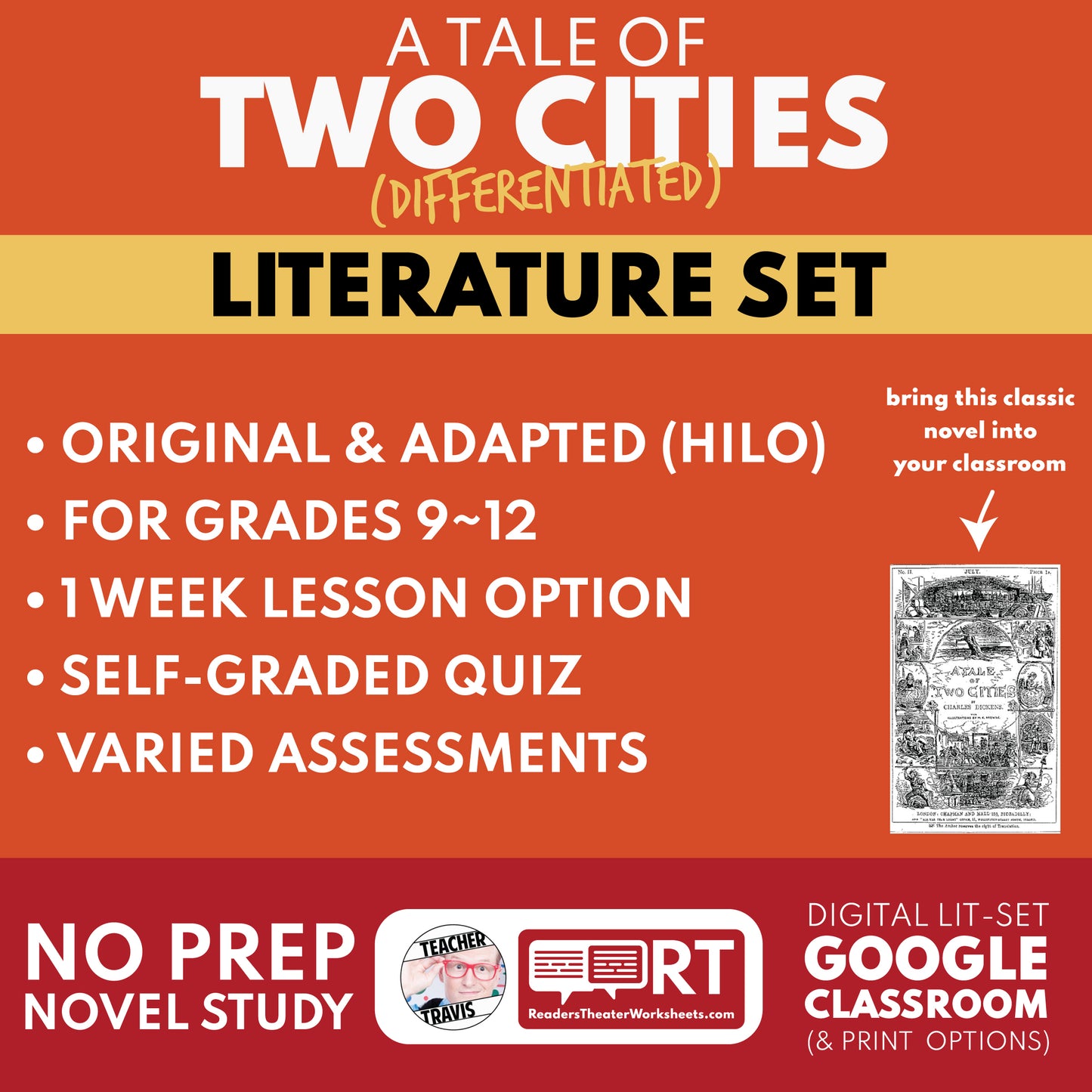
A differentiated literature study guide for grades 9–12 using A Tale of Two Cities Differentiated Novel Study. Supports mixed reading levels with original and leveled reading options, vocabulary, comprehension questions, discussion, written response, quizzes, and teacher support.
Classroom Uses Whole Class, Close Reading, Discussion, Assessment, Review, Enrichment, Intervention, Homework, Sub Plan view all
- Whole Class
- Close Reading
- Discussion
- Assessment
- Review
- Enrichment
- Intervention
- Homework
- Sub Plan
Included Original Text, Leveled Text, Teacher Guide, Student Worksheet, Answer Key, Quiz, Google Forms Quiz, Vocabulary, Discussion Questions, Writing Prompt view all
- Original Text
- Leveled Text
- Teacher Guide
- Student Worksheet
- Answer Key
- Quiz
- Google Forms Quiz
- Vocabulary
- Discussion Questions
- Writing Prompt
Format PDF, DOCX, Google Docs, Google Forms, Printable, Editable view all
- DOCX
- Google Docs
- Google Forms
- Printable
- Editable
Differentiation Original Version, Leveled Version, Mixed Reading Levels, Struggling Readers, Advanced Readers, Vocabulary Support, Short Sections view all
- Original Version
- Leveled Version
- Mixed Reading Levels
- Struggling Readers
- Advanced Readers
- Vocabulary Support
- Short Sections
Problem: A long classic novel can be an excellent curriculum anchor, but the prep burden is real—especially when student reading levels vary widely, time is limited, and the original text’s length makes it difficult to keep momentum across a full unit.
Here’s the solution: This differentiated novel study / digital lit-set solves that problem by giving you two complete reading tracks that stay perfectly aligned: the complete original text of A Tale of Two Cities plus a five-part adapted version designed for faster pacing and clearer access. The unit is mapped part-for-part to the original chapters (Parts 1–5), so students can read different versions while moving through the same storyline at the same time.
Every discussion question, multiple-choice exit quiz, short-answer item, and challenge question works for both tracks, so you can run one shared set of assessments and discussions while students support their answers with evidence from whichever text they are reading.
Perfect for Grades 8–10 classrooms ready to build close-reading habits, theme and character analysis, evidence-based writing and discussion, and attention to author’s craft (structure, symbolism, and the way public systems shape private lives) without adding extra planning or separate materials for different reading levels.
Quick Guide for Teachers:
Adapted-Only Track (Fastest: 5-Day Model)
- Best for Grades 9–10 classes that need a manageable, one-week novel experience.
- Day 1–5: Students read one adapted part per day and use the matching Main Ideas & Themes Discussion Questions and self-grading multiple-choice quiz.
- End the week with the Final Worksheet (Vocabulary Words, Short Answer Questions, and Challenge Questions).
- This track keeps lessons tight, predictable, and complete in five days.
Original-Only Track (Longer: Multi-Day Per Section)
- Ideal for stronger readers or classes ready for original language and sentence structure.
- Students read the original chapters aligned to each adapted Part
- Use the same Discussion Questions, MC exit quizzes, and Final Worksheet; all items are text-accurate for both versions.
- Vocabulary Words (10) are usable for both tracks, because each word appears in both the adapted text and the corresponding original chapters.
- This track preserves the full descriptive style and classic voice while giving you ready-made, age-appropriate assessments.
Dual-Track Differentiation (Mixed Readers, Flexible Timelines)
- Lets your entire class study the same plot, scenes, and themes at the same time—even when some students need the adapted text and others handle the full novel.
- Assign adapted Part 1 to students who need a shorter, clearer text and original corresponding chapters to students reading the full text; repeat this pattern through Parts 2–5 (timing will depend on your classroom's reading level)
- Give original-text students multiple days per section while adapted-text students reread key scenes, complete vocabulary tasks, and tackle discussion questions in pairs or small groups.
- All assessments are usable for both tracks: Discussion Questions, MC Exit Quizzes for each Part, and the Final Worksheet (Vocabulary, Short Answer, and Challenge Questions).
What’s the Tradeoff of Using the Adapted Version?
Pros:
- Reduces the novel to a fraction of its original length, fitting neatly into a one-week unit.
- Well suited for shorter attention spans and developing readers in Grades 9-10
- Preserves core narrative elements, characters, and themes
- Far better than skipping the book entirely due to time limits or reading-level concerns.
- Works for whole-class read-alouds, small-group novel studies, independent reading, or focused close-reading lessons.
Cons:
- Omits some original language, side scenes, and descriptive passages for brevity, so students do not see every nuance of the original author's style.
- Leaves fewer opportunities for deep line-by-line stylistic analysis than a full-length, multi-week novel study.
Bottom Line:
If you have the time and budget, nothing beats the feel of a real paperback in every student’s hands. But when time, copies, and reading levels are real constraints, a digital literature set like this—adapted text + original text mapping + shared assessments—lets you bring this classic novel into your classroom instead of leaving it on the “maybe someday” shelf. If you were to buy traditional paperbacks at about $7 per book for 30 students, that is a $210 investment. This digital lit-set gives you a reusable, print-friendly alternative you can adapt for many years and multiple groups.
Try a digital lit set first for FREE! (It's just like this one)
[FREE DOWNLOAD] The Great Gatsby Differentiated Novel Study | Lit Set
This product includes a zip file consisting of:
NOTE: All files are editable and include (PDF, DOCX, PPTX, Google Docs/Slides/Forms)
Full Original Text: ~135,000 words | 7.7 Flesch-Kincaid GL
- Lexile Ranges: ~1010L - 1335L | CEFR ~B2 / C1-
- Great for advanced readers (or 8–10 graders), extension groups, longer-term novel studies.
-
BONUS: Free Access to the text on our LEVELED-LIT CLASSICS Library Platform.
Adapted Version Text: ~15,000 words | 5.7 Flesch-Kincaid GL
- Lexile Ranges: ~925L - 1070L | CEFR ~B1 / B2-
- On-level Grade 6 readers
- Supported Grade 8-10 readers
- *Both versions tell the same story, allowing students to participate in shared discussions even when reading different texts.
Student Final Worksheet/Quizzes (PPTX, Google Slides/Forms)
- 10 Vocabulary Words
- 10 Short Answer Recall/Comprehension
- 5 Challenge Questions (synthesis, analysis, themes, real life connection)
- 5 Multiple Choice Quizzes (20 Questions) (1 per part)
Teacher’s Guide & Answer Key
- 5 Sets of Daily Discussion Questions (1 per part)
- 5 Sets of Self-Graded Exit Quizzes (1 per part, 20Qs each)
- Answer Keys for Vocab, Short Answer, and Challenge Questions
- Key Figures & Places reference sheets to help students track characters and settings
Adapted Version Summary (and source chapters)
Part 1 – Recalled to Life
Adapted from: Book 1, Chapters I–VI of the original novel.
Jarvis Lorry receives a cryptic message and travels toward France with Lucie Manette to recover her father, who has been hidden after long imprisonment. In Saint Antoine, the Defarges guide them through a community marked by hunger and watchfulness. Lucie meets Dr. Manette, whose damaged identity clings to shoemaking and a prison-number routine, and the Part establishes the novel’s tension between public order and private ruin.
Part 2 – Testimony and Privilege
Adapted from: Book 2, Chapters I–IX of the original novel.
In London, Jerry Cruncher’s home life exposes harshness beneath ordinary respectability, while the treason trial of Charles Darnay shows justice operating as public theater. The case hinges on uncertain identification and a startling resemblance that disrupts easy certainty. In France, aristocratic luxury is set against public suffering, and a child’s death under a nobleman’s carriage turns resentment into a sharper, more organized threat.
Part 3 – Two Promises
Adapted from: Book 2, Chapters X–XIII of the original novel.
A violent chain of consequence continues in France, where revenge and punishment deepen the story’s sense that cruelty breeds more cruelty. In England, Darnay seeks to marry Lucie and confesses his true family name to Dr. Manette, forcing the household to confront the past behind Manette’s suffering. Dr. Manette relapses into shoemaking, and Carton’s private promise to Lucie introduces a serious moral thread that will matter later.
Part 4 – Echoing Footsteps
Adapted from: Book 2, Chapter XIV through Book 3, Chapter VII of the original novel.
The narrative moves through years where London’s private happiness and France’s growing unrest advance side by side. Jerry Cruncher’s “night work” exposes society’s hidden violations, while Madame Defarge’s knitting turns grievance into a system that remembers names and prepares targets. Lucie and Darnay marry, Dr. Manette’s recovery remains fragile, and the repeated sense of approaching “footsteps” signals that history is closing in on the household.
Part 5 – The Far Better Thing
Adapted from: Book 3, Chapters VIII–XV of the original novel.
Darnay returns to France in response to a desperate appeal and is quickly trapped by revolutionary categories and prisons. Dr. Manette’s past grants temporary influence, but a condemning letter revives the inherited guilt Darnay tried to escape. Carton uses leverage, secrecy, and resemblance to coordinate a narrow path to survival, and the story culminates in a final substitution that reframes wasted life as chosen purpose under extreme pressure.
Frequently Asked Questions About the Adapted A Tale of Two Cities Novel Study
Can I use the adapted text for reluctant or below-level readers without watering down the unit?
Answer: Yes. The adapted version is approximately 15,000 words at a 5.7 Flesch-Kincaid Grade Level, designed to keep the plot, tone, and key character dynamics intact while reducing sentence tangles and improving clarity, so students can participate in Grade 9-level thinking using accessible text.
Is this aligned to high school CCSS skill expectations for the stated grade band?
Answer: The tasks are built around RL.9–10 reading standards (evidence, theme, character, word choice, structure), SL.9–10 discussion expectations, and L.9–10 vocabulary and academic language work; students repeatedly practice claim-evidence-reasoning and text-dependent analysis across quizzes, short answers, and whole-book challenge prompts.
How does one assessment set work if some students read the original and others read the adaptation?
Answer: Each Part is mapped to a specific original chapter range, and every prompt is designed so evidence can be drawn from either version; students answer the same questions, cite the text they read, and are evaluated with the same criteria for accuracy, reasoning, and attention to author’s craft.
This is a complete, no-prep dual-track unit that keeps your whole class on one pacing path while supporting different reading levels with one coherent set of assessments and discussions.
Get this in a Bundle of 10 Digital Lit Sets & SAVE 40%
CCSS Standards
Reading Literature: CCSS RL.9-10.1, CCSS RL.9-10.2, CCSS RL.9-10.3, CCSS RL.9-10.4, CCSS RL.9-10.5, CCSS RL.9-10.6, CCSS RL.11-12.1, CCSS RL.11-12.2, CCSS RL.11-12.3, CCSS RL.11-12.4, CCSS RL.11-12.5, CCSS RL.11-12.6
Speaking & Listening: CCSS SL.9-10.1, CCSS SL.11-12.1
Language: CCSS L.9-10.4, CCSS L.11-12.4
Anchor Standards: CCRA.R.1, CCRA.R.2, CCRA.R.3, CCRA.R.4, CCRA.R.5, CCRA.R.6, CCRA.W.1, CCRA.W.2, CCRA.W.9, CCRA.SL.1, CCRA.L.1, CCRA.L.2, CCRA.L.4
Share