
Skip to product information
1 of 1

Reader's Theater Worksheets

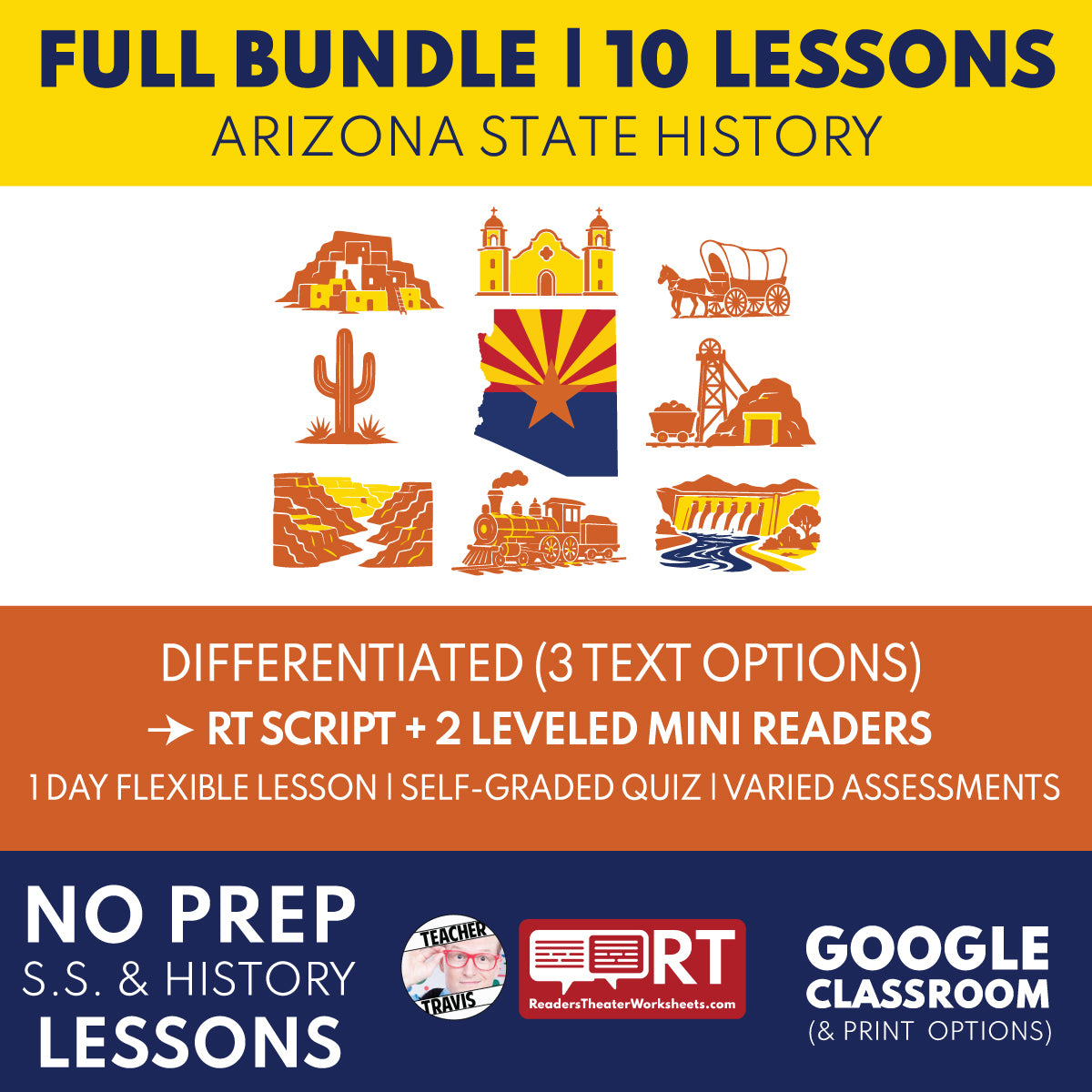
Arizona State History Grade 4 Bundle | 10 Differentiated Lessons | RT Scripts & Readers

Arizona State History Grade 4 Bundle | 10 Differentiated Lessons | RT Scripts & Readers

Regular price $17.50 USD
Regular price $27.00 USD Sale price $17.50 USD
Sale Sold out
Digital Instant Download

Bring Arizona State History to life with a complete Grade 3-focused Reader’s Theater and differentiated Mini Reader bundle covering geography, ancestral communities, Native Nations and sovereignty, Spanish and Mexican Arizona, U.S. territorial change, mining and railroads, statehood, water development, World War II and rights, and modern civic life.

This ten-script mini unit gives students three ways to access the same essential content: engaging Reader’s Theater scripts for oral fluency and discussion, Original Mini Readers for independent Grade 3 reading, and Accessible Mini Readers with stronger Grade 3 support for mixed-level classes, multilingual learners, intervention, homework, or faster one-day use.

Try the format free: Download Part 1: Land, Water, and Arizona Regions at no cost before purchasing the complete bundle.

10 Complete Arizona State History Lessons

  1. 1. Land, Water, and Arizona Regions — Students use maps, rivers, elevation, land regions, and a short timeline to explain why land and water shape where and how people live.
  2. 2. Ancestral Communities and Desert Innovation — Students examine canals, farming, artifacts, maps, archaeology, chronology, and living-community sources while learning why archaeological labels must be used carefully.
  3. 3. Native Nations and Sovereignty — Students compare maps, government information, and Nation-authored sources to understand that Tribal Nations have their own governments, homelands, and living communities.
  4. 4. Spanish Missions and Mexican Arizona — Students begin with O’odham communities already living and farming in southern Arizona, then trace mission expansion, resistance, presidios, Mexican independence, and changing rule.
  5. 5. Borders, Territory, and Native Homelands — Students use changing maps, routes, treaties, and public-history evidence to study the Gadsden Purchase, Arizona Territory, Navajo forced removal and return, and Yavapai/Apache displacement.
  6. 6. Copper, Cattle, Railroads, and Newcomers — Students investigate how industry and transportation helped towns and markets grow while also examining labor conditions, unequal opportunity, and the 1917 Bisbee Deportation.
  7. 7. Statehood, Constitution, and Citizenship — Students trace the Arizona Constitution, 1912 statehood, women’s suffrage, direct democracy, citizenship, Native voting barriers, and the 1948 court decision that changed voting access.
  8. 8. Dams, Water, Farms, and Growing Cities — Students compare Roosevelt Dam, Hoover Dam, groundwater, the Central Arizona Project, city growth, and Gila River Indian Community history to evaluate benefits and tradeoffs.
  9. 9. World War II, Migration, and Rights — Students examine Poston and Gila River incarceration, Navajo Code Talker service, the 1948 Native voting-rights change, and Cesar Chavez’s Arizona organizing.
  10. 10. Modern Arizona and Civic Life — Students build a modern Arizona mosaic that distinguishes state, local, and Tribal governments and explains how resources, movement, and civic choices connect communities today.

Perfect For

  • Arizona Grade 3 Social Studies and Arizona Studies
  • Mixed reading levels in grades 3–5
  • Reader’s Theater, Mini Readers, oral fluency, and content-area literacy
  • Whole-class lessons, small groups, sub plans, review, intervention, and enrichment
  • Teachers who need flexible printable and Google Classroom materials for a connected Arizona history sequence

Flexible Classroom Use

  • Use Reader’s Theater for whole-class or small-group oral reading and evidence-based discussion.
  • Use the Original or Accessible Mini Readers for independent reading, homework, centers, intervention, multilingual-learner support, or differentiated groups.
  • Assign the simple multiple-choice quiz for a quick check or use two-part questions and challenge questions for deeper reasoning.
  • Teach all ten lessons in sequence or select individual topics to match your district pacing guide.

Differentiation Built Into Every Lesson

  • Reader’s Theater with eight student-friendly speaking roles
  • Original Mini Reader at the Grade 3 focus level
  • Accessible Mini Reader preserving the same assessed history with stronger Grade 3 support
  • Shared vocabulary and assessments across all three reading paths
  • Questions designed so students can answer from any one of the three student texts

What Each Lesson Includes

  • 10-scene Reader’s Theater Script
  • Original Mini Reader
  • Accessible Mini Reader
  • Vocabulary in context
  • 10 two-part comprehension questions
  • 5 two-part challenge questions
  • 20-question multiple-choice quiz
  • Teacher answer keys and discussion prompts
  • Arizona standards and source notes
  • Google Forms / Google Classroom-ready workflow support

Skills Addressed

  • Reading fluency and comprehension
  • Vocabulary in context
  • Map skills, geography, and human-environment relationships
  • Chronology, cause and effect, and change over time
  • Historical evidence and source comparison
  • Comparing perspectives and recognizing evidence limits
  • Government, citizenship, economics, and civic participation
  • Discussion and concise evidence-based writing

Standards Connections

CCSS literacy connections: RI.3.1, RI.3.2, RI.3.3, RI.3.4, SL.3.1, and RF.3.4 through evidence-based reading, vocabulary, discussion, and oral fluency. Across the set, Arizona Grade 3 Social Studies standards address history, geography, civics, economics, inquiry, Tribal governments, resources, migration, cause and effect, and change over time. Each Teacher Guide identifies its lesson-specific Arizona standards and applications.

Text Summary

Students begin with Arizona’s land, water, and regions, then study ancestral communities and living Native Nations before tracing Spanish and Mexican rule, changing U.S. borders, forced removal, territorial industries, statehood, water development, World War II and rights, and modern civic life.

Across the bundle, students learn that Arizona history is shaped by geography, Native sovereignty, migration, government decisions, resource use, labor, technology, rights struggles, and communities responding to change.

View full details