

Dynamic History
The Great Pyramids: How Were They Really Built? | Dynamic History Module | Grades 6-8
The Great Pyramids: How Were They Really Built? | Dynamic History Module | Grades 6-8
Couldn't load pickup availability
Classroom Use at a Glance
A complete grades 6-8 Dynamic History lesson on Great Pyramid construction, calibrated primarily to Grade 6. Includes a six-stop two-day interactive investigation, Teacher Guide and Answer Key, and shared Google classroom files. Students distinguish measurements from estimates, trace stone sources, analyze Merer’s papyrus, examine the builders’ town, compare sledge and ramp evidence, and separate well-supported construction steps from unresolved questions.
Classroom Uses Whole Class, Small Groups, Content-Area Reading, Discussion, Assessment, Review, Homework, Sub Plan view all
- Whole Class
- Small Groups
- Content-Area Reading
- Discussion
- Assessment
- Review
- Homework
- Sub Plan
Included Teacher Guide, Student Worksheet, Answer Key, Quiz, Google Forms Quiz, Vocabulary, Challenge Questions view all
- Teacher Guide
- Student Worksheet
- Answer Key
- Quiz
- Google Forms Quiz
- Vocabulary
- Challenge Questions
Format PDF, DOCX, Google Docs, Google Slides, Google Forms, ZIP Download, Printable, Editable view all
- DOCX
- Google Docs
- Google Slides
- Google Forms
- ZIP Download
- Printable
- Editable
Differentiation Accessible Version, Mixed Reading Levels, ELL Support, Struggling Readers, Vocabulary Support, Small-Group Support view all
- Accessible Version
- Mixed Reading Levels
- ELL Support
- Struggling Readers
- Vocabulary Support
- Small-Group Support
Turn the Great Pyramid into an evidence investigation instead of a single building theory. This Dynamic History module for grades 6-8, calibrated primarily to Grade 6, follows six stops from measured dimensions and stone sources to Merer’s transport logbook, the builders’ town, ramp evidence, and the questions that remain unresolved.
Students work with measurements, quarry evidence, maps, papyrus records, archaeological remains, later images, modern experiments, and comparison evidence. The investigation asks what is directly measured or recorded, what is estimated or inferred, what methods were possible, and what the evidence still cannot prove about Giza.
Will this meet my classroom's needs?
Try the first lesson for FREE and see how the Dynamic History format works with your students before purchasing.
Want to save 35%?
Get the full seven-lesson bundle here and save 35% compared with purchasing the six paid lessons individually.
What students investigate
- Which famous pyramid numbers are direct measurements and which are modern estimates rather than ancient counts
- Where core limestone, Tura casing stone, and Aswan granite came from and what quarry evidence can and cannot establish
- What Merer’s contemporary papyrus logbook records about transporting limestone by river toward Khufu’s pyramid
- Why later sledge imagery and modern wet-sand experiments show possible methods without directly documenting Khufu’s crews
- What the builders’ town reveals about an organized, supplied workforce without settling every worker’s status or the total workforce size
- How the Hatnub ramp supports steep-hauling comparison while the Great Pyramid’s exact ramp layout and highest-stone method remain unknown
What's included
- Two-day guided Dynamic History investigation with six historical stops
- Teacher Guide and Answer Key with suggested Day 1 and Day 2 pacing
- Editable digital student worksheet and print student worksheet
- Self-graded Google Forms quiz and multiple-choice print quiz
- Assessment bank with 5 vocabulary terms, 4 two-part short-answer questions, 2 two-part challenge questions, and 15 multiple-choice questions
Flexible classroom use
- Teach the core investigation across two 45-50 minute class periods
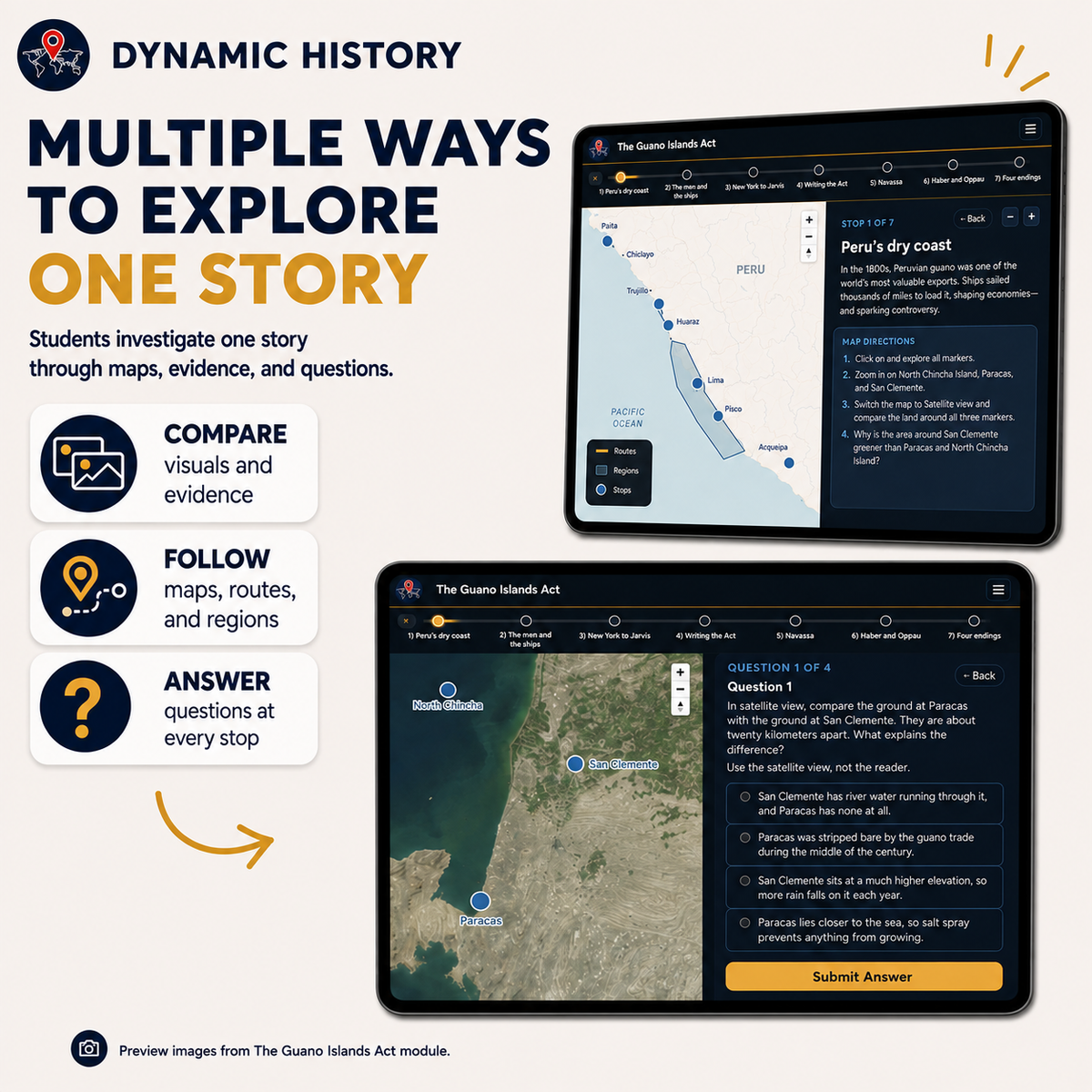
- Use the interactive Dynamic History experience when students have devices
- Use selected written questions for homework, review, or a short check for understanding
- Use the complete assessment as a separate assessment period when desired
Skills addressed
- Using measurements, archaeological remains, maps, and primary-source records to support claims
- Distinguishing direct evidence from modern estimates, later images, experiments, and comparison evidence
- Explaining what quarry, transport, settlement, and administrative evidence establishes about the project
- Evaluating whether evidence that a method could work proves that Khufu’s builders used it at Giza
- Identifying which major construction questions remain unresolved
Standards alignment
CCSS History/Social Studies literacy connections documented in the Teacher Guide include RH.6-8.1, RH.6-8.2, RH.6-8.7, and RH.6-8.8. Written synthesis may support WHST.6-8.9.
Share