Dynamic History
King Tut: What Can One Tomb Tell Us About Ancient Egypt? | Dynamic History Module | Grades 6-8
King Tut: What Can One Tomb Tell Us About Ancient Egypt? | Dynamic History Module | Grades 6-8
Couldn't load pickup availability
Classroom Use at a Glance
A complete grades 6-8 Dynamic History lesson on Tutankhamun’s tomb and archaeological evidence, calibrated primarily to Grade 6. Includes a six-stop two-day interactive investigation, Teacher Guide and Answer Key, and shared Google classroom files. Students use Carter’s records, provenance, context, object documentation, burial evidence, comparison sites, and KV54 to distinguish strong evidence from overgeneralization and revise interpretations when context changes.
Classroom Uses Whole Class, Small Groups, Content-Area Reading, Discussion, Assessment, Review, Homework, Sub Plan view all
- Whole Class
- Small Groups
- Content-Area Reading
- Discussion
- Assessment
- Review
- Homework
- Sub Plan
Included Teacher Guide, Student Worksheet, Answer Key, Quiz, Google Forms Quiz, Vocabulary, Challenge Questions view all
- Teacher Guide
- Student Worksheet
- Answer Key
- Quiz
- Google Forms Quiz
- Vocabulary
- Challenge Questions
Format PDF, DOCX, Google Docs, Google Slides, Google Forms, ZIP Download, Printable, Editable view all
- DOCX
- Google Docs
- Google Slides
- Google Forms
- ZIP Download
- Printable
- Editable
Differentiation Accessible Version, Mixed Reading Levels, ELL Support, Struggling Readers, Vocabulary Support, Small-Group Support view all
- Accessible Version
- Mixed Reading Levels
- ELL Support
- Struggling Readers
- Vocabulary Support
- Small-Group Support
Make Tutankhamun’s tomb more than a treasure lesson with this Dynamic History module for grades 6-8, calibrated primarily to Grade 6. Across six stops, students follow the 1922 discovery, map tomb context, examine Carter’s recording system, match objects to claims, test what one royal burial can represent, and revisit the misidentified KV54 pit.
Students work with notebooks, plans, photographs, objects, provenance, museum interpretations, and comparison sites. The investigation asks what the tomb can support well, what it cannot tell us about most Egyptians, and how archaeological explanations improve when context and later evidence point elsewhere.
Will this meet my classroom's needs?
Try the first lesson for FREE and see how the Dynamic History format works with your students before purchasing.
Want to save 35%?
Get the full seven-lesson bundle here and save 35% compared with purchasing the six paid lessons individually.
What students investigate
- What Carter’s notebook establishes about the 1922 discovery and why “relatively intact” is more accurate than “untouched”
- Why workforce estimates, memories, and the limited number of recorded Egyptian worker names should not be treated as a complete count
- How tomb rooms, reopened doorways, containers, seals, and nearby objects contribute to provenance and archaeological context
- How object cards, plans, photographs, notes, and shared object numbers preserved context after objects were moved
- How natron, seals, floral collars, cloth, and Luxor Temple evidence support different claims and sometimes require words such as “may” or “probably”
- Why one royal tomb is not representative of all Egyptians and how KV54 shows an interpretation changing when context is reconsidered
What's included
- Two-day guided Dynamic History investigation with six historical stops
- Teacher Guide and Answer Key with suggested Day 1 and Day 2 pacing
- Editable digital student worksheet and print student worksheet
- Self-graded Google Forms quiz and multiple-choice print quiz
- Assessment bank with 5 vocabulary terms, 4 two-part short-answer questions, 2 two-part challenge questions, and 15 multiple-choice questions
Flexible classroom use
- Teach the core investigation across two 45-50 minute class periods
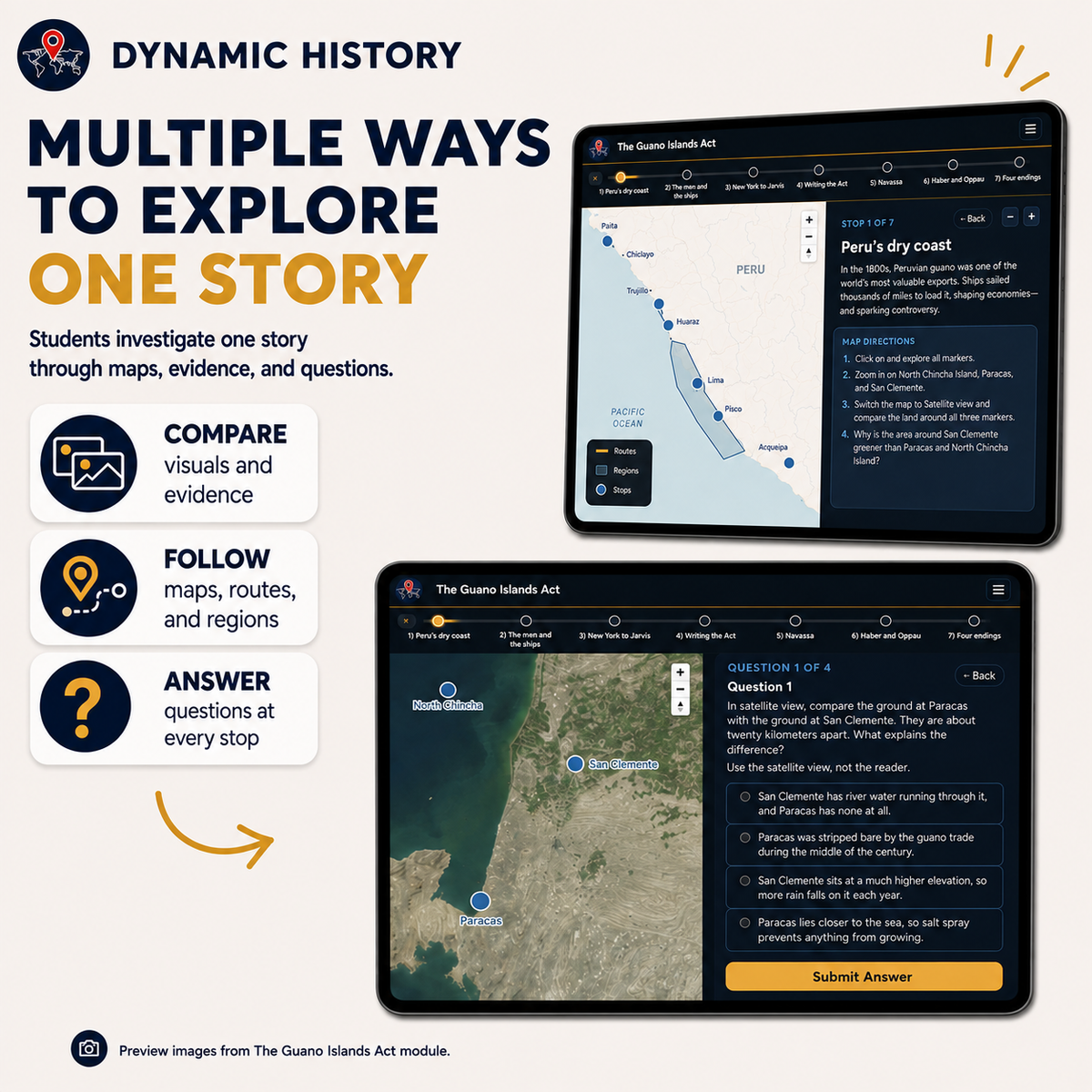
- Use the interactive Dynamic History experience when students have devices
- Use selected written questions for homework, review, or a short check for understanding
- Use the complete assessment as a separate assessment period when desired
Skills addressed
- Using notebooks, photographs, plans, objects, and archaeological sites to support historical claims
- Explaining why provenance and context change how an object can be interpreted
- Distinguishing documented facts, estimates, memories, and qualified interpretation
- Separating rich evidence from evidence that represents a larger population
- Revising an explanation when context and comparison evidence support a better interpretation
Standards alignment
CCSS History/Social Studies literacy connections documented in the Teacher Guide include RH.6-8.1, RH.6-8.2, RH.6-8.7, and RH.6-8.8. Written synthesis may support WHST.6-8.9.
Share