
Readers Theater Worksheets
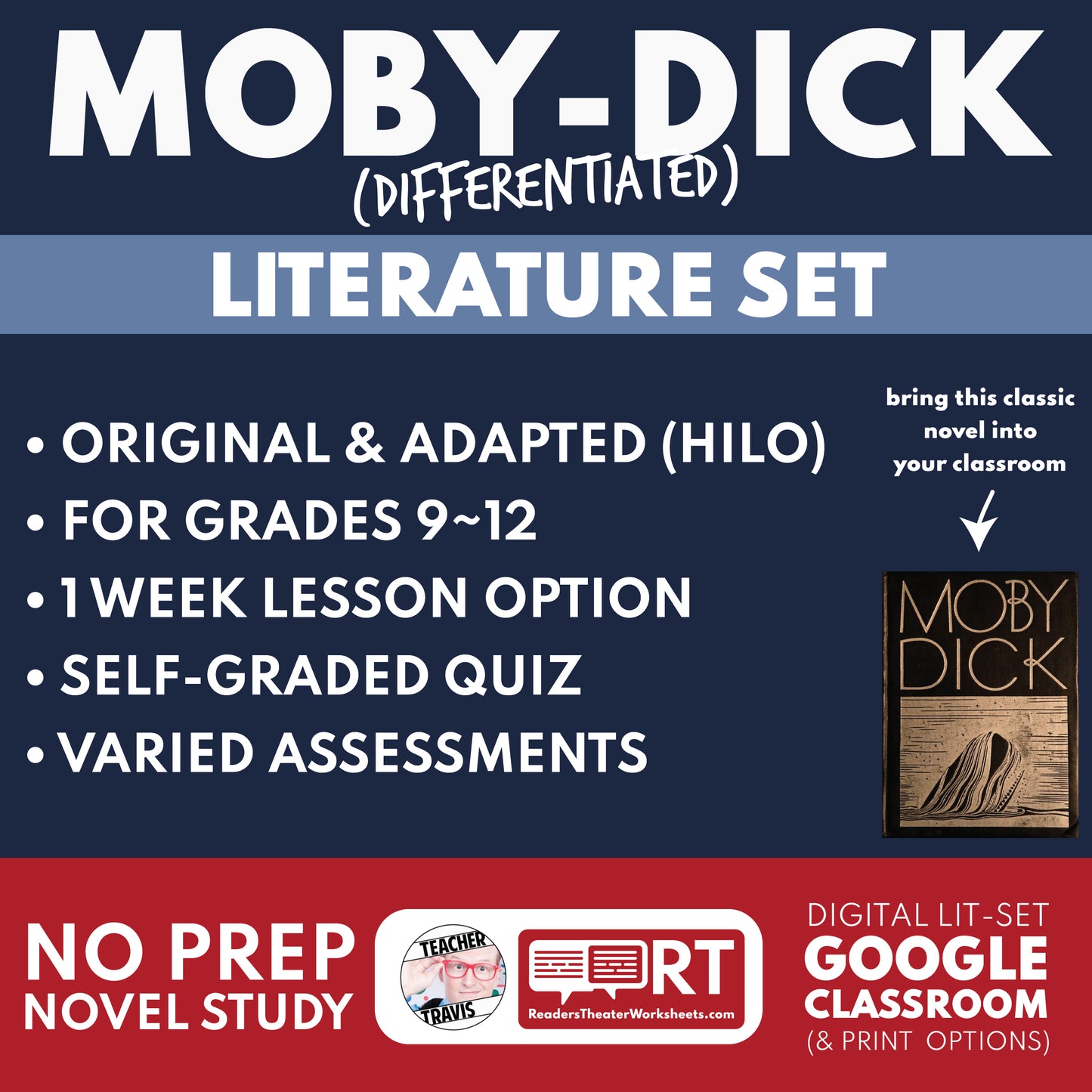
Moby-Dick Differentiated Novel Study | ELA Literature | Melville Lit Set for High School
Moby-Dick Differentiated Novel Study | ELA Literature | Melville Lit Set for High School
Couldn't load pickup availability
Classroom Use at a Glance
A no-prep differentiated literature study guide for high school students with reading, comprehension, vocabulary, discussion, writing, quiz, and teacher support materials. Designed for mixed-ability ELA classes, close reading, literature discussion, assessment, and differentiated instruction.
Classroom Uses Whole Class, Small Groups, Close Reading, Discussion, Assessment, Review, Enrichment, Sub Plan view all
- Whole Class
- Small Groups
- Close Reading
- Discussion
- Assessment
- Review
- Enrichment
- Sub Plan
Included Original Text, Teacher Guide, Student Worksheet, Answer Key, Quiz, Google Forms Quiz, Vocabulary, Discussion Questions, Challenge Questions, Writing Prompt view all
- Original Text
- Teacher Guide
- Student Worksheet
- Answer Key
- Quiz
- Google Forms Quiz
- Vocabulary
- Discussion Questions
- Challenge Questions
- Writing Prompt
Format PDF, DOCX, Google Docs, Google Forms, Printable, Editable view all
- DOCX
- Google Docs
- Google Forms
- Printable
- Editable
Differentiation Leveled Version, Original Version, Mixed Reading Levels, Vocabulary Support, Short Sections view all
- Leveled Version
- Original Version
- Mixed Reading Levels
- Vocabulary Support
- Short Sections
Problem: Most classic novel studies break down in real classrooms for two reasons: the original text is long and demanding, and student reading levels inside one class are rarely uniform—so teachers end up building separate tracks or simplifying discussions until the unit loses rigor.
Here’s the solution: This differentiated novel study / digital lit-set for Moby-Dick by Herman Melville solves that problem by giving you both the complete original text and a condensed, five-part adapted version, so you can keep the class moving together while students read at the level that fits.
Every discussion question, multiple-choice exit quiz, short-answer item, and challenge question works for both tracks, so you can run one coherent unit without rewriting prompts, re-keying tests, or splitting the class into separate curricula.
Perfect for Grades 9–10 novel study units focused on text evidence, character complexity, symbolism, author choices, academic vocabulary, and high-quality discussion.
Quick Guide for Teachers:
Adapted-Only Track (Fastest: 5-Day Model)
- Best for Grades 9–10 classes that need a manageable, one-week novel experience.
- Day 1–5: Students read one adapted part per day and use the matching Main Ideas & Themes Discussion Questions and self-grading multiple-choice quiz.
- End the week with the Final Worksheet (Vocabulary Words, Short Answer Questions, and Challenge Questions).
- This track keeps lessons tight, predictable, and complete in five days.
Original-Only Track (Longer: Multi-Day Per Section)
- Ideal for stronger readers or classes ready for original language and sentence structure.
- Students read the original chapters aligned to each adapted Part
- Use the same Discussion Questions, MC exit quizzes, and Final Worksheet; all items are text-accurate for both versions.
- Vocabulary Words (10) are usable for both tracks, because each word appears in both the adapted text and the corresponding original chapters.
- This track preserves the full descriptive style and classic voice while giving you ready-made, age-appropriate assessments.
Dual-Track Differentiation (Mixed Readers, Flexible Timelines)
- Lets your entire class study the same plot, scenes, and themes at the same time—even when some students need the adapted text and others handle the full novel.
- Assign adapted Part 1 to students who need a shorter, clearer text and original corresponding chapters to students reading the full text; repeat this pattern through Parts 2–5 (timing will depend on your classroom's reading level)
- Give original-text students multiple days per section while adapted-text students reread key scenes, complete vocabulary tasks, and tackle discussion questions in pairs or small groups.
- All assessments are usable for both tracks: Discussion Questions, MC Exit Quizzes for each Part, and the Final Worksheet (Vocabulary, Short Answer, and Challenge Questions).
What’s the Tradeoff of Using the Adapted Version?
Pros:
- Reduces the novel to a fraction of its original length, fitting neatly into a one-week unit.
- Well suited for shorter attention spans and developing readers in Grades 9-10
- Preserves core narrative elements, characters, and themes
- Far better than skipping the book entirely due to time limits or reading-level concerns.
- Works for whole-class read-alouds, small-group novel studies, independent reading, or focused close-reading lessons.
Cons:
- Omits some original language, side scenes, and descriptive passages for brevity, so students do not see every nuance of the original author's style.
- Leaves fewer opportunities for deep line-by-line stylistic analysis than a full-length, multi-week novel study.
Bottom Line:
If you have the time and budget, nothing beats the feel of a real paperback in every student’s hands. But when time, copies, and reading levels are real constraints, a digital literature set like this—adapted text + original text mapping + shared assessments—lets you bring this classic novel into your classroom instead of leaving it on the “maybe someday” shelf. If you were to buy traditional paperbacks at about $7 per book for 30 students, that is a $210 investment. This digital lit-set gives you a reusable, print-friendly alternative you can adapt for many years and multiple groups.
Try a digital lit set first for FREE! (It's just like this one)
[FREE DOWNLOAD] The Great Gatsby Differentiated Novel Study | Lit Set
This product includes a zip file consisting of:
NOTE: All files are editable and include (PDF, DOCX, PPTX, Google Docs/Slides/Forms)
Full Original Text: ~209,000 words | 9.9 Flesch-Kincaid GL
- Lexile Ranges: ~1080L - 1385L | CEFR ~B2 / C1-
- Great for advanced readers (or 8–10 graders), extension groups, longer-term novel studies.
-
BONUS: Free Access to the text on our LEVELED-LIT CLASSICS Library Platform.
Adapted Version Text: ~17,000 words | 6.2 Flesch-Kincaid GL
- Lexile Ranges: ~925L - 1090L | CEFR ~B1 / B2-
- Great for Grades 8–10 readers who need a shorter text with the same language level—faster pacing, clearer structure, and more manageable reading volume while keeping rigorous vocabulary and syntax.
- *Both versions tell the same story, allowing students to participate in shared discussions even when reading different texts.
Student Final Worksheet/Quizzes (PPTX, Google Slides/Forms)
- 10 Vocabulary Words
- 10 Short Answer Recall/Comprehension
- 5 Challenge Questions (synthesis, analysis, themes, real life connection)
- 5 Multiple Choice Quizzes (20 Questions) (1 per part)
Teacher’s Guide & Answer Key
- 5 Sets of Daily Discussion Questions (1 per part)
- 5 Sets of Self-Graded Exit Quizzes (1 per part, 20Qs each)
- Answer Keys for Vocab, Short Answer, and Challenge Questions
- Key Figures & Places reference sheets to help students track characters and settings
Student Final Worksheet/Quizzes (PPTX, Google Slides/Forms)
- 10 Vocabulary Words
- 10 Short Answer Recall/Comprehension
- 5 Challenge Questions (synthesis, analysis, themes, real life connection)
- 5 Multiple Choice Quizzes (20 Questions) (1 per part)
- Teacher’s Guide & Answer Key
- 5 Sets of Daily Discussion Questions (1 per part)
- 5 Sets of Self-Graded Exit Quizzes (1 per part, 20Qs each)
- Answer Keys for Vocab, Short Answer, and Challenge Questions
- Key Figures & Places reference sheets to help students track characters and settings
Adapted Version Summary (and source chapters)
Part 1 – The Shorebound Beginning
Adapted from: Chapters 1–16 of the original novel.
Ishmael introduces himself and explains why he goes to sea when his life on land feels inwardly poisoned. In New Bedford he meets Queequeg, and their uneasy first encounter becomes a surprising bond. Religious language and moral warning enter early through the sermon and through ominous talk around the voyage. Ishmael and Queequeg commit to the Pequod, stepping into a journey that already feels shadowed by foreboding.
Part 2 – The Captain’s Shadow
Adapted from: Chapters 17–42 of the original novel.
Aboard the Pequod, the ship’s routines and hierarchy take shape, and Ahab’s presence becomes a growing force. In the quarter-deck scene, he declares the White Whale his true target and binds the crew to the hunt through reward and pressure. Ishmael alternates between shipboard action and reflective explanation, showing how work and thought begin to orbit whales. The part closes with the sense that meaning itself is unstable—what looks pure or safe can become terrifying under the mind’s projections.
Part 3 – Blood, Labor, and Law at Sea
Adapted from: Chapters 43–89 of the original novel.
Whaling becomes a system of violence processed into routine: the chase, the cutting-in, the dangerous lines, the try-works, and the ship’s grim industry. Ishmael’s philosophical chapters widen the frame, turning practical rules—like ownership at sea—into arguments about power and authority. Ship meetings (“gams”) feed Ahab’s obsession as he demands news of the White Whale. The voyage increasingly feels like a floating world where law, meaning, and sanity are under pressure.
Part 4 – Signs and Fractures
Adapted from: Chapters 90–127 of the original novel.
Strange discoveries and moral tests accumulate: the ambergris episode, the coin’s shifting interpretations, and the crew’s attempts to manage unease with humor and argument. Pip’s castaway trauma shows how the sea’s blankness can break a mind, and Ahab’s response reveals a complicated capacity for recognition and tenderness. Starbuck reaches a private crisis—seeing disaster ahead yet unable to cross into murder to stop it. Ordinary objects (a coffin, tools, rituals) are converted into ominous signs within Ahab’s tightening trajectory.
Part 5 – The Chase and the Aftermath
Adapted from: Chapters 128–135 + Epilogue of the original novel.
Ahab refuses diversion even when another captain begs for help, confirming how obsession erases ordinary moral obligations. The Pequod enters the final pursuit: three days of escalating loss, prophecy made physical, and the brutal mechanics of rope and line turning into doom. Ahab’s end arrives as the hunt consumes ship and crew alike, and the Pequod sinks. Ishmael survives only by clinging to what was meant for death, and he is rescued to carry the story forward as a lone witness.
Frequently Asked Questions About the Adapted Moby-Dick Novel Study
1) Can I use the adapted text for reluctant or below-level readers without watering down the unit?
Yes. The adapted version is approximately 17,000 words at a 6.2 Flesch-Kincaid Grade Level, so students can complete a rigorous novel study with manageable reading volume while still working with the same core events, symbols, and character conflicts as the original track.
Readable
2) Is this aligned to high school ELA standards for Grades 9–10?
Yes. The tasks are built around text evidence, theme development, complex character analysis, language and symbolism, structure, point of view, and discussion—aligning to RL.9–10, SL.9–10, and L.9–10 clusters that are directly demanded by the prompts and responses.
3) How does the differentiation work if some students read the original and others read the adapted version?
Because the chapter map keeps Parts 1–5 aligned to the same narrative arc, students can read different versions while answering the same questions: every discussion prompt, quiz item, short-answer question, and challenge question is designed to be answerable from either track.
This is a complete, no-prep unit that lets you run one coherent Moby-Dick novel study while supporting mixed reading levels with true dual-track materials.
Get this in a Bundle of 10 Digital Lit Sets & SAVE 40%
CCSS Standards
Reading Literature: CCSS RL.9-10.1, CCSS RL.9-10.2, CCSS RL.9-10.3, CCSS RL.9-10.4, CCSS RL.9-10.5, CCSS RL.9-10.6, CCSS RL.11-12.1, CCSS RL.11-12.2, CCSS RL.11-12.3, CCSS RL.11-12.4, CCSS RL.11-12.5, CCSS RL.11-12.6
Speaking & Listening: CCSS SL.9-10.1, CCSS SL.11-12.1
Language: CCSS L.9-10.4, CCSS L.11-12.4
Anchor Standards: CCRA.R.1, CCRA.R.2, CCRA.R.3, CCRA.R.4, CCRA.R.5, CCRA.R.6, CCRA.W.1, CCRA.W.2, CCRA.W.9, CCRA.SL.1, CCRA.L.1, CCRA.L.2, CCRA.L.4
Share