Readers Theater Worksheets
Nevada State History | Across the High Desert RT Script + Mini Readers | Grade 4
Nevada State History | Across the High Desert RT Script + Mini Readers | Grade 4
Couldn't load pickup availability
Classroom Use at a Glance
Across the High Desert — Grade 4 Nevada State History Reader’s Theater, Mini Readers, vocabulary, inquiry and self-graded quiz.
Subjects History, Social Studies, Geography, ELA view all
- History
- Social Studies
- Geography
- ELA
Classroom Uses Sub Plan, Small Groups, Whole Class, Fluency Practice, Close Reading, Discussion, Assessment, Review, Performance Reading, Content-Area Reading view all
- Sub Plan
- Small Groups
- Whole Class
- Fluency Practice
- Close Reading
- Discussion
- Assessment
- Review
- Performance Reading
- Content-Area Reading
Included Reader’s Theater Script, Original Mini Reader, Accessible Mini Reader, Teacher Guide, Student Worksheet, Answer Key, Quiz, Google Forms Quiz, Vocabulary, Discussion Questions, Challenge Questions, Slides view all
- Reader’s Theater Script
- Original Mini Reader
- Accessible Mini Reader
- Teacher Guide
- Student Worksheet
- Answer Key
- Quiz
- Google Forms Quiz
- Vocabulary
- Discussion Questions
- Challenge Questions
- Slides
Format DOCX, Google Docs, Google Slides, Google Forms, ZIP Download, Printable, Editable view all
- DOCX
- Google Docs
- Google Slides
- Google Forms
- ZIP Download
- Printable
- Editable
Differentiation Leveled Version, Accessible Version, Original Version, Mixed Reading Levels, Vocabulary Support, Small-Group Support view all
- Leveled Version
- Accessible Version
- Original Version
- Mixed Reading Levels
- Vocabulary Support
- Small-Group Support
In 1834, a wool-goods caravan seeks a safe southern route through the high desert. In 1847, an emigrant family heads west along the Humboldt River corridor. The two journeys reveal why travelers depended on water, terrain, and routes already known by Native peoples.
This two-period Reader's Theater contrasts the Old Spanish Trail trading network with the California Trail migration corridor. Students follow documented differences in travel purpose and landscape, then hear a present-day museum label conversation about how to describe these routes accurately. The travelers and their words are fictional, but named routes, eras, and Native homeland context follow historical research.
Part 2 of 10 — Nevada State History, Grade 4. A complete, standalone historical Reader’s Theater lesson with two differentiated Mini Readers and aligned assessments.
The Story Students Perform
This two-period Reader's Theater contrasts the Old Spanish Trail trading network with the California Trail migration corridor. Students follow documented differences in travel purpose and landscape, then hear a present-day museum label conversation about how to describe these routes accurately. The travelers and their words are fictional, but named routes, eras, and Native homeland context follow historical research. Historical routes branched and cannot be reduced to one precise modern line. Present-day Nevada borders are a reference aid, not proof of Indigenous territorial boundaries or a full record of individual journeys.
Historical Learning Focus
- Locate southern Nevada's Old Spanish Trail network and the northern Humboldt River corridor associated with the California Trail.
- Compare trading pack caravans of the 1830s with westbound emigrant migration during the 1840s.
- Describe how springs, rivers, canyons, and supplies limited historical travel decisions.
- Recognize that Native communities used and knew these places before newcomers mapped national trails.
- Compare documented maps without treating two historically different networks as the same path.
Essential question: Why did travelers choose different routes across present-day Nevada, and whose places and resources did they cross?
At a Glance
- Nevada Grade 4, Part 2 of a connected ten-lesson sequence.
- Ten-scene Reader’s Theater, designed for classroom performance and historical discussion.
- Original and Accessible Mini Readers teach the same essential historical evidence with different reading support.
- Ten vocabulary terms, ten two-part short questions, five two-part challenge questions and twenty multiple-choice items.
- Self-graded Google Forms quiz; classroom materials available through an editable shared Google Drive folder.
- An instructional geographic visual is included; use it for classroom orientation and the lesson-specific map task, not precise navigation.
What’s Included
- Teacher Guide with planning/pacing options, lesson focus, discussion prompts, factual context and sources.
- Ten-scene Reader’s Theater script with role assignments, classroom reading and performance opportunities.
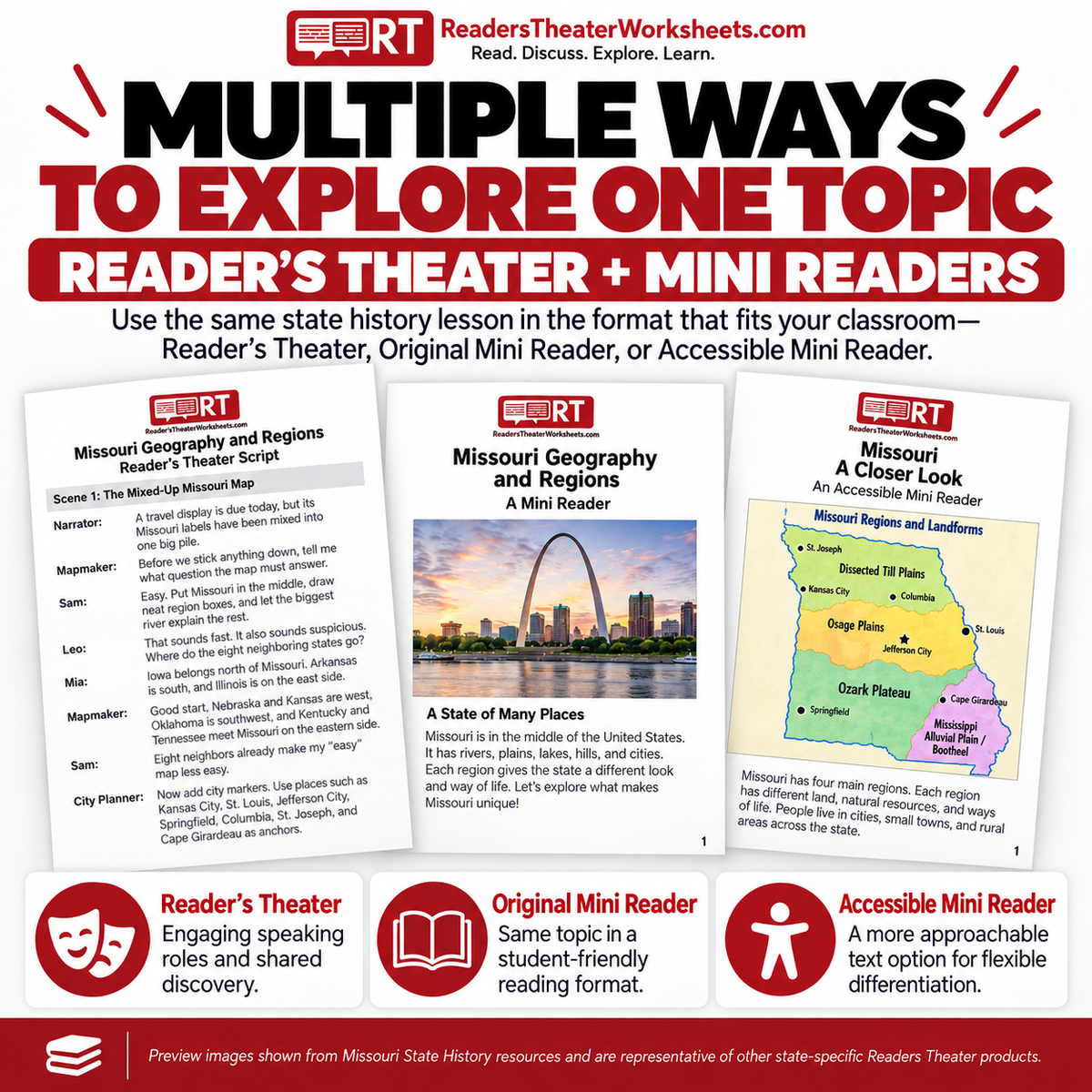
- Original Mini Reader plus Accessible Mini Reader so groups can work with the same historical evidence at different reading complexities.
- Ten vocabulary terms and definitions, with reading-comprehension and text-evidence practice.
- Ten short-answer prompts and five challenge prompts, each with parts A and B; teacher answer keys and standards alignment.
- Twenty-question multiple-choice teacher key, student print quiz and editable/self-grading digital form.
- Student worksheet and classroom-ready Slides for written responses or practice, plus a Start Here access PDF.
- Historical source notes and teacher-facing safeguards about chronology, geography, uncertainty, or terminology.
Teaching and Differentiation
Begin by introducing the essential question and a few content terms, then assign readers by interest and reading support needs. Perform selected scenes or all ten across a flexible schedule. Students can read the Original or Accessible Mini Reader before or after the play; use the same short-answer and challenge questions to check historical understanding. The separate Mini Readers are not different historical stories: their common evidence allows meaningful discussion across groups. Use the teacher pacing options for one, two or three class periods and extend with the inquiry activity below.
Skills and Classroom Uses
The lesson develops fluency, vocabulary in context, historical comprehension, chronology, comparison, source awareness, supported claims and discussion. A teacher can use it for whole-class performance, small-group reading, social-studies literacy, a short sub plan, review or an assessment check. Inquiry extension: Compare separate official trail maps and annotate where the northern and southern routes differed, using the supplied statewide map only for orientation.
Standards and Historical Accuracy
This resource addresses SS.4.13 with SS.4.23 through the separate map-comparison task; related geography reasoning is partial. The Teacher Guide identifies the specific alignments and their limits rather than claiming comprehensive coverage of every state standard. Accuracy note: Historical routes branched and cannot be reduced to one precise modern line. Present-day Nevada borders are a reference aid, not proof of Indigenous territorial boundaries or a full record of individual journeys. The classroom performance is fictionalized, while historical events, identities, places and dates follow the prepared research records. An instructional geographic visual is included; use it for classroom orientation and the lesson-specific map task, not precise navigation.
All 10 Nevada State History Lessons
P01 Living With the Land; P02 Across the High Desert; P03 A Mountain of Silver; P04 A State in a Hurry; P05 The Iron Road West; P06 Where the Rivers Went; P07 Votes Across Nevada; P08 Building the Giant Dam; P09 The Door Opens; P10 The Stories in the Trees.
Series P01, “Living With the Land,” introduces the Nevada collection through Indigenous homelands and living Tribal communities. Explore it before or alongside this lesson for geographical context.
How Digital Access Works
After purchasing or receiving the product, open the included Start Here PDF. Click the red “OPEN SHARED GOOGLE FOLDER” button to access the shared Google Drive folder for this lesson. Make your own copies of the editable Google files before changing or assigning them in Google Classroom. Digital forms and slides accompany printable files; school-domain restrictions can affect access. Follow the instructions in the PDF rather than editing the shared originals.
Text Summary
Across the High Desert follows two distinct fictional journeys grounded in official trail histories. In 1834, a New Mexican pack caravan trades woolen goods across southern routes. In 1847, a westbound emigrant family faces water and passage decisions along the northern Humboldt corridor. Present-day museum writers then decide how to name the trails accurately and include the Native Nations whose lands travelers crossed. The original and accessible Mini Readers explain the same historical evidence and source limits.
Explore the Complete Nevada State History Collection
This is Part 2 of 10 in the Grade 4 Nevada State History series. See the complete ten-lesson Nevada State History bundle, which brings together every chapter, differentiated Mini Readers, and the accompanying learning activities.
New to this series? Try Part 1, “Living With the Land,” as a free sample before choosing this individual lesson or the complete bundle.
Previous lesson: Part 1 — Living With the Land.
Next lesson: Part 3 — A Mountain of Silver.
Share