Reader's Theater Worksheets
Nevada State History | Reader's Theater Scripts & Mini Readers | Grade 4 Bundle
Nevada State History | Reader's Theater Scripts & Mini Readers | Grade 4 Bundle
Couldn't load pickup availability
Classroom Use at a Glance
Ten Nevada Grade 4 State History Reader’s Theater lessons; 100 scenes, 20 differentiated Mini Readers, vocabulary, written assessments, 200 MC questions, Google Forms, and free P01 sample.
Subjects History, Social Studies, Geography, ELA view all
- History
- Social Studies
- Geography
- ELA
Classroom Uses Sub Plan, Small Groups, Whole Class, Fluency Practice, Close Reading, Discussion, Assessment, Review, Performance Reading, Content-Area Reading view all
- Sub Plan
- Small Groups
- Whole Class
- Fluency Practice
- Close Reading
- Discussion
- Assessment
- Review
- Performance Reading
- Content-Area Reading
Included Reader’s Theater Script, Original Mini Reader, Accessible Mini Reader, Teacher Guide, Student Worksheet, Answer Key, Quiz, Google Forms Quiz, Vocabulary, Discussion Questions, Challenge Questions, Slides view all
- Reader’s Theater Script
- Original Mini Reader
- Accessible Mini Reader
- Teacher Guide
- Student Worksheet
- Answer Key
- Quiz
- Google Forms Quiz
- Vocabulary
- Discussion Questions
- Challenge Questions
- Slides
Format DOCX, Google Docs, Google Slides, Google Forms, ZIP Download, Printable, Editable view all
- DOCX
- Google Docs
- Google Slides
- Google Forms
- ZIP Download
- Printable
- Editable
Differentiation Leveled Version, Accessible Version, Original Version, Mixed Reading Levels, Vocabulary Support, Small-Group Support view all
- Leveled Version
- Accessible Version
- Original Version
- Mixed Reading Levels
- Vocabulary Support
- Small-Group Support
Ten Nevada history stories. One complete Grade 4 teaching sequence. Explore the landscapes, migration routes, industries, public decisions, workers, rights movements, and preserved histories that shaped Nevada. This collection brings ten standalone historical Reader’s Theater lessons together in chronological and thematic teaching order, from the Great Basin and living Indigenous Nations to nineteenth-century statehood, railroads and water projects, twentieth-century civic changes, and fragile evidence recorded on aspen trees.
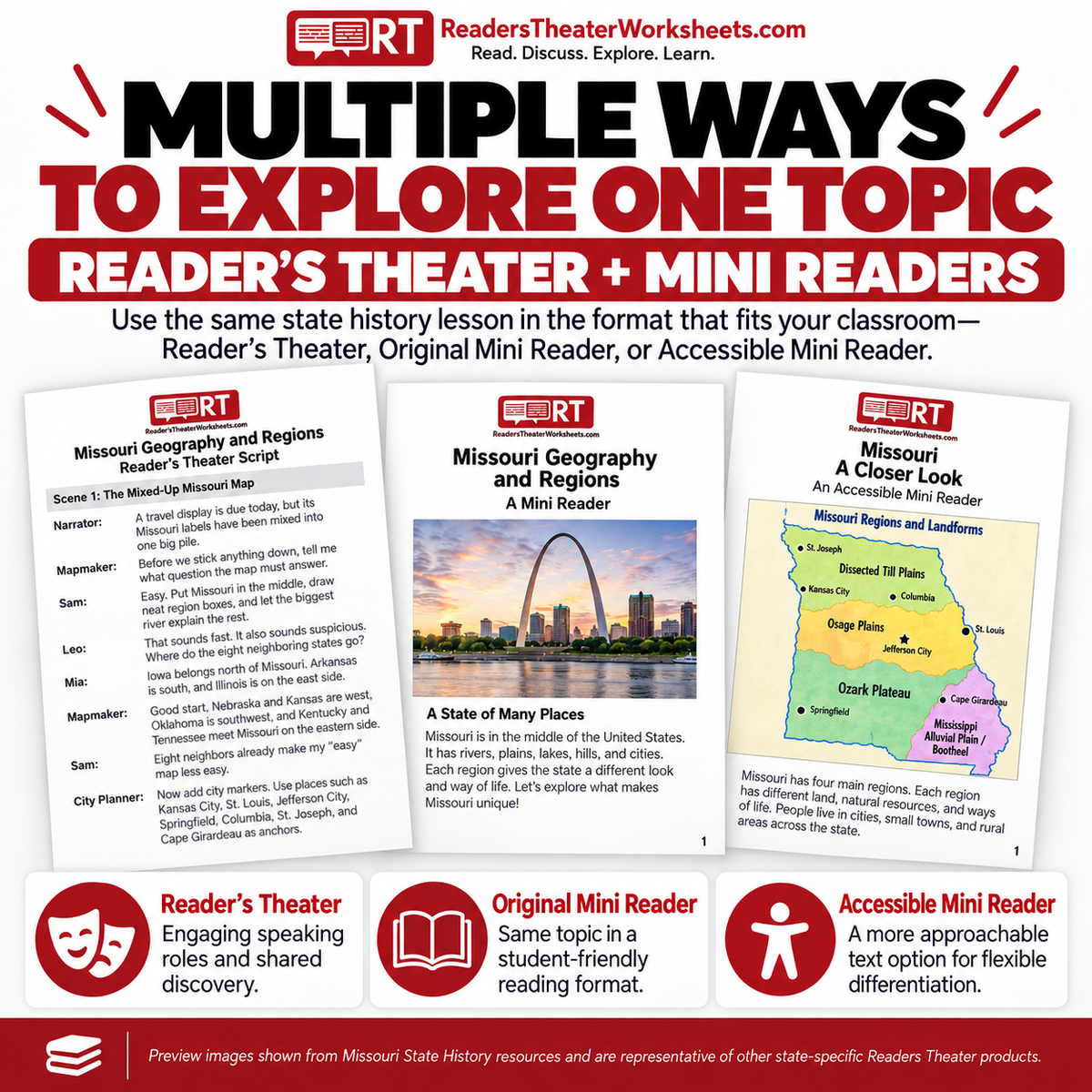
Every lesson contains a ten-scene Reader’s Theater with dialogue designed for group reading, an Original Mini Reader, and an Accessible Mini Reader that revisit the same essential historical evidence using differentiated reading demands. Students can perform, compare evidence, discuss decisions, work with domain vocabulary, answer written questions, and complete a multiple-choice check for understanding. Use the entire sequence or assign individual stories within your Grade 4 Nevada unit.
All Ten Lessons — Exact Included Products
The links below point to the ten actual lesson listings in this bundle, in instructional order. Part 1 is available individually for free. The bundle is a separate product, not another lesson in the included collection.
- Part 01 — Living With the Land (FREE sample). Landscape and living Indigenous communities. Explore Nevada landscapes alongside Waší∙šiw (Washoe), Northern Paiute, Western Shoshone, Southern Paiute, and Fort Mojave histories. Distinguish particular Tribal Nations, historical homelands, present-day governments, and stewardship without treating modern boundaries as a map of every homeland.
- Part 02 — Across the High Desert. Two different routes through the high desert. Compare the Old Spanish Trail trading network with the California Trail migration corridor. Two fictional journeys in 1834 and 1847 show different travel purposes, water decisions, and the Native homelands crossed by travelers.
- Part 03 — A Mountain of Silver. Silver mining and Virginia City. Examine the Comstock Lode and silver-era Virginia City, including mining work, business opportunities, and contributions of Chinese residents. Consider who benefited from the boom and whose work made it possible.
- Part 04 — A State in a Hurry. Nevada statehood in 1864. Investigate the Civil War-era drive toward statehood, constitutional questions, the 1864 admission timeline, and the telegraph transmission of Nevada’s constitution. Examine decisions rather than assuming statehood happened for one simple reason.
- Part 05 — The Iron Road West. Railroads and their workers. Trace Central Pacific construction through Nevada, with Chinese railroad workers, difficult terrain, and the links among routes, jobs, communities, and the expanding transcontinental rail network.
- Part 06 — Where the Rivers Went. Water diversions and competing needs. Explore the Newlands Project, Truckee River water, farms near Fallon, Pyramid Lake, and how irrigation decisions created lasting consequences for different communities and the environment.
- Part 07 — Votes Across Nevada. Voting, rights, and participation. Follow Nevada conversations about voting rights, women’s suffrage, civic participation, and the state constitution. Distinguish the 1914 Nevada vote from later broader national changes.
- Part 08 — Building the Giant Dam. Building Hoover Dam. Study construction at Hoover Dam, the Colorado River, Lake Mead, and the people and communities affected by a major Depression-era infrastructure project.
- Part 09 — The Door Opens. Civil rights and access in Las Vegas. Investigate segregation, Nevada civil-rights organizing, the Moulin Rouge, and the work of local people and organizations toward more equal access to public life.
- Part 10 — The Stories in the Trees. Preserving stories in aspen trees. Use aspen arborglyphs at Great Basin National Park to consider Basque sheepherders, later Peruvian and Mexican sheep workers, uncertain identities, and responsible preservation of historical evidence.
Learning Focus and Historical Thinking
Use these connected lessons to investigate how landforms and waterways influence travel and settlement without determining people’s choices; why Native Nations and their living governments must be described specifically; how different migrations, mineral discoveries and transportation investments reshaped communities; how decisions about water allocation affect farms, lakes and people; and how constitutional change, civic participation and organized civil-rights work developed across time.
The lessons emphasize chronology, cause and effect, historical geography, differences in perspective, and careful use of evidence. Students practice separating what a record establishes from what a fictional character concludes. Teacher-facing context and research notes support historically accurate classroom discussions, including when a source cannot answer every question.
What Teachers Receive Across the Bundle
- 10 historical Reader’s Theater scripts with 10 scenes each (100 scenes in all) and casts designed for classroom performance or paired reading.
- 20 differentiated Mini Readers: an Original and an Accessible reading in each lesson, following the same historical learning objectives.
- Teacher Guides with lesson context, pacing, role/casting guidance, classroom prompts and source notes.
- Vocabulary: 10 terms per lesson (100 across the bundle), with context and definitions.
- Written-response work: ten two-part short questions plus five two-part challenge questions per lesson, with teacher answers and standards information (150 written questions across ten lessons).
- Quizzes: 20 four-option multiple-choice items in each lesson, student-facing quizzes and teacher keys (200 multiple-choice items across the bundle), plus self-grading Google Forms resources.
- Supporting classroom materials: student worksheets, editable digital materials and accompanying Slides where provided with each lesson, plus Start Here instructions for accessing shared folders.
- Map instruction where appropriate: selected lessons include geography/map activities. Not every lesson contains a map.
Differentiation and Classroom Uses
The Grade 4 focus fits the Grades 3–5 band. Use the Original Mini Readers for students ready for fuller prose and the Accessible Mini Readers for a supported route through the same historical concepts. Flexible casting and performance allow mixed reading groups to participate in one discussion. The stories work as social-studies content reading, fluency practice, collaborative discussion, evidence-based writing, unit review, enrichment, or guided intervention.
Teachers can stage the scripts, read scenes in small groups, distribute a Mini Reader before or after performing, then use the two-part written assessments and quizzes to check whether students can explain history with evidence. The ten topics create a coherent survey without assuming that a single community experienced the past in the same way as every other community.
Standards and Source Care
Developed for Nevada’s Grade 4 state-history instructional focus, with social-studies connections to historical inquiry, chronology, state geography, civics, migration, economy, and cultural history. The materials draw on product-specific historical research and support teacher discussion of Native Nations, sources, dates, and limits of historical evidence. The individual Teacher Guides supply the lesson-level standards alignments and source notes; do not use fictional dialogue as a substitute for a historical primary document.
Start Here: Digital Access and Preparation
Each lesson includes a Start Here PDF that points to that lesson’s shared Google Drive folder. Open the PDF and use the red OPEN SHARED GOOGLE FOLDER link, then make copies of editable Google Docs, Slides and Forms before adapting or assigning them in Google Classroom. Printable materials and teacher directions are included. School-managed Google accounts may require permissions adjustments; follow the access/troubleshooting notes in the Start Here document.
Want to preview the teaching style before purchasing the complete bundle? Open the free Part 1 — Living With the Land lesson. You can also review any of the ten linked individual lesson pages above for its own story, historical focus and materials.
Complete Nevada State History Series — Teacher Overview
Start with Nevada’s varied physical landscapes and the histories and present-day communities of Native Nations. Follow routes used in different periods, the Comstock silver economy, Civil War-era statehood, and the Central Pacific Railroad. Examine irrigation and the Truckee River system alongside civic participation and women’s suffrage. Then explore the Hoover Dam project, Las Vegas civil-rights history, and preservation of the stories recorded by Nevada’s sheepherders. The result is a set of connected, classroom-ready encounters with Nevada history rather than a list of dates to memorize.
Share