
Readers Theater Worksheets
New Jersey State History | Transportation, Industry, Environment, and New Jersey Today RT Script and Mini Readers | Grades 3-5
New Jersey State History | Transportation, Industry, Environment, and New Jersey Today RT Script and Mini Readers | Grades 3-5
Couldn't load pickup availability
Classroom Use at a Glance
A grades 3–5 New Jersey State History lesson on transportation, industry, invention, migration, urban growth, environmental change, conservation, and modern New Jersey connections, with three coordinated reading options and shared assessments.
Classroom Uses Whole Class, Small Groups, Fluency Practice, Content-Area Reading, Discussion, Assessment, Review view all
- Whole Class
- Small Groups
- Fluency Practice
- Content-Area Reading
- Discussion
- Assessment
- Review
Included Reader’s Theater Script, Original Mini Reader, Accessible Mini Reader, Teacher Guide, Student Worksheet, Answer Key, Quiz, Google Forms Quiz, Vocabulary, Discussion Questions, Challenge Questions, Primary Source Extension view all
- Reader’s Theater Script
- Original Mini Reader
- Accessible Mini Reader
- Teacher Guide
- Student Worksheet
- Answer Key
- Quiz
- Google Forms Quiz
- Vocabulary
- Discussion Questions
- Challenge Questions
- Primary Source Extension
Format PDF, DOCX, Google Forms, ZIP Download, Printable, Editable view all
- DOCX
- Google Forms
- ZIP Download
- Printable
- Editable
Differentiation Accessible Version, Original Version, Mixed Reading Levels, ELL Support, Struggling Readers, Vocabulary Support, Small-Group Support view all
- Accessible Version
- Original Version
- Mixed Reading Levels
- ELL Support
- Struggling Readers
- Vocabulary Support
- Small-Group Support
Trace how new ways of moving, making, inventing, and using land changed New Jersey—and why every shortcut brought both opportunities and consequences. This grades 3-5 resource centers Grade 4 social studies while providing three coordinated student-text options.
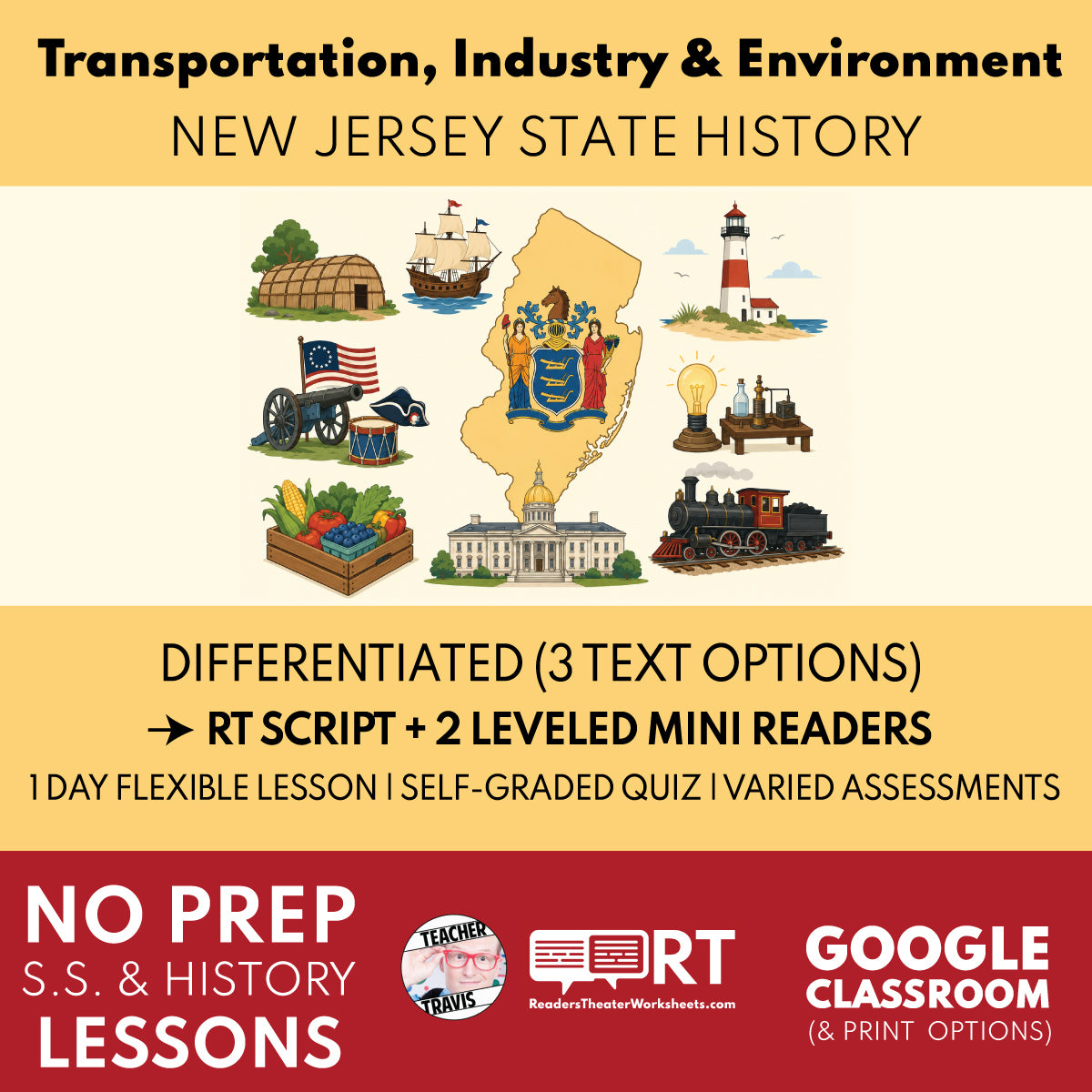
Transportation, Industry, Environment, and New Jersey Today provides three coordinated student-text options built around “Every Shortcut Changes the Map.” Students follow four statewide case-study anchors—Paterson and Great Falls, the Delaware and Raritan Canal corridor, Menlo Park, and the Pinelands—to trace how new ways of making, moving, inventing, and using land reshaped economic connections. The lesson emphasizes change over time, geography, migration, urbanization, environmental effects, conservation, and documented perspectives without turning later New Jersey history into a complete chronological survey.
Lesson 10 of the 10-lesson New Jersey State History bundle. Get the complete New Jersey State History Mini Unit Bundle here.
View the Full 10-Lesson New Jersey Bundle
Classroom Use
Every assessment option is designed to be answerable from the Reader’s Theater Script, the Original Mini Reader, or the Accessible Mini Reader. Teachers can place students in different reading paths while keeping the class on the same essential history, vocabulary, questions, and quiz.
Standards Alignment
New Jersey Student Learning Standards include 6.1.5.GeoHE.1, 6.1.5.GeoHE.2, 6.1.5.GeoGI.4, 6.1.5.EconEM.4; the final Teacher Guide contains the complete lesson-specific list. CCSS literacy connections are supported through informational reading, text evidence, vocabulary in context, speaking and listening, and explanatory writing tasks embedded in the lesson.
Perfect For
- New Jersey transportation and industry units
- Paterson and Great Falls industrial history
- Delaware and Raritan Canal and railroad connections
- Menlo Park, invention, and technology
- Pinelands development, environment, and conservation
Flexible Differentiation
- Use the Reader’s Theater script for whole-class participation, small-group performance, oral fluency, and discussion.
- Use the Original Mini Reader for independent reading, homework, or students who benefit from added detail.
- Use the Accessible Mini Reader for mixed reading levels, ELL support, intervention, struggling readers, or faster one-day use.
- Print selected pages or assign the included Google Classroom-ready files.
- Use the worksheet, challenge questions, print quiz, or self-graded Google Forms quiz for assessment and review.
Skills Addressed
- Great Falls waterpower and Paterson industrial growth
- Factories, workers, and urbanization
- Delaware and Raritan Canal
- Reading fluency and collaborative discussion
- Vocabulary in context and text evidence
- Cause, comparison, perspective, and historical reasoning as appropriate to the topic
What’s Included
Student Text Options
- Reader’s Theater Script with 12 recurring speaking roles
- Original Mini Reader
- Accessible Mini Reader
Assessment Materials
- Vocabulary in context
- 10 two-part comprehension questions
- 5 two-part challenge questions
- 20-question multiple-choice quiz
- Self-graded Google Forms quiz
Teacher Materials
- Teacher Guide and standards alignment
- Answer keys
- Discussion prompts
- Primary-source or evidence extension
- Printable and editable files
Explore All 10 New Jersey State History Lessons
This individual lesson is part of a connected ten-lesson sequence. Use the complete bundle as a mini unit, or select individual lessons to match your pacing guide.
- 1. Land, Water, and New Jersey Regions — New Jersey geography, physical regions, waterways, the Pine Barrens, community types, and change over time.
- 2. Lenape Homelands and Communities — Lenape homelands, waterways, seasonal community life, colonization, Brotherton, displacement, continuity, and living Native communities.
- 3. Dutch New Netherland in New Jersey — Dutch New Netherland, waterways, the fur trade, settlement, Native land pressure, colonial rivalry, and the 1664 English takeover.
- 4. New Sweden and the Delaware Valley — New Sweden, the Delaware Valley, Swedish and Finnish settlement, Fort Elfsborg, Native exchange, colonial rivalry, and the 1655 Dutch takeover.
- 5. East Jersey, West Jersey, and English Rule — English takeover, proprietary government, East Jersey, West Jersey, Burlington, Perth Amboy, migration, landholding, and the 1702 reunion.
- 6. Quakers, Religious Diversity, and Colonial Rights — Quakers, religious diversity, West Jersey’s 1677 Concessions and Agreements, representative government, colonial rights, limits, and slavery.
- 7. Colonial Farms, Ports, Towns, and Enslavement — colonial farms, rivers, ports, towns, markets, Atlantic trade, indentured servitude, slavery, and unequal freedom.
- 8. From Proprietors to a Royal Colony — the 1702 transition from proprietary to royal government, Crown authority, elected assembly, land disputes, representation, and imperial connections through 1763.
- 9. How New Jersey Government Works — local, county, and state government; New Jersey’s legislative, executive, and judicial branches; representation; public policy; and civic participation.
- 10. Transportation, Industry, Environment, and New Jersey Today — transportation, industry, invention, migration, urban growth, environmental change, conservation, and modern New Jersey connections.
Get the Complete New Jersey State History Bundle
Text Summary
Maya and Eli begin with the claim that every new shortcut simply made New Jersey faster and better. They test that idea at Great Falls, where waterpower supported Paterson’s planned industrial growth; along the Delaware and Raritan Canal and expanding railroads; at Menlo Park, where organized invention linked technology with wider networks; and in the Pinelands, where natural resources, development, and conservation reveal different goals. By the final scene, the students replace a simple progress story with a cause-and-consequence map showing opportunities, costs, migration, urban growth, environmental change, and continuing choices.
Share