
Readers Theater Worksheets
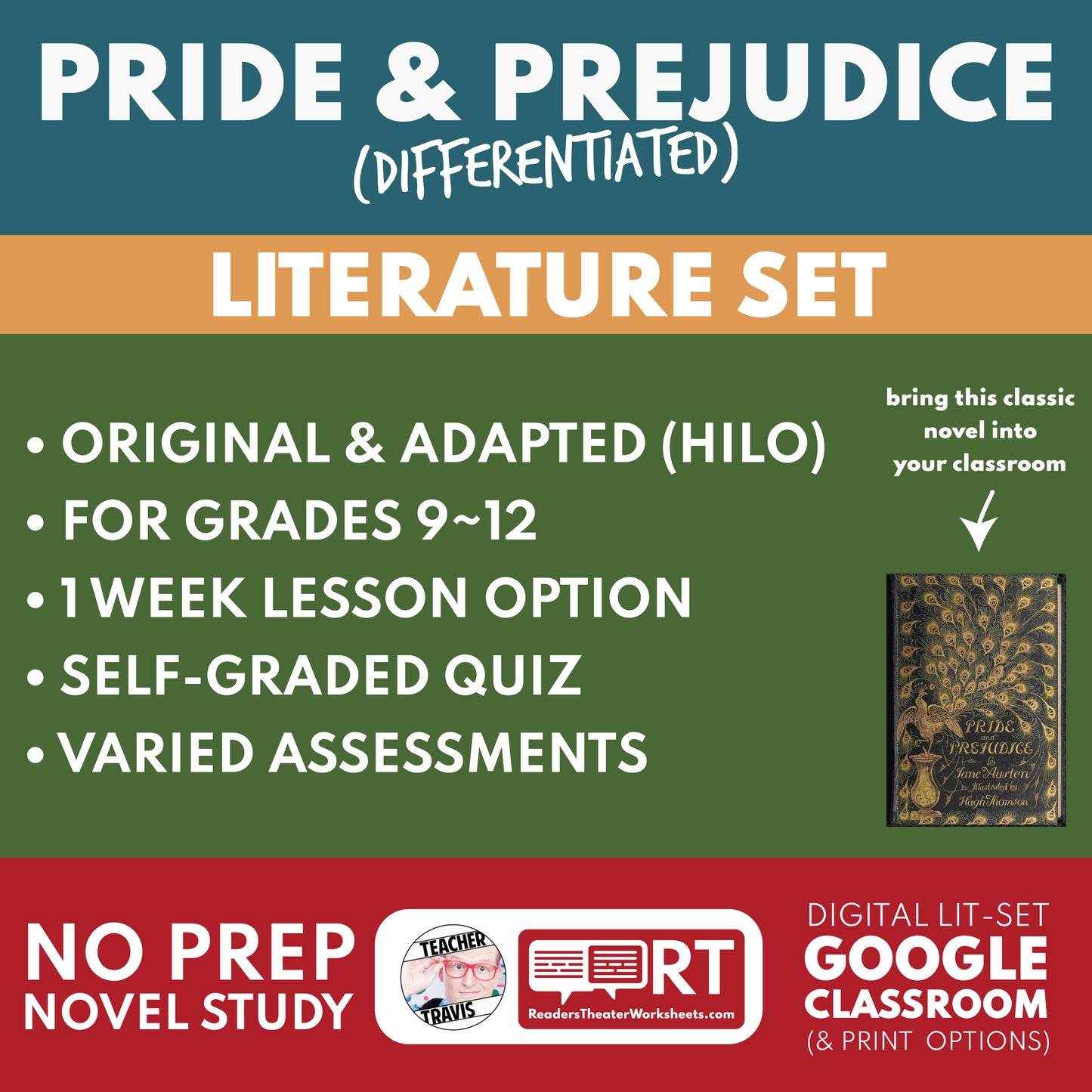
Pride and Prejudice Differentiated Novel Study | ELA Literature | Austen Lit Set for High School
Pride and Prejudice Differentiated Novel Study | ELA Literature | Austen Lit Set for High School
Couldn't load pickup availability
Classroom Use at a Glance
A no-prep differentiated literature study guide for high school students with reading, comprehension, vocabulary, discussion, writing, quiz, and teacher support materials. Designed for mixed-ability ELA classes, close reading, literature discussion, assessment, and differentiated instruction.
Classroom Uses Whole Class, Small Groups, Close Reading, Discussion, Assessment, Review, Enrichment, Sub Plan view all
- Whole Class
- Small Groups
- Close Reading
- Discussion
- Assessment
- Review
- Enrichment
- Sub Plan
Included Original Text, Teacher Guide, Student Worksheet, Answer Key, Quiz, Google Forms Quiz, Vocabulary, Discussion Questions, Challenge Questions, Writing Prompt view all
- Original Text
- Teacher Guide
- Student Worksheet
- Answer Key
- Quiz
- Google Forms Quiz
- Vocabulary
- Discussion Questions
- Challenge Questions
- Writing Prompt
Format PDF, DOCX, Google Docs, Google Forms, Printable, Editable view all
- DOCX
- Google Docs
- Google Forms
- Printable
- Editable
Differentiation Leveled Version, Original Version, Mixed Reading Levels, Vocabulary Support, Short Sections view all
- Leveled Version
- Original Version
- Mixed Reading Levels
- Vocabulary Support
- Short Sections
Problem: Many teachers want to teach classic literature, but the original texts can be too long or linguistically dense for mixed-level classrooms—especially when time is limited and students need meaningful, standards-based assessment without weeks of remediation.
Here’s the solution: This differentiated novel study (digital lit-set) solves that problem by giving you both tracks in one complete unit: the full original Pride and Prejudice text and a streamlined adapted five-part version for faster pacing and stronger accessibility. You get a stable, part-for-part chapter map (Parts 1–5) so students can read different versions while staying aligned to the same instruction, discussions, and assessments.
Every discussion question, multiple-choice exit quiz, short-answer item, and challenge question works for both tracks—so you can differentiate reading levels without rewriting your unit, splitting the class into separate plans, or sacrificing rigor.
Perfect for Grades 9–10 ELA classrooms supporting close reading, evidence-based discussion, theme and character analysis, craft and structure, and academic vocabulary development.
Quick Guide for Teachers:
Adapted-Only Track (Fastest: 5-Day Model)
- Best for Grades 9–10 classes that need a manageable, one-week novel experience.
- Day 1–5: Students read one adapted part per day and use the matching Main Ideas & Themes Discussion Questions and self-grading multiple-choice quiz.
- End the week with the Final Worksheet (Vocabulary Words, Short Answer Questions, and Challenge Questions).
- This track keeps lessons tight, predictable, and complete in five days.
Original-Only Track (Longer: Multi-Day Per Section)
- Ideal for stronger readers or classes ready for original language and sentence structure.
- Students read the original chapters aligned to each adapted Part
- Use the same Discussion Questions, MC exit quizzes, and Final Worksheet; all items are text-accurate for both versions.
- Vocabulary Words (10) are usable for both tracks, because each word appears in both the adapted text and the corresponding original chapters.
- This track preserves the full descriptive style and classic voice while giving you ready-made, age-appropriate assessments.
Dual-Track Differentiation (Mixed Readers, Flexible Timelines)
Lets your entire class study the same plot, scenes, and themes at the same time—even when some students need the adapted text and others handle the full novel. Assign adapted Part 1 to students who need a shorter, clearer text and original corresponding chapters to students reading the full text; repeat this pattern through Parts 2–5 (timing will depend on your classroom's reading level) Give original-text students multiple days per section while adapted-text students reread key scenes, complete vocabulary tasks, and tackle discussion questions in pairs or small groups. All assessments are usable for both tracks: Discussion Questions, MC Exit Quizzes for each Part, and the Final Worksheet (Vocabulary, Short Answer, and Challenge Questions).
What’s the Tradeoff of Using the Adapted Version?
Pros:
- Reduces the novel to a fraction of its original length, fitting neatly into a one-week unit.
- Well suited for shorter attention spans and developing readers in Grades 9-10
- Preserves core narrative elements, characters, and themes
- Far better than skipping the book entirely due to time limits or reading-level concerns.
- Works for whole-class read-alouds, small-group novel studies, independent reading, or focused close-reading lessons.
- Cons:
Omits some original language, side scenes, and descriptive passages for brevity, so students do not see every nuance of the original author's style.
Leaves fewer opportunities for deep line-by-line stylistic analysis than a full-length, multi-week novel study.
Bottom Line:
If you have the time and budget, nothing beats the feel of a real paperback in every student’s hands. But when time, copies, and reading levels are real constraints, a digital literature set like this—adapted text + original text mapping + shared assessments—lets you bring this classic novel into your classroom instead of leaving it on the “maybe someday” shelf. If you were to buy traditional paperbacks at about $7 per book for 30 students, that is a $210 investment. This digital lit-set gives you a reusable, print-friendly alternative you can adapt for many years and multiple groups.
Try a digital lit set first for FREE! (It's just like this one)
[FREE DOWNLOAD] The Great Gatsby Differentiated Novel Study | Lit Set
This product includes a zip file consisting of:
NOTE: All files are editable and include (PDF, DOCX, PPTX, Google Docs/Slides/Forms)
Full Original Text: ~125,000 words | ~9.0 Flesch-Kincaid GL
- Lexile Ranges: ~950L - 1250L | CEFR ~B2- / B2
- Great for on-level to advanced Grades 8–10 readers, extension groups, and longer-form classic novel studies.
-
BONUS: Free Access to the text on our LEVELED-LIT CLASSICS Library Platform.
Adapted Version Text: ~12,800 words | ~8.0 Flesch-Kincaid GL
- Lexile Ranges: ~950L - 1250L | CEFR ~B2- / B2 Great for Grades 8–10 readers who need a shorter text with the same language level—faster pacing, clearer structure, and more manageable reading volume while keeping rigorous vocabulary and syntax.
- *Both versions tell the same story, allowing students to participate in shared discussions even when reading different texts.
Student Final Worksheet/Quizzes (PPTX, Google Slides/Forms)
- 10 Vocabulary Words
- 10 Short Answer Recall/Comprehension
- 5 Challenge Questions (synthesis, analysis, themes, real life connection)
- 5 Multiple Choice Quizzes (20 Questions) (1 per part)
- Teacher’s Guide & Answer Key
- 5 Sets of Daily Discussion Questions (1 per part)
- 5 Sets of Self-Graded Exit Quizzes (1 per part, 20Qs each)
- Answer Keys for Vocab, Short Answer, and Challenge Questions
- Key Figures & Places reference sheets to help students track characters and settings
- Adapted Version Summary (and source chapters)
Part 1 – First Impressions, Social Stakes, and the Pressure to Marry
Adapted from: Chapters 1–14 of the original novel.
A wealthy newcomer and his friend reshape local expectations, turning ordinary visits and assemblies into a marriage market with real economic consequences. Elizabeth forms an early dislike of Darcy after a public slight, while Jane’s gentleness and hope make her more vulnerable to social manipulation. At Netherfield, class performance becomes visible: who is judged, who judges, and how “proper” behavior is weaponized. The part closes by sharpening the inheritance pressure and bringing the entail into the foreground.
Part 2 – Wickham’s Story, the Netherfield Ball, and the Cost of Practical Choices
Adapted from: Chapters 15–23 of the original novel.
Wickham’s charm and narrative skill give Elizabeth a ready-made moral explanation that fits her existing bias against Darcy. The Netherfield ball intensifies social scrutiny, exposing both private feelings and public humiliations. Mr. Collins’s proposal becomes comic and threatening at once, converting inheritance into direct leverage over Elizabeth’s future. Charlotte’s engagement forces Elizabeth to confront how “sensible” choices can be emotionally unsettling under economic constraint.
Part 3 – Rosings Power, Darcy’s Proposal, and the Shock of New Evidence
Adapted from: Chapters 24–38 of the original novel.
In Kent, patronage and hierarchy dominate daily life, especially through Lady Catherine’s control and interrogation. Darcy re-enters Elizabeth’s world under different conditions, and Elizabeth’s certainty about him becomes harder to maintain. Darcy’s first proposal blends genuine feeling with social contempt, prompting a fierce refusal rooted in grievance and moral anger. His letter then destabilizes Elizabeth’s confidence and begins the novel’s central shift: judgment must be re-earned through evidence.
Part 4 – Pemberley, Revisions of Character, and a Sudden Threat to Reputation
Adapted from: Chapters 39–46 of the original novel.
Elizabeth returns home and tries to re-balance her understanding of Darcy while new risks rise through Lydia’s unchecked behavior. Traveling with the Gardiners, Elizabeth sees Pemberley and hears credible testimony about Darcy that conflicts with her earlier portrait of him. Darcy’s conduct changes in ways that appear deliberate and principled rather than merely polite. The part ends when private growth is interrupted by public danger: a letter reveals that Lydia has gone off with Wickham, threatening the family’s future.
Part 5 – Scandal, Responsibility, and Partnership Built on Respect
Adapted from: Chapters 47–61 of the original novel.
The Bennet family scrambles to contain the elopement, learning that “repair” can be achieved without true moral transformation. Darcy intervenes discreetly and at cost, protecting Elizabeth’s family without demanding credit, which becomes a decisive test of character. Bingley’s return allows Jane’s steady affection to reach a secure conclusion, while Elizabeth’s growth is tested by Lady Catherine’s attempt at control. The story resolves through corrected judgment and responsible action: love becomes durable where respect, humility, and evidence align.
Frequently Asked Questions About the Adapted Pride and Prejudice Novel Study
Can I use the adapted version for reluctant or below-level readers without losing the story?
Yes. The adapted text keeps the full plot and character arc in a five-part structure while reducing overall load and increasing clarity. The adapted version is ~13,108 words at a 6.9 Flesch-Kincaid Grade Level, making it workable for students who need faster pacing, clearer syntax, or a supported entry point before (or alongside) the full original.
Is this resource aligned to CCSS for Grades 9–10?
Yes—aligned to RL.9–10 (text evidence, theme, character, craft/structure, point of view), SL.9–10 (discussion and presentation), and L.9–10 (academic vocabulary and word meaning) in direct support of Grade 9–10 literature study tasks.
How does differentiation work if some students read the original and others read the adapted version?
Both tracks follow the same Part 1–5 structure, mapped directly to original chapter ranges. Students read their assigned version for the same Part, then complete identical discussions, quizzes, and written responses—so you maintain one instructional plan while meeting multiple reading levels.
Get this in a Bundle of 10 Digital Lit Sets & SAVE 40%
CCSS Standards
Reading Literature: CCSS RL.9-10.1, CCSS RL.9-10.2, CCSS RL.9-10.3, CCSS RL.9-10.4, CCSS RL.9-10.5, CCSS RL.9-10.6, CCSS RL.11-12.1, CCSS RL.11-12.2, CCSS RL.11-12.3, CCSS RL.11-12.4, CCSS RL.11-12.5, CCSS RL.11-12.6
Speaking & Listening: CCSS SL.9-10.1, CCSS SL.11-12.1
Language: CCSS L.9-10.4, CCSS L.11-12.4
Anchor Standards: CCRA.R.1, CCRA.R.2, CCRA.R.3, CCRA.R.4, CCRA.R.5, CCRA.R.6, CCRA.W.1, CCRA.W.2, CCRA.W.9, CCRA.SL.1, CCRA.L.1, CCRA.L.2, CCRA.L.4
Share