Readers Theater Worksheets
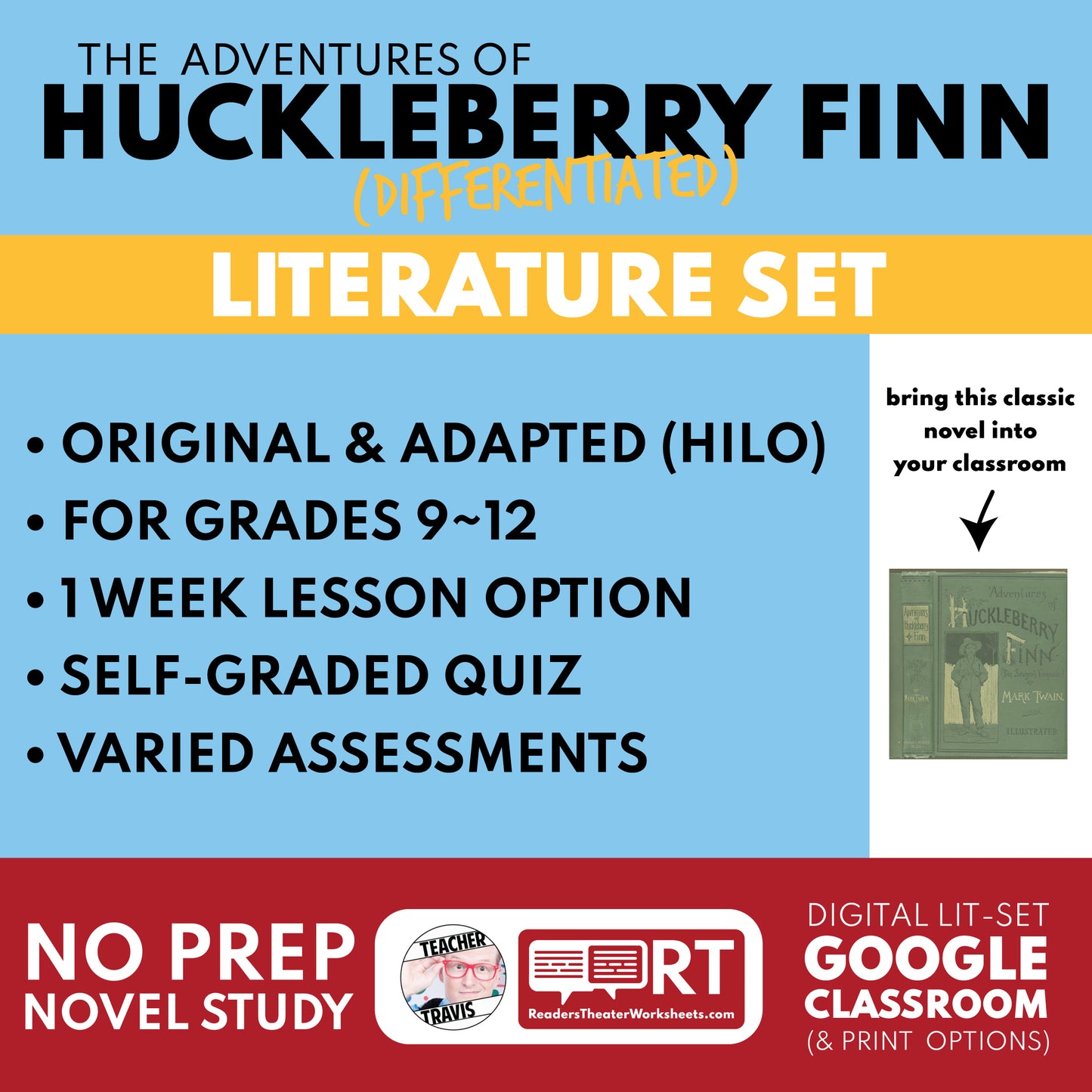
The Adventures of Huckleberry Finn Differentiated Novel Study | ELA Literature | Twain Lit Set for High School
The Adventures of Huckleberry Finn Differentiated Novel Study | ELA Literature | Twain Lit Set for High School
Couldn't load pickup availability
Classroom Use at a Glance
A no-prep differentiated literature study guide for high school students with reading, comprehension, vocabulary, discussion, writing, quiz, and teacher support materials. Designed for mixed-ability ELA classes, close reading, literature discussion, assessment, and differentiated instruction.
Classroom Uses Whole Class, Small Groups, Close Reading, Discussion, Assessment, Review, Enrichment, Sub Plan view all
- Whole Class
- Small Groups
- Close Reading
- Discussion
- Assessment
- Review
- Enrichment
- Sub Plan
Included Original Text, Teacher Guide, Student Worksheet, Answer Key, Quiz, Google Forms Quiz, Vocabulary, Discussion Questions, Challenge Questions, Writing Prompt view all
- Original Text
- Teacher Guide
- Student Worksheet
- Answer Key
- Quiz
- Google Forms Quiz
- Vocabulary
- Discussion Questions
- Challenge Questions
- Writing Prompt
Format PDF, DOCX, Google Docs, Google Forms, Printable, Editable view all
- DOCX
- Google Docs
- Google Forms
- Printable
- Editable
Differentiation Leveled Version, Original Version, Mixed Reading Levels, Vocabulary Support, Short Sections view all
- Leveled Version
- Original Version
- Mixed Reading Levels
- Vocabulary Support
- Short Sections
Problem: You want your students to experience classic literature, but you do not have weeks (or months) to push through a 110,000-word novel with mixed reading levels in the room.
Here’s the solution: This differentiated novel study / digital lit-set solves that problem by including the complete original text of The Adventures of Huckleberry Finn (Mark Twain) alongside a five-part adapted version written for clearer, more accessible reading. You get both texts in one resource, plus a stable Part 1–5 chapter map so the class can stay synchronized: Original text (~110,000 words; FK 6.3) and adapted text (~13,800 words; FK 5.0).
Every discussion question, multiple-choice exit quiz, short-answer item, and challenge question works for both tracks—so students can read different versions while completing the same assessments and participating in the same whole-class conversations.
Perfect for Grades 8–10 ELA classrooms focused on theme and character analysis, point of view, evidence-based reasoning, and accountable discussion aligned to RL/SL/L skill clusters.
Quick Guide for Teachers:
Adapted-Only Track (Fastest: 5-Day Model)
- Best for Grades 9–10 classes that need a manageable, one-week novel experience.
- Day 1–5: Students read one adapted part per day and use the matching Main Ideas & Themes Discussion Questions and self-grading multiple-choice quiz.
- End the week with the Final Worksheet (Vocabulary Words, Short Answer Questions, and Challenge Questions).
- This track keeps lessons tight, predictable, and complete in five days.
Original-Only Track (Longer: Multi-Day Per Section)
- Ideal for stronger readers or classes ready for original language and sentence structure.
- Students read the original chapters aligned to each adapted Part
- Use the same Discussion Questions, MC exit quizzes, and Final Worksheet; all items are text-accurate for both versions.
- Vocabulary Words (10) are usable for both tracks, because each word appears in both the adapted text and the corresponding original chapters.
- This track preserves the full descriptive style and classic voice while giving you ready-made, age-appropriate assessments.
Dual-Track Differentiation (Mixed Readers, Flexible Timelines)
- Lets your entire class study the same plot, scenes, and themes at the same time—even when some students need the adapted text and others handle the full novel.
- Assign adapted Part 1 to students who need a shorter, clearer text and original corresponding chapters to students reading the full text; repeat this pattern through Parts 2–5 (timing will depend on your classroom's reading level)
- Give original-text students multiple days per section while adapted-text students reread key scenes, complete vocabulary tasks, and tackle discussion questions in pairs or small groups.
- All assessments are usable for both tracks: Discussion Questions, MC Exit Quizzes for each Part, and the Final Worksheet (Vocabulary, Short Answer, and Challenge Questions).
What’s the Tradeoff of Using the Adapted Version?
Pros:
- Reduces the novel to a fraction of its original length, fitting neatly into a one-week unit.
- Well suited for shorter attention spans and developing readers in Grades 9-10
- Preserves core narrative elements, characters, and themes
- Far better than skipping the book entirely due to time limits or reading-level concerns.
- Works for whole-class read-alouds, small-group novel studies, independent reading, or focused close-reading lessons.
Cons:
- Omits some original language, side scenes, and descriptive passages for brevity, so students do not see every nuance of the original author's style.
- Leaves fewer opportunities for deep line-by-line stylistic analysis than a full-length, multi-week novel study.
Bottom Line:
If you have the time and budget, nothing beats the feel of a real paperback in every student’s hands. But when time, copies, and reading levels are real constraints, a digital literature set like this—adapted text + original text mapping + shared assessments—lets you bring this classic novel into your classroom instead of leaving it on the “maybe someday” shelf. If you were to buy traditional paperbacks at about $7 per book for 30 students, that is a $210 investment. This digital lit-set gives you a reusable, print-friendly alternative you can adapt for many years and multiple groups.
Try a digital lit set first for FREE! (It's just like this one)
[FREE DOWNLOAD] The Great Gatsby Differentiated Novel Study | Lit Set
This product includes a zip file consisting of:
NOTE: All files are editable and include (PDF, DOCX, PPTX, Google Docs/Slides/Forms)
Full Original Text: ~110,000 words | 6.3 Flesch-Kincaid GL
- Lexile Ranges: ~925L - 1120L | CEFR ~B1 / low B2
- Great for on-level Grade 6–7 readers, extension groups, longer-term novel studies.
-
BONUS: Free Access to the text on our LEVELED-LIT CLASSICS Library Platform.
Adapted Version Text: ~13,800 words | 5.0 Flesch-Kincaid GL
- Lexile Ranges: ~830L - 1010L | CEFR ~B1
- Supported Grades 8/9 readers
- Divided into 5 parts for easy daily reading sessions
- *Both versions tell the same story, allowing students to participate in shared discussions even when reading different texts.
Student Final Worksheet/Quizzes (PPTX, Google Slides/Forms)
- 10 Vocabulary Words
- 10 Short Answer Recall/Comprehension
- 5 Challenge Questions (synthesis, analysis, themes, real life connection)
- 5 Multiple Choice Quizzes (20 Questions) (1 per part)
Teacher’s Guide & Answer Key
- 5 Sets of Daily Discussion Questions (1 per part)
- 5 Sets of Self-Graded Exit Quizzes (1 per part, 20Qs each)
- Answer Keys for Vocab, Short Answer, and Challenge Questions
- Key Figures & Places reference sheets to help students track characters and settings
Student Final Worksheet/Quizzes (PPTX, Google Slides/Forms)
- 10 Vocabulary Words
- 10 Short Answer Recall/Comprehension
- 5 Challenge Questions (synthesis, analysis, themes, real life connection)
- 5 Multiple Choice Quizzes (20 Questions) (1 per part)
Teacher’s Guide & Answer Key
- 5 Sets of Daily Discussion Questions (1 per part)
- 5 Sets of Self-Graded Exit Quizzes (1 per part, 20Qs each)
- Answer Keys for Vocab, Short Answer, and Challenge Questions
- Key Figures & Places reference sheets to help students track characters and settings
Adapted Version Summary (and source chapters)
Part 1 – Under Rules and Under Threat
Adapted from: Chapters I–VII of the original novel.
Huck lives under strict “civilizing” rules, learning that respectability often comes with control and judgment. He tries to fit in for the Widow’s sake and for Tom Sawyer’s approval, but he never stops craving freedom. When Pap returns, Huck is trapped in real danger instead of pretend adventure. Huck escapes by planning carefully and staging his own death, leaving town behind.
Part 2 – The River as Refuge, the River as Risk
Adapted from: Chapters VIII–XVI of the original novel.
Huck finds Jim hiding and learns Jim’s freedom is urgent because he may be sold away. They travel by raft and face storms, hunger, and people who would capture Jim. Huck’s disguises and quick decisions keep them alive, but his conscience fights him as they near Cairo. When they miss their chance and drift deeper into slave territory, Huck realizes freedom is not just movement—it is a moral choice with consequences.
Part 3 – Shore Corruption and Crowd Cowardice
Adapted from: Chapters XVII–XXIII of the original novel.
Huck is pulled into a wealthy household and witnesses how “honor” can excuse senseless violence in a feud. Back on the river, two con men take over the raft and begin using it as a base for scams. Huck sees townspeople manipulated by shame, spectacle, and fear of standing alone. The river remains a fragile refuge, but it also carries Huck and Jim into new forms of human corruption.
Part 4 – A Line in the Sand
Adapted from: Chapters XXIV–XXXI of the original novel.
The duke and king target a grieving family and attempt to steal an estate, crossing into cruelty that cannot be laughed off. Huck’s growing respect for Mary Jane and the sisters pushes him to act, even when acting is dangerous. He disrupts the fraud, then discovers Jim has been sold. Huck tears up the “right” plan to betray Jim and commits to rescue instead, choosing loyalty over the rules he has been taught.
Part 5 – The “Adventure” and the Aftermath
Adapted from: Chapters XXXII–XLII of the original novel.
Huck reaches the Phelps farm and tries to rescue Jim, but Tom turns the escape into a complicated “adventure.” The plan becomes dangerous, Tom is wounded, and Jim is recaptured because he chooses to help rather than run. When the truth comes out that Jim was already free, the story exposes the cruelty of treating real confinement as play. Huck refuses to be “civilized” again and decides to head for the Territory.
Frequently Asked Questions About the Adapted The Adventures of Huckleberry Finn Novel Study
Can I use the adapted text for reluctant or below-level readers without changing the unit?
Yes. The adapted version is ~13,800 words at a Flesch-Kincaid Grade Level of 5.0, and every assessment in this unit is designed to work for either reading track—adapted or original—so you do not need separate assignments.
Does this resource align to CCSS for the stated grade band?
Yes. The unit’s tasks are built around defensible RL (evidence, theme, character, point of view), SL (collaborative discussion), and L (academic vocabulary/word meaning) cluster standards appropriate for Grades 8–10.
How does the differentiation work in a real classroom?
Students read either the complete original chapters or the adapted Part text for the same Part number, then complete the same discussion prompts and assessments. This keeps pacing and conversation unified while supporting mixed reading readiness.
This is a complete, no-prep dual-track novel study that lets you teach the same rigorous unit while students read the version that fits them.
Get this in a Bundle of 10 Digital Lit Sets & SAVE 40%
CCSS Standards
Reading Literature: CCSS RL.9-10.1, CCSS RL.9-10.2, CCSS RL.9-10.3, CCSS RL.9-10.4, CCSS RL.9-10.5, CCSS RL.9-10.6, CCSS RL.11-12.1, CCSS RL.11-12.2, CCSS RL.11-12.3, CCSS RL.11-12.4, CCSS RL.11-12.5, CCSS RL.11-12.6
Speaking & Listening: CCSS SL.9-10.1, CCSS SL.11-12.1
Language: CCSS L.9-10.4, CCSS L.11-12.4
Anchor Standards: CCRA.R.1, CCRA.R.2, CCRA.R.3, CCRA.R.4, CCRA.R.5, CCRA.R.6, CCRA.W.1, CCRA.W.2, CCRA.W.9, CCRA.SL.1, CCRA.L.1, CCRA.L.2, CCRA.L.4
Share