Readers Theater Worksheets
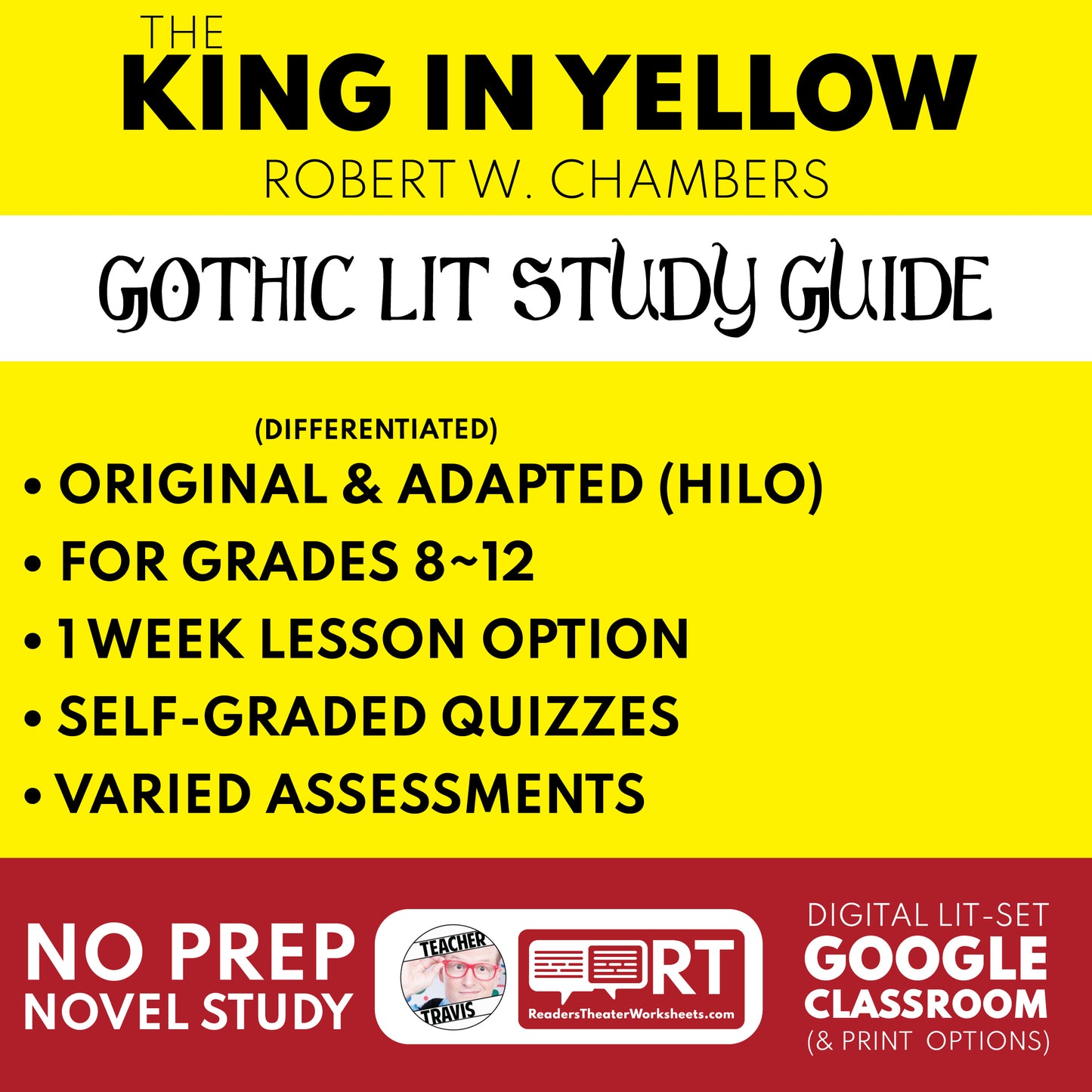
The King in Yellow by Robert W. Chambers | Differentiated Classical Goth Lit Study Guide for Grades 9–12
The King in Yellow by Robert W. Chambers | Differentiated Classical Goth Lit Study Guide for Grades 9–12
Couldn't load pickup availability
Classroom Use at a Glance
A differentiated literature study guide for mixed-grade ELA classes using The King in Yellow by Robert W. Chambers | Differentiated Classical Goth Lit Study Guide for Grades 9–12. Built to support mixed reading levels, close reading, vocabulary, discussion, assessment, and no-prep ELA instruction.
Classroom Uses Close Reading, Discussion, Assessment, Whole Class, Homework, Sub Plan view all
- Close Reading
- Discussion
- Assessment
- Whole Class
- Homework
- Sub Plan
Included Original Text, Leveled Text, Teacher Guide, Student Worksheet, Answer Key, Quiz, Google Forms Quiz, Vocabulary, Discussion Questions, Writing Prompt view all
- Original Text
- Leveled Text
- Teacher Guide
- Student Worksheet
- Answer Key
- Quiz
- Google Forms Quiz
- Vocabulary
- Discussion Questions
- Writing Prompt
Format PDF, DOCX, Google Docs, Google Forms, Online Library Access, Printable, Editable view all
- DOCX
- Google Docs
- Google Forms
- Online Library Access
- Printable
- Editable
Differentiation Original Version, Leveled Version, Mixed Reading Levels, Vocabulary Support, Struggling Readers, Advanced Readers view all
- Original Version
- Leveled Version
- Mixed Reading Levels
- Vocabulary Support
- Struggling Readers
- Advanced Readers
PROBLEM: Most classic novel studies break down in real classrooms for two reasons: the original text is long and demanding, and student reading levels inside one class are rarely uniform—so teachers end up building separate tracks or simplifying discussions until the unit loses rigor.
SOLUTION: This differentiated novel study for The King in Yellow solves that problem by giving you both the complete original text and a condensed, five-part adapted version, so you can keep the class moving together while students read at the level that fits.
Every discussion question, multiple-choice exit quiz, short-answer item, and challenge question works for both tracks, so you can run one coherent unit without rewriting prompts, splitting instruction, or lowering expectations.
Perfect for Grades 9–12 classrooms focused on close reading, theme development, character analysis, ethical reasoning, textual evidence, and seminar-style discussion—while still supporting mixed reading levels with a clean, dual-track structure.
Quick Guide for Teachers:
Adapted-Only Track (Fastest: 5-Day Model)
- Best for Grades 9–12 classes that need a manageable, one-week novel experience.
- Day 1–5: Students read one adapted part per day and use the matching Main Ideas & Themes Discussion Questions and self-grading multiple-choice quiz.
- End the week with the Final Worksheet (Vocabulary Words, Short Answer Questions, and Challenge Questions).
- This track keeps lessons tight, predictable, and complete in five days.
Original-Only Track (Longer: Multi-Day Per Section)
- Ideal for stronger readers or classes ready for original language and sentence structure.
- Students read the original chapters aligned to each adapted Part.
- Use the same Discussion Questions, MC exit quizzes, and Final Worksheet; all items are text-accurate for both versions.
- Vocabulary Words (10) are usable for both tracks, because each word appears in both the adapted text and the corresponding original chapters.
- This track preserves the full descriptive style and classic voice while giving you ready-made, age-appropriate assessments.
Dual-Track Differentiation (Mixed Readers, Flexible Timelines)
- Lets your entire class study the same plot, scenes, and themes at the same time—even when some students need the adapted text and others handle the full novel.
- Assign adapted Part 1 to students who need a shorter, clearer text and original corresponding chapters to students reading the full text; repeat this pattern through Parts 2–5 (timing will depend on your classroom's reading level).
- Give original-text students multiple days per section while adapted-text students reread key scenes, complete vocabulary tasks, and tackle discussion questions in pairs or small groups.
- All assessments are usable for both tracks: Discussion Questions, MC Exit Quizzes for each Part, and the Final Worksheet (Vocabulary, Short Answer, and Challenge Questions).
This product includes a zip file consisting of:
NOTE: All files are editable and include (PDF, DOCX, PPTX, Google Docs/Slides/Forms)
Full Original Text: 72,000 words | 8.4 Flesch-Kincaid GL
- Great for advanced readers, extension groups, longer-term novel studies.
Adapted Version Text: 14,000 words | 7.1 Flesch-Kincaid GL
- Designed as a shorter, accessible track while preserving the same plot arc, themes, and assessment alignment.
- Supports readers who need a faster pace through the story without losing the unit’s discussion depth.
- *Both versions tell the same story, allowing students to participate in shared discussions even when reading different texts.
Student Final Worksheet/Quizzes (PPTX, Google Slides/Forms)
- 10 Vocabulary Words
- 10 Short Answer Recall/Comprehension
- 5 Challenge Questions (synthesis, analysis, themes, real life connection)
- 5 Multiple Choice Quizzes (20 Questions) (1 per part)
Teacher’s Guide & Answer Key
- 5 Sets of Daily Discussion Questions (1 per part)
- 5 Sets of Self-Graded Exit Quizzes (1 per part, 20Qs each)
- Answer Keys for Vocab, Short Answer, and Challenge Questions
- Key Figures & Places reference sheets to help students track characters and settings
NEED MORE?
- Free Bonus Access Code: Leveled-Lit Classics Platform (in the download)
- SAVE 40%! Get the Top 8 Gothic Lit Bundle
- Try One Before You Buy One: [Free Download] Frankenstein Gothic Study Guide
What’s the Tradeoff of Using the Adapted Version?
Pros:
- Reduces the novel to a fraction of its original length, fitting neatly into a one-week unit.
- Well suited for shorter attention spans and developing readers in Grades 9–10.
- Preserves core narrative elements, characters, and themes.
- Far better than skipping the book entirely due to time limits or reading-level concerns.
- Works for whole-class read-alouds, small-group novel studies, independent reading, or focused close-reading lessons.
Cons:
Omits some original language, side scenes, and descriptive passages for brevity, so students do not see every nuance of the original author’s style.
Leaves fewer opportunities for deep line-by-line stylistic analysis than a full-length, multi-week novel study.
Adapted Version Summary
Part 1 – A Future Fever and the Artist’s Miracle
Adapted from: CHAPTER I – CHAPTER II
Two pressures collide: near-future paranoia about power and “destiny,” and an artist’s pursuit of beauty that turns intimate and strange. Perception becomes unstable in both politics and art, and desire begins acting like a mechanism that distorts reality rather than a feeling that clarifies it.
Part 2 – Worship, Signs, and the Threshold of Horror
Adapted from: CHAPTER III – CHAPTER IV
Ordinary settings—church, street, studio, home—become sites of intrusion. The King in Yellow imagery behaves less like explanation than a contagion of meaning, driving fixation, terror, death, and testimony without offering safe closure.
Part 3 – Old-World Romance and a Moral Parable
Adapted from: CHAPTER V – CHAPTER VI
Love is shaped by distance, memory, and social boundary, then compressed into an allegory about what love demands when wealth and pride tempt it toward corruption. Devotion is portrayed as both beautiful and punishing, with sacrifice as the measure of sincerity.
Part 4 – Poverty, Tenderness, and Encroaching Threat
Adapted from: CHAPTER VII – CHAPTER VIII
Grief and intimacy dominate first, then the narrative expands into a long portrait of hardship where love must operate under material pressure. The ending leaves fragile safety exposed, building suspense driven by outside forces rather than inner fantasy.
Part 5 – Parisian Reckonings and a Final Leaving
Adapted from: CHAPTER IX – CHAPTER X
Love and reputation become lived experience—choices made in public and paid for in private—moving toward reconciliation and stark, irreversible departure. The closing chapter seals the collection with a quiet symbolic exit that emphasizes consequence over explanation.
Frequently Asked Questions
Can I teach this as a whole-class unit if my students read at different levels?
Yes. Use the adapted Parts as the shared anchor and pacing spine for everyone, then offer the mapped original chapters for extension and evidence work.
Are the assessments truly text-dependent?
Yes. The exit quizzes and short-answer prompts require plot knowledge, motivation analysis, symbolism/theme interpretation, and craft-based reasoning grounded in the Part text.
What pacing works best?
A common pacing is one Part per week (5 weeks), with discussion mid-week and the exit quiz + short answers at the end of each Part.
Standards
Reading Literature: CCSS RL.9-10.1, CCSS RL.9-10.2, CCSS RL.9-10.3, CCSS RL.9-10.4, CCSS RL.9-10.5, CCSS RL.9-10.6
Writing: CCSS W.9-10.1, CCSS W.9-10.2
Speaking & Listening: CCSS SL.9-10.1
Language: CCSS L.9-10.4
Anchor Standards: CCRA.R.1, CCRA.R.2, CCRA.R.3, CCRA.R.4, CCRA.R.5, CCRA.W.1, CCRA.W.2, CCRA.SL.1, CCRA.L.4
Share