
Readers Theater Worksheets
Frankenstein by Mary Shelley | Differentiated Classical Goth Lit Study Guide for Grades 9–12
Frankenstein by Mary Shelley | Differentiated Classical Goth Lit Study Guide for Grades 9–12
Couldn't load pickup availability
Classroom Use at a Glance
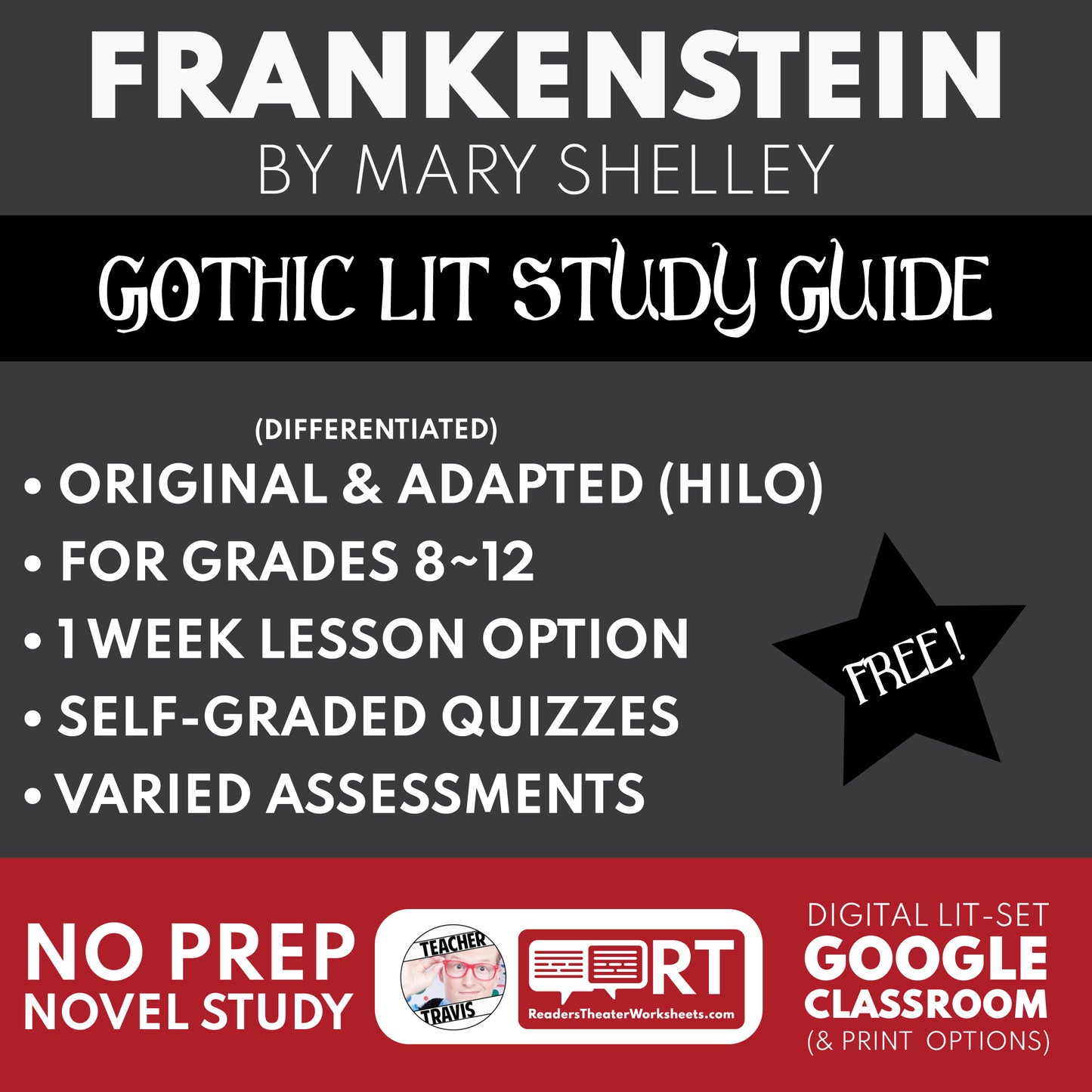
A differentiated study guide for Grades 9 to 12 built to support mixed reading levels, close reading, vocabulary, comprehension, discussion, written response, quizzes, and teacher-led literature instruction.
Classroom Uses Whole Class, Close Reading, Discussion, Assessment, Review, Enrichment, Intervention, Homework, Sub Plan view all
- Whole Class
- Close Reading
- Discussion
- Assessment
- Review
- Enrichment
- Intervention
- Homework
- Sub Plan
Included Original Text, Leveled Text, Teacher Guide, Student Worksheet, Answer Key, Quiz, Google Forms Quiz, Vocabulary, Discussion Questions, Writing Prompt view all
- Original Text
- Leveled Text
- Teacher Guide
- Student Worksheet
- Answer Key
- Quiz
- Google Forms Quiz
- Vocabulary
- Discussion Questions
- Writing Prompt
Format PDF, DOCX, Google Docs, Google Forms, Printable, Editable, ZIP Download view all
- DOCX
- Google Docs
- Google Forms
- Printable
- Editable
- ZIP Download
Differentiation Original Version, Leveled Version, Mixed Reading Levels, Struggling Readers, Advanced Readers, Vocabulary Support, Short Sections view all
- Original Version
- Leveled Version
- Mixed Reading Levels
- Struggling Readers
- Advanced Readers
- Vocabulary Support
- Short Sections
PROBLEM: Most classic novel studies break down in real classrooms for two reasons: the original text is long and demanding, and student reading levels inside one class are rarely uniform—so teachers end up building separate tracks or simplifying discussions until the unit loses rigor.
SOLUTION: This differentiated novel study / digital lit-set for Frankenstein by Mary Shelley solves that problem by giving you both the complete original text and a condensed, five-part adapted version, so you can keep the class moving together while students read at the level that fits.
Every discussion question, multiple-choice exit quiz, short-answer item, and challenge question works for both tracks, so you can run one coherent unit without rewriting prompts, splitting instruction, or lowering expectations.
Perfect for Grades 9–12 classrooms focused on close reading, theme development, character analysis, ethical reasoning, textual evidence, and seminar-style discussion—while still supporting mixed reading levels with a clean, dual-track structure.
Quick Guide for Teachers:
Adapted-Only Track (Fastest: 5-Day Model)
- Best for Grades 9–12 classes that need a manageable, one-week novel experience.
- Day 1–5: Students read one adapted part per day and use the matching Main Ideas & Themes Discussion Questions and self-grading multiple-choice quiz.
- End the week with the Final Worksheet (Vocabulary Words, Short Answer Questions, and Challenge Questions).
- This track keeps lessons tight, predictable, and complete in five days.
Original-Only Track (Longer: Multi-Day Per Section)
- Ideal for stronger readers or classes ready for original language and sentence structure.
- Students read the original chapters aligned to each adapted Part.
- Use the same Discussion Questions, MC exit quizzes, and Final Worksheet; all items are text-accurate for both versions.
- Vocabulary Words (10) are usable for both tracks, because each word appears in both the adapted text and the corresponding original chapters.
- This track preserves the full descriptive style and classic voice while giving you ready-made, age-appropriate assessments.
Dual-Track Differentiation (Mixed Readers, Flexible Timelines)
- Lets your entire class study the same plot, scenes, and themes at the same time—even when some students need the adapted text and others handle the full novel.
- Assign adapted Part 1 to students who need a shorter, clearer text and original corresponding chapters to students reading the full text; repeat this pattern through Parts 2–5 (timing will depend on your classroom's reading level).
- Give original-text students multiple days per section while adapted-text students reread key scenes, complete vocabulary tasks, and tackle discussion questions in pairs or small groups.
- All assessments are usable for both tracks: Discussion Questions, MC Exit Quizzes for each Part, and the Final Worksheet (Vocabulary, Short Answer, and Challenge Questions).
This product includes a zip file consisting of:
NOTE: All files are editable and include (PDF, DOCX, PPTX, Google Docs/Slides/Forms)
Full Original Text: ~75,000 words | 10.9 Flesch-Kincaid GL
- Great for advanced readers, extension groups, longer-term novel studies.
Adapted Version Text: ~15,000 words | 8.3 Flesch-Kincaid GL
- Designed as a shorter, accessible track while preserving the same plot arc, themes, and assessment alignment.
- Supports readers who need a faster pace through the story without losing the unit’s discussion depth.
- *Both versions tell the same story, allowing students to participate in shared discussions even when reading different texts.
Student Final Worksheet/Quizzes (PPTX, Google Slides/Forms)
- 10 Vocabulary Words
- 10 Short Answer Recall/Comprehension
- 5 Challenge Questions (synthesis, analysis, themes, real life connection)
- 5 Multiple Choice Quizzes (20 Questions) (1 per part)
Teacher’s Guide & Answer Key
- 5 Sets of Daily Discussion Questions (1 per part)
- 5 Sets of Self-Graded Exit Quizzes (1 per part, 20Qs each)
- Answer Keys for Vocab, Short Answer, and Challenge Questions
- Key Figures & Places reference sheets to help students track characters and settings
What’s the Tradeoff of Using the Adapted Version?
Pros:
- Reduces the novel to a fraction of its original length, fitting neatly into a one-week unit.
- Well suited for shorter attention spans and developing readers in Grades 9–10.
- Preserves core narrative elements, characters, and themes.
- Far better than skipping the book entirely due to time limits or reading-level concerns.
- Works for whole-class read-alouds, small-group novel studies, independent reading, or focused close-reading lessons.
Cons:
Omits some original language, side scenes, and descriptive passages for brevity, so students do not see every nuance of the original author’s style.
Leaves fewer opportunities for deep line-by-line stylistic analysis than a full-length, multi-week novel study.
FREE BONUS: Access Code included to the original and adapted/abridged text on the LEVELED-LIT CLASSICS Library Platform.
SAVE 40%! Get the Gothic Lit Bundle
How can I be sure this resource will meet my needs?
It's free! Download it now and see if it will meet your classroom's needs.
Also, you can test drive these other digital lit sets for FREE!
- [FREE DOWNLOAD] The Great Gatsby Differentiated Novel Study
- [FREE DOWNLOAD] Adapted Peter Pan Differentiated Novel Study
- [FREE DOWNLOAD] The Wonderful Wizard of Oz Adapted Version
- [FREE DOWNLOAD] A Christmas Carol Adapted Version
- [FREE DOWNLOAD] Narrative of the Life of Frederick Douglass Study Guide
Adapted Version Summary
Part 1 – Letters from the Ice; The Ambition to Create
Adapted from: Letters 1–4; Chapters 1–4
Walton begins a perilous voyage for discovery and rescues Victor Frankenstein, who then tells his own history. Victor describes a sheltered upbringing, intense curiosity, and a growing obsession with uncovering the principle of life. He isolates himself in Ingolstadt and pushes his studies toward a single goal: creating a living being. The Part ends as the experiment succeeds—and terror replaces triumph.
Part 2 – The Aftermath and the First Ruin
Adapted from: Chapters 5–10
Victor recoils from what he has made and collapses into illness, secrecy, and dread while trying to resume ordinary life. Death and accusation strike close to home, and Victor’s silence allows others to suffer consequences tied to his hidden act. As he tries to regain control through avoidance, the violence escalates. The Part culminates when Victor meets the creature again and is forced to hear a demand he cannot ignore.
Part 3 – The Creature’s Education and the Turn to Vengeance
Adapted from: Chapters 11–16
The creature narrates his awakening and learns to speak, read, and reason by watching human beings from the margins. He longs for companionship and attempts a careful approach to human society, hoping kindness will be possible. Rejection, fear, and cruelty repeatedly crush that hope and convert it into anger. By the end, the creature directs his suffering toward Victor and commits to deliberate retaliation.
Part 4 – The Bargain for a Mate; The Broken Promise
Adapted from: Chapters 17–20
The creature demands a companion and binds Victor to a coercive bargain: create a second being or face further ruin. Victor begins the work but grows afraid of expanding the threat and breaks the promise in front of the creature. The creature answers with a vow that turns Victor’s future into a target. Victor’s hope narrows into dread as he realizes the conflict will strike at what he loves most.
Part 5 – Wedding Night, Loss, and the Arctic Reckoning
Adapted from: Chapters 21–24; Walton, in continuation
Victor is pulled through legal danger, grief, and escalating loss as the creature fulfills the promised campaign. He becomes consumed by pursuit, treating revenge as the only structure left in his life. Walton records Victor’s end and confronts the creature in a final, morally charged scene. The closing emphasizes consequences rather than closure: ambition and vengeance finish their work, and no one wins.
Frequently Asked Questions
Can I use the adapted text for reluctant or below-level readers without losing rigor?
Yes. The adapted version is designed to keep the ideas and conflicts intact while reducing density and archaic phrasing. Students can complete the same discussions and assessments as classmates using the original text because prompts target central events, motives, and themes preserved in both tracks.
Is this aligned to high school ELA standards for the stated grade band?
Yes. Tasks are built around text evidence, theme development, character analysis, academic vocabulary, and collaborative discussion. The unit emphasizes evidence-based reasoning rather than recall-only questioning.
How does differentiation work if students are reading different versions?
Both versions are mapped to the same five parts, each tied to specific original chapter ranges. Because prompts and assessments are designed to be answerable from either track, you can teach one sequence, run one set of quizzes and questions, and still accommodate different reading loads.
Standards
Reading Literature: CCSS RL.9-10.1, CCSS RL.9-10.2, CCSS RL.9-10.3, CCSS RL.9-10.4, CCSS RL.9-10.5, CCSS RL.9-10.6
Writing: CCSS W.9-10.1, CCSS W.9-10.2
Speaking & Listening: CCSS SL.9-10.1
Language: CCSS L.9-10.4
Anchor Standards: CCRA.R.1, CCRA.R.2, CCRA.R.3, CCRA.R.4, CCRA.R.5, CCRA.W.1, CCRA.W.2, CCRA.SL.1, CCRA.L.4
Share
We are just starting our exploration of RT and this is a great introduction for the students