Readers Theater Worksheets
The Pig War | Reader's Theater Script & Mini Readers | Grades 9-12
The Pig War | Reader's Theater Script & Mini Readers | Grades 9-12
Couldn't load pickup availability
Classroom Use at a Glance
A grades 9-12 Historical Reader's Theater on the 1859 Pig War with a 10-scene, 15-role script, Mini Readers, teacher guide, worksheets, quiz, and answer key. Strong fit for Washington State History, Pacific Northwest History, and U.S. History units on the Oregon Treaty, San Juan Islands, jurisdiction, escalation, restraint, diplomacy, joint occupation, and arbitration.
Classroom Uses Whole Class, Small Groups, Fluency Practice, Content-Area Reading, Discussion, Assessment, Review, Sub Plan view all
- Whole Class
- Small Groups
- Fluency Practice
- Content-Area Reading
- Discussion
- Assessment
- Review
- Sub Plan
Included Reader’s Theater Script, Original Mini Reader, Accessible Mini Reader, Teacher Guide, Student Worksheet, Answer Key, Quiz, Google Forms Quiz, Vocabulary, Discussion Questions, Challenge Questions view all
- Reader’s Theater Script
- Original Mini Reader
- Accessible Mini Reader
- Teacher Guide
- Student Worksheet
- Answer Key
- Quiz
- Google Forms Quiz
- Vocabulary
- Discussion Questions
- Challenge Questions
Format PDF, DOCX, Google Forms, ZIP Download, Printable, Editable view all
- DOCX
- Google Forms
- ZIP Download
- Printable
- Editable
Differentiation Accessible Version, Original Version, Mixed Reading Levels, ELL Support, Struggling Readers, Vocabulary Support, Small-Group Support view all
- Accessible Version
- Original Version
- Mixed Reading Levels
- ELL Support
- Struggling Readers
- Vocabulary Support
- Small-Group Support
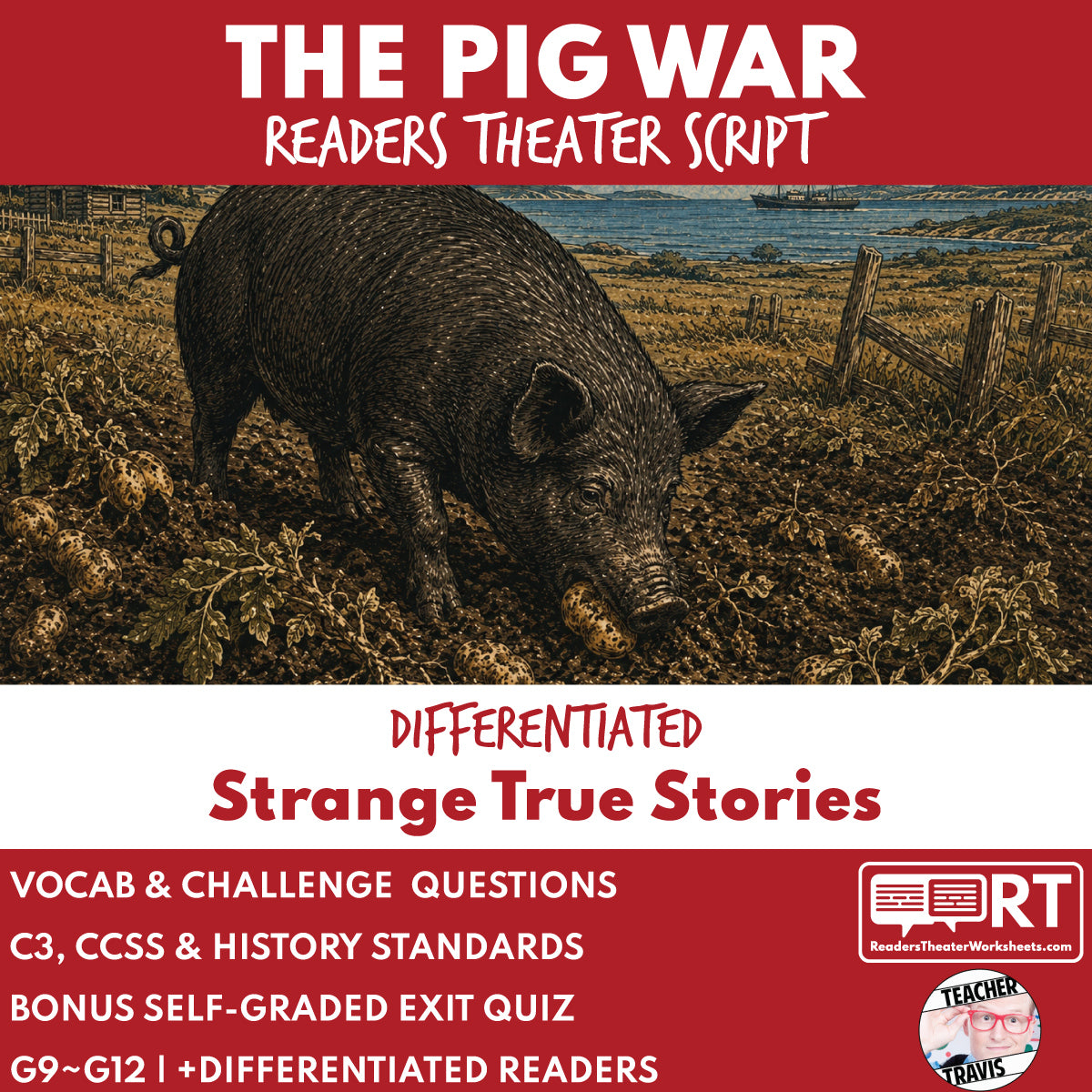
Turn the 1859 Pig War into a high-school historical drama about Washington Territory, borders, jurisdiction, military escalation, restraint, and diplomacy. This grades 9-12 Reader's Theater follows how one dead pig exposed an unresolved U.S.-British boundary dispute on San Juan Island and pushed two nations toward an armed confrontation.
Across ten scenes, students follow the choices of settlers, military officers, and government leaders as a local property dispute becomes a question of sovereignty. The script makes restraint visible as a historical action: several people had the authority to escalate the crisis and chose not to fire.
Historical Content
- The 1846 Oregon Treaty and Haro-versus-Rosario boundary question
- Hudson's Bay Company activity and American settlement on San Juan Island
- Lyman Cutlar, Charles Griffin, and the June 1859 pig shooting
- Jurisdiction, sovereignty, occupation, and competing national claims
- William Harney, George Pickett, James Douglas, Geoffrey Hornby, and R. Lambert Baynes
- Winfield Scott, joint occupation, the Treaty of Washington, and the 1872 arbitration
What's Included
- 10-scene Historical Reader's Theater script
- Original Mini Reader
- Accessible Mini Reader
- Teacher Guide and Answer Key
- Vocabulary in context
- 10 two-part short-answer questions
- 5 two-part challenge questions
- 20-question multiple-choice quiz
- Self-grading Google Forms quiz
- Digital and printable student worksheet support
- Discussion questions, pacing options, standards alignment, and sources/further reading
Where This Fits in Your Curriculum
This Reader's Theater is a strong fit for Washington State History, Pacific Northwest History, and U.S. History units on the Oregon Treaty, territorial expansion, U.S.-British relations, diplomacy, borders, and arbitration. It also works well for civics or government discussions about jurisdiction, sovereignty, escalation, de-escalation, and negotiated dispute resolution.
Skills Addressed
- Historical cause and effect
- Text evidence and source comparison
- Vocabulary in context
- Collaborative speaking and listening
- Perspective-taking and historical decision-making
- Evidence-based written response
Standards Alignment
C3 D2.His.1.9-12 and D2.His.14.9-12; CCSS RH.9-10.1, RH.9-10.2, RH.9-10.9, WHST.9-10.9, and SL.9-10.1.
Pair It With the Matching Resource
The Pig War Dynamic History Module gives students the same verified history through the other instructional format.
Try Strange True Stories Free
Preview both classroom formats at no cost: FREE Guano Islands Act Dynamic History Module and FREE Guano Act Reader's Theater.
Save With the Full Strange True Stories Bundle
Get all 5 Dynamic History modules + all 5 matching Reader's Theater resources, plus the bundle-exclusive Educator Planning & Implementation Guide. Browse the complete Strange True Stories collection.
Share